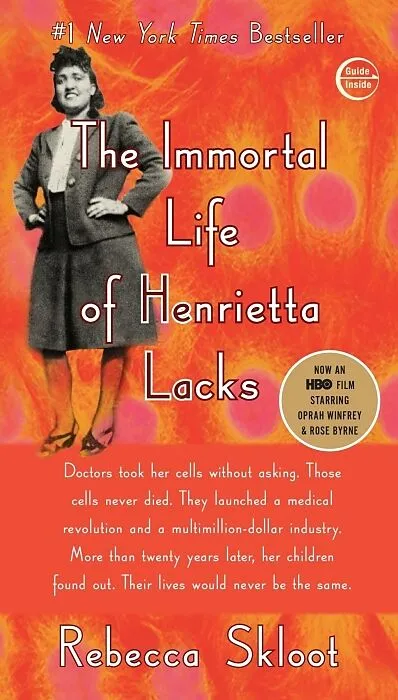
The Immortal Life of Henrietta Lacks
Beschreibung
Zusatztext 105249115 Informationen zum Autor REBECCA SKLOOT is an award-winning science writer whose work has appeared in The New York Times Magazine; O, The Oprah Magazine; Discover; and many others. She is coeditor of The Best American Science Writing 2011 a...Format auswählen
- Kartonierter EinbandCHF 19.20
Wird oft zusammen gekauft
Andere Kunden kauften auch
Beschreibung
Zusatztext 105249115 Informationen zum Autor REBECCA SKLOOT is an award-winning science writer whose work has appeared in The New York Times Magazine; O, The Oprah Magazine; Discover; and many others. She is coeditor of The Best American Science Writing 2011 and has worked as a correspondent for NPR's Radiolab and PBS's Nova ScienceNOW . She was named one of five surprising leaders of 2010 by the Washington Post . Skloot's debut book, The Immortal Life of Henrietta Lacks, took more than a decade to research and write, and instantly became a New York Times bestseller. It was chosen as a best book of 2010 by more than sixty media outlets, including Entertainment Weekly , People , and the New York Times . It is being translated into more than twenty-five languages, adapted into a young reader edition, and being made into an HBO film produced by Oprah Winfrey and Alan Ball. Skloot is the founder and president of The Henrietta Lacks Foundation. She has a B.S. in biological sciences and an MFA in creative nonfiction. She has taught creative writing and science journalism at the University of Memphis, the University of Pittsburgh, and New York University. She lives in Chicago. For more information, visit her website at RebeccaSkloot.com, where you'll find links to follow her on Twitter and Facebook. Klappentext #1 NEW YORK TIMES BESTSELLER • "The story of modern medicine and bioethics-and, indeed, race relations-is refracted beautifully, and movingly."-Entertainment Weekly NOW A MAJOR MOTION PICTURE FROM HBO® STARRING OPRAH WINFREY AND ROSE BYRNE • ONE OF THE "MOST INFLUENTIAL" (CNN), "DEFINING" (LITHUB), AND "BEST" (THE PHILADELPHIA INQUIRER) BOOKS OF THE DECADE • ONE OF ESSENCE'S 50 MOST IMPACTFUL BLACK BOOKS OF THE PAST 50 YEARS • WINNER OF THE CHICAGO TRIBUNE HEARTLAND PRIZE FOR NONFICTION NAMED ONE OF THE BEST BOOKS OF THE YEAR BY The New York Times Book Review • Entertainment Weekly • O: The Oprah Magazine • NPR • Financial Times • New York • Independent (U.K.) • Times (U.K.) • Publishers Weekly • Library Journal • Kirkus Reviews • Booklist • Globe and Mail Her name was Henrietta Lacks, but scientists know her as HeLa. She was a poor Southern tobacco farmer who worked the same land as her slave ancestors, yet her cells-taken without her knowledge-became one of the most important tools in medicine: The first "immortal" human cells grown in culture, which are still alive today, though she has been dead for more than sixty years. HeLa cells were vital for developing the polio vaccine; uncovered secrets of cancer, viruses, and the atom bomb's effects; helped lead to important advances like in vitro fertilization, cloning, and gene mapping; and have been bought and sold by the billions. Yet Henrietta Lacks remains virtually unknown, buried in an unmarked grave. Henrietta's family did not learn of her "immortality" until more than twenty years after her death, when scientists investigating HeLa began using her husband and children in research without informed consent. And though the cells had launched a multimillion-dollar industry that sells human biological materials, her family never saw any of the profits. As Rebecca Skloot so brilliantly shows, the story of the Lacks family-past and present-is inextricably connected to the dark history of experimentation on African Americans, the birth of bioethics, and the legal battles over whether we control the stuff we are made of. Over the decade it took to uncover this story, Rebecca became enmeshed in the lives of the Lacks family-especially Henrietta's daughter Deborah. Deborah was consumed with questions: Had scientists cloned her mother? Had they killed her to harvest her cells? And if her mother was so important to medicine, why couldn't her children afford health insurance? Intimate in feeling, astonishing...
"One of the most graceful and moving nonfiction books I’ve read in a very long time . . . The Immortal Life of Henrietta Lacks . . . floods over you like a narrative dam break, as if someone had managed to distill and purify the more addictive qualities of Erin Brockovich, Midnight in the Garden of Good and Evil and The Andromeda Strain. . . . It feels like the book Ms. Skloot was born to write. It signals the arrival of a raw but quite real talent.”—Dwight Garner, The New York Times
"Skloot's vivid account begins with the life of Henrietta Lacks, who comes fully alive on the page. . . . Immortal Life reads like a novel.”—Eric Roston, *The Washington Post
“Gripping . . . by turns heartbreaking, funny and unsettling . . . raises troubling questions about the way Mrs. Lacks and her family were treated by researchers and about whether patients should control or have financial claims on tissue removed from their bodies.”*—Denise Grady, The New York Times
“The Immortal Life of Henrietta Lacks is a fascinating read and a ringing success. It is a well-written, carefully-researched, complex saga of medical research, bioethics, and race in America. Above all it is a human story of redemption for a family, torn by loss, and for a writer with a vision that would not let go.”—Douglas Whynott, The Boston Globe
**
"Riveting . . . raises important questions about medical ethics . . . It's an amazing story. . . . Deeply chilling . . . Whether those uncountable HeLa cells are a miracle or a violation, Skloot tells their fascinating story at last with skill, insight and compassion.”—Colette Bancroft, St. Petersburg *Times
-
“The history of HeLa is a rare and powerful combination of race, class, gender, medicine, bioethics, and intellectual property; far more rare is the writer than can so clearly fuse those disparate threads into a personal story so rich and compelling. Rebecca Skloot has crafted a unique piece of science journalism that is impossible to put down—or to forget.”—Seed magazine
“No one can say exactly where Henrietta Lacks is buried: during the many years Rebecca Skloot spent working on this book, even Lacks’s hometown of Clover, Virginia, disappeared. But that did not stop Skloot in her quest to exhume, and resurrect, the story of her heroine and her family. What this important, invigorating book lays bare is how easily science can do wrong, especially to the poor. The issues evoked here are giant: who owns our bodies, the use and misuse of medical authority, the unhealed wounds of slavery ... and Skloot, with clarity and compassion, helps us take the long view. This is exactly the sort of story that books were made to tell—thorough, detailed, quietly passionate, and full of revelation.”—TED CONOVER, author of Newjack and The Routes of Man
“It’s extremely rare when a reporter’s passion finds its match in a story. Rarer still when the people in that story courageously join that reporter in the search for what we most need to know about ourselves. When this occurs with a moral journalist who is also a true writer, a human being with a heart capable of holding all of life’s damage and joy, the stars have aligned. This is an extraordinary gift of a book, beautiful and devastating—a work of outstanding literary reportage. Read it! It’s the best you will find in many many years.”—ADRIAN NICOLE LEBLANC, author of Random Family
  
 ”The Immortal Life of Henrietta Lacks brings to mind the work of Philip K. Dick and Edgar Allan Poe. But this tale is true. Rebecca Skloot explores the racism and greed, the idealism and faith in science that helped to save thousands of lives but nearly destroyed a family. This is an extraordinary book, haunting and beautifully told.”—ERIC SCHLOSSER, author …