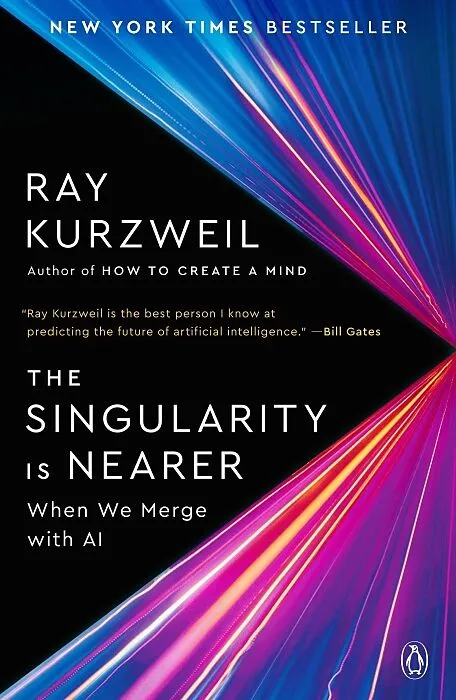
The Singularity Is Nearer
Beschreibung
AN INSTANT ONE OF TIME’S 100 MOST INFLUENTUAL PEOPLE IN ARTIFICIAL INTELLIGENCE The noted inventor and futurist’s successor to his landmark book Since it was first published in 2005, Ray Kurzweil’s In this entirely new book Ray Kurzweil bring...Format auswählen
- Kartonierter EinbandCHF 21.10

Wird oft zusammen gekauft
Andere Kunden kauften auch
Beschreibung
AN INSTANT ONE OF TIME’S 100 MOST INFLUENTUAL PEOPLE IN ARTIFICIAL INTELLIGENCE The noted inventor and futurist’s successor to his landmark book Since it was first published in 2005, Ray Kurzweil’s In this entirely new book Ray Kurzweil brings a fresh perspective to advances toward the Singularity--assessing his 1999 prediction that AI will reach human level intelligence by 2029 and examining the exponential growth of technology--that, in the near future, will expand human intelligence a millionfold and change human life forever. Among the topics he discusses are rebuilding the world, atom by atom with devices like nanobots; radical life extension beyond the current age limit of 120; reinventing intelligence by connecting our brains to the cloud; how exponential technologies are propelling innovation forward in all industries and improving all aspects of our well-being such as declining poverty and violence; and the growth of renewable energy and 3-D printing. He also considers the potential perils of biotechnology, nanotechnology, and artificial intelligence, including such topics of current controversy as how AI will impact employment and the safety of autonomous cars, and "After Life" technology, which aims to virtually revive deceased individuals through a combination of their data and DNA. The culmination of six decades of research on artificial intelligence, Chapter 1
Where Are We in the Six Stages?
In The Singularity Is Near, I described the basis of consciousness as information. I cited six epochs, or stages, from the beginning of our universe, with each stage creating the next stage from the information processing of the last. Thus, the evolution of intelligence works via an indirect sequence of other processes.
The First Epoch was the birth of the laws of physics and the chemistry they make possible. A few hundred thousand years after the big bang, atoms formed from electrons circling around a core of protons and neutrons. Protons in a nucleus seemingly should not be so close together, because the electromagnetic force tries to drive them violently apart. However, there happens to be a separate force called the strong nuclear force, which keeps the protons together. “Whoever” designed the rules of the universe provided this additional force, otherwise evolution through atoms would have been impossible.
Billions of years later, atoms formed molecules that could represent elaborate information. Carbon was the most useful building block, in that it could form four bonds, as opposed to one, two, or three for many other nuclei. That we live in a world that permits complex chemistry is extremely unlikely. For example, if the strength of gravity were ever so slightly weaker, there would be no supernovas to create the chemical elements that life is made from. If it were just slightly stronger, stars would burn out and die before intelligent life could form. Just this one physical constant had to be in an extremely narrow range or we would not be here. We live in a universe that is very precisely balanced to allow a level of order that has enabled evolution to unfold.
Several billion years ago, the Second Epoch began: life. Molecules became complex enough to define an entire organism in one molecule. Thus, living creatures, each with their own DNA, were able to evolve and spread.
In the Third Epoch, animals described by DNA then formed brains, which themselves stored and processed information. These brains gave evolutionary advantages, which helped brains develop more complexity over millions of years.
In the Fourth Epoch, animals used their higher-level cognitive ability, along with their thumbs, to translate thoughts into complex actions. This was humans. Our species used these abilities to create technology that was able to store and manipulate information—from papyrus to hard drives. These technologies augmented our brains’ abilities to perceive, recall, and evaluate information patterns. This is another source of evolution that itself is far greater than the level of progress before it. With brains, we added roughly one cubic inch of brain matter every 100,000 years, whereas with digital computation we are doubling price-performance about every sixteen months.
In the Fifth Epoch, we will directly merge biological human cognition with the speed and power of our digital technology. This is brain–computer interfaces. Human neural processing happens at a speed of several hundred cycles per second, as compared with several billion per second for digital technology. In addition to speed and memory size, augmenting our brains with nonbiological computers will allow us to add many more layers to our neocortices—unlocking vastly more complex and abstract cognition than we can currently imagine.
The Sixth Epoch is where our intelligence spreads throughout the universe, turning ordinary matter into computronium, which is matter organized at the ultimate density of computation.
In my 1999 book The Age of Spiritual Machines, I predicted that a Turing test—wherein an AI can communicate by text indistinguishably from a human—would be passed by 2029. I repeated that in 2005’s The Singularity Is Near. Passing a valid Turing test means that an AI has mastered language and commonsense reasoning as possessed by humans. Turing described his concept in 1950,1 but he did not specify how the test should be administered. In a bet that I have with Mitch Kapor, we defined our own rules that are much more difficult than other interpretations.
My expectation was that in order to pass a valid Turing test by 2029, we would need to be able to attain a great variety of intellectual achievements with AI by 2020. And indeed, since that prediction, AI has mastered many of humanity’s toughest intellectual challenges—from games like Jeopardy! and Go to serious applications like radiology and drug discovery. As I write this, top AI systems like Gemini and GPT‑4 are broadening their abilities to many different domains of performance—encouraging steps on the road to general intelligence.
Ultimately, when a program passes the Turing test, it will actually need to make itself appear far less intelligent in many areas because otherwise it would be clear that it is an AI. For example, if it could correctly solve any math problem instantly, it would fail the test. Thus, at the Turing test level, AIs will have capabilities that in fact go far beyond the best humans in most fields.
Humans are now in the Fourth Epoch, with our technology already producing results that exceed what we can understand for some tasks. For the aspects of the Turing test that AI has not yet mastered, we are making rapid and accelerating progress. Passing the Turing test, which I have been anticipating for 2029, will bring us to the Fifth Epoch.
A key capability in the 2030s will be to connect the upper ranges of our neocortices to the cloud, which will directly extend our thinking. In this way, rather than AI being a competitor, it will become an extension of ourselves. By the time this happens, the nonbiological portions of our minds will provide thousands of times more cognitive capacity than the biological parts.
As this progresses exponentially, we will extend our minds many millions-fold by 2045. It is this incomprehensible speed and magnitude of transformation that will enable us to borrow the singularity metaphor from physics to describe our future.