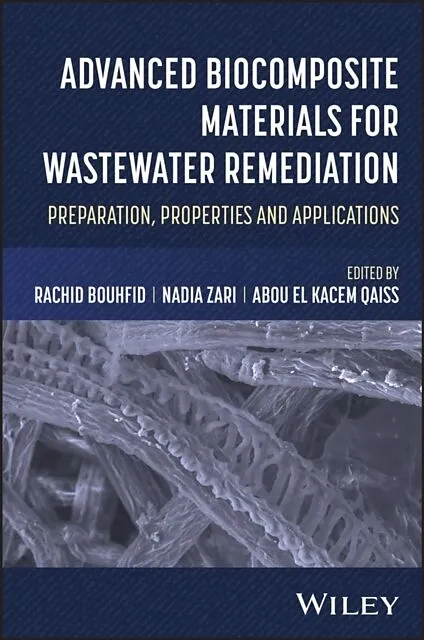
Biocomposite Materials for Wastewater Remediation
Beschreibung
Autorentext Prof. Rachid Bouhfid is an Associate Professor at the International Water Research Institute, Mohammed VI Polytechnic University (UM6P), Morocco. He previously served as Research Director at the Moroccan Foundation for Advanced Science, Innovation ...Format auswählen
- Fester EinbandCHF 256.00

Wird oft zusammen gekauft
Andere Kunden kauften auch
Beschreibung
Autorentext
Prof. Rachid Bouhfid is an Associate Professor at the International Water Research Institute, Mohammed VI Polytechnic University (UM6P), Morocco. He previously served as Research Director at the Moroccan Foundation for Advanced Science, Innovation and Research (MAScIR) and Assistant Professor at Artois University, France. With over 18 years of research and teaching experience, he has authored more than 280 peer-reviewed articles, six books, and 54 book chapters, and holds 43 patents. Prof. Abou el Kacem Qaiss is an Associate Professor and Director of the Composites and Nanocomposites Center at MAScIR-UM6P. He holds a PhD in Chemical Engineering from Laval University, Canada, and brings more than 30 years of academic, industrial, and research experience. His work has produced over 190 journal papers, 30 book chapters, and six edited volumes, alongside extensive mentorship of graduate students. Dr. Nadia Zari is Head Scientist at MAScIR-UM6P. Her research centers on sustainable biocomposite materials for wastewater treatment, focusing on local bioresources and advanced chemical modifications. She has held progressive research roles at MAScIR since 2009 and has contributed to innovative work in environmental biomaterials, waste-to-energy systems, and solar thermal energy storage.
Klappentext
Explores biocomposite materials for sustainable wastewater treatment and advanced environmental applications The growing demand for sustainable, efficient, and cost-effective wastewater treatment solutions underscores the importance of biocomposite materials as a next-generation technology. Derived from renewable resources and enhanced with nanomaterials or functional additives, biocomposites combine biodegradability, affordability, and high performance in removing contaminants such as dyes, heavy metals, organic compounds, and pathogens. Biocomposite Materials for Wastewater Remediation: Preparation, Properties, and Applications examines how biocomposite materials are designed and optimized as adsorbents, photocatalysts, and membranes for diverse water treatment scenarios. With contributions from global experts across chemistry, materials science, and environmental engineering, the text addresses both the technical and practical aspects of biocomposites, including physicochemical and mechanical properties, treatment mechanisms, and scalability. In-depth chapters also review major challenges-such as durability, reusability, and integration into industrial wastewater systems-while highlighting strategies to overcome current limitations. Illuminating the current state of the field and pointing to future directions in sustainable water treatment, this book:
- Covers the synthesis, modification, and functionalization of bio-based composites for water remediation
- Provides detailed characterization techniques for assessing structural, mechanical, and adsorption properties
- Reviews the comparative advantages of biocomposites versus conventional treatment materials
- Features real-world case studies addressing performance gaps and scaling challenges
- Discusses potential for industrial deployment and long-term environmental benefits Emphasizing the vital role of biocomposites in the evolving toolkit for addressing water pollution, this title is an essential reference for graduate and postgraduate students in environmental science, chemical engineering, and materials science, particularly in courses such as Environmental Remediation Technologies, Polymer Composites, and Water Treatment Engineering. It is also a valuable resource for wastewater engineers, polymer chemists, and effluent treatment plant specialists.
Inhalt
List of Contributors
Preface
Chapter 1 Natural Fiber-Based Biocomposites for Wastewater treatment
Chapter 2 Synthesis and characterization of chitosan biopolymer material for application in wastewater treatment via adsorption
Chapter 3 Cellulose Nanomaterials: From Extraction to Wastewater Remediation
Chapter 4 Biochar-based biocomposites for wastewater treatment
Chapter 5 Lignin valorization as biopolymer in wastewater treatment
Chapter 6 Alginate-TiO2 composite: Formulation and optimization for wastewater treatment
Chapter 7 Cellulose nanocrystalline biocomposites applications in wastewater treatment
Chapter 8 Graphene Bionanocomposites: Preparation and Applications in Wastewater Remediation
Chapter 9 Lignocellulosic biocomposite adsorbents for removal of pollutants from urba waste
Chapter 10 Magnetic Biocomposites for Wastewater Remediation
Chapter 11 Alginate Biocomposite Materials: Development and Application in Wastewater Treatment
Chapter 12 Chitosan/clay membranes for heavy metals removal
Chapter 13 Cellulose based composites membranes for pollutants elimination
Chapter14 Alginate nanocomposite membranes for WWT
Chapter 15 Photocatalytic photothermal membranes for microbial wastewater remediation
Chapter 16 Nanocellulose Biocomposite Membranes for Wastewater Treatment
Chapter 17 Wastewater treatment plants based on biocomposite materials
Chapter 18 Biocomposites for wastewater remediation: Present trends and challenges for the future
Index