
IHR WARENKORB IST AKTUELL LEER.
Haben Sie noch nichts passendes gefunden? Stöbern Sie durch unser komplettes Sortiment.
Oder melden Sie sich an bzw. registrieren Sie sich.
- Kostenlose Lieferung
- Kauf auf Rechnung
- Ex Libris Tiefpreis
- Filiallieferung und 650+ Abholorte
- Rabatt-Bons als Club-Mitglied
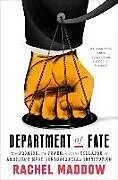
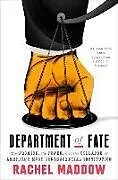
Department of Fate
Beschreibung
Autorentext Rachel Maddow Klappentext #1 NEW YORK TIMES BESTSELLER • Rachel Maddow leads a revelatory, rollicking trip through the history of the Justice Department, finding heroism and treachery in equal measure—and, in the end, a rescue effort for...Format auswählen
- Fester EinbandCHF 38.80
- BroschiertCHF 41.20

Wird oft zusammen gekauft
Andere Kunden kauften auch
Beschreibung
Autorentext
Rachel Maddow
Klappentext
**#1 NEW YORK TIMES BESTSELLER • Rachel Maddow leads a revelatory, rollicking trip through the history of the Justice Department, finding heroism and treachery in equal measure—and, in the end, a rescue effort for our battered democracy.
“A head-spinning chronicle of the last century and a half of federal prosecution . . . What begins as an indictment of Trump thus expands into a wide-ranging exploration of the depth of class and racial conflict in American history.”—The New York Times Book Review**
Over its nearly 150 years, the United States Department of Justice became America’s most consequential institution, determining the rules and limits of what makes us who we are as a country: our political freedoms, our economy, and our nation’s most revolutionary core principle: equal protection under the law.
As the Department made wildly consequential decisions about what types of Americans to target, and for what crimes, it has been steered at times by patriotism, bravery, and self-sacrifice, but just as often by lust for power, corruption, and vengeance. Its political masters have cherrypicked economic winners and losers, determined which causes will be allowed to succeed or fail, and dictated which people and places will thrive and which will be beaten down. The department has fixed the path of the nation’s political swings.
In this searing new history, Rachel Maddow traces these triumphs and misdeeds through the founding and rise of the KKK, the riotous chaos of the Red Scare, civil rights murders and violence, railroad barons’ crushing of unions, cabinet scandals that make Watergate look like Mister Rogers’ Neighborhood, the faux erudite lawlessness of the Reagan Administration, and the collapse into thug rule in the Trump Administration.
Written in her typical whip-smart prose and with a biting sense of clarity, Department of Fate invites us to see how the history of this key institution illuminates a path ahead for a more resilient, re-democratized America committed to making good on even its loftiest promises. In a moment beset with polarization and misinformation, Maddow’s voice shines in this blistering demand to do better—to rebuild the republic, and stronger this time.
Leseprobe
Prologue
“Never a Crusader”
There were only a hundred government lawyers and maybe a dozen reporters on hand in the Great Hall of the Department of Justice on April 1, 1940, for a scheduled speech by the recently appointed attorney general, Robert H. Jackson. Jackson would go on to be a justice of the U.S. Supreme Court (he famously got up from his deathbed to be on the bench for the reading of the historic Brown v. Board opinion in 1954) and would win a place in world history as the chief U.S. prosecutor at the International Military Tribunal, convicting the worst of the Nazi criminals at the public trials in Nuremberg. But in the first days of the spring of 1940, Robert H. Jackson was a little-known lawyer from the western edge of New York state who had been bouncing from government job to government job for six years—assistant general counsel at the Bureau of Internal Revenue, head of the Department of Justice’s Tax Division, then its Antitrust Division, and then solicitor general.
Jackson didn’t spend much time calling attention to himself, whatever his office. “His face is kind, his smile open and quick, and he’s relaxed and easy to meet,” one reporter wrote of him in those years. When Franklin Delano Roosevelt appointed him attorney general in January 1940, Jackson entered his longtime friend’s cabinet with no brief beyond providing reasonable legal arguments for the president’s always bold program. “I was never a crusader,” Jackson had said. “I just liked a good fight.”
The address Jackson prepared for the Second Annual Conference of United States Attorneys in the Great Hall that April morning was a short, sharp piece of business. Jackson took his speeches seriously. “He always wanted to be an orator,” noted a feature writer who visited the Jackson family at their home in a Washington hotel that same week. The new attorney general made a point to write his own speeches himself, in streamlined prose that demanded and deserved the audience’s attention. He anticipated no applause lines or laugh lines; he didn’t waste words. Jackson practiced delivering his speeches either to his teenage daughter or, in a pinch, to his horse.
So, it may well be that the horse was among the first to hear Jackson’s now famous call for prosecutorial humility. Jackson’s speech was inspired in part by the performance of his predecessor, Frank Murphy. Murphy had settled for the attorney generalship after he lost out on his preferred job as secretary of war. He then used his position atop the Department of Justice to chase headlines. Murphy tried to claim credit for breaking up a Hitler-loving, bomb-making, fascist organization in New York called the Christian Front (they were acquitted); he also announced to the press that he had plans to prosecute Boss Pendergast in Kansas City and the heads of other Democratic political machines in Chicago and Jersey City. After muddying up the names of Pendergast, Kelly, and Hague for a few months, Attorney General Murphy then held a press conference to announce that he had decided to let two of the three machine bosses off the hook. “Murphy was not malicious,” Jackson said of him. “But he was so egocentric, so centered on himself, that he never thought of the effect on the other person.” Jackson was determined to avoid and correct for Murphy’s failures.
Jackson’s speech to the U.S. attorneys conference clocked in at just under two thousand words, and just under fifteen minutes. It didn’t generate much in the way of headlines. What little newspaper coverage there was of the speech was cursory. One of the country’s major wire services missed the point entirely. “Attorney General Robert Jackson admitted to the Federal Prosecutors of the Nation, gathered here yesterday, that the Government is without any ‘definite standards to determine what constitutes a subversive activity,’ ” was its technically true but also inapposite lede.
Quite an amazing thing, then, that Robert H. Jackson’s brief and spottily covered oration that day has come to be regarded as the legal equivalent of the presentation of the Ten Commandments: Attorney General Jackson descended from the mountaintop with tablets in hand, the Truth etched in stone by the finger of God, the purpose of the Department of Justice revealed, the proper role of the American prosecutor defined for the ages. Law professors, law journal editors, historians, and journalists reference the Jackson speech with increasing frequency these days. At least one former line prosecutor has admitted to keeping a copy of the speech on her desk at Justice, close enough to pick up and consult at any moment.
But the text of Jackson’s speech—it was titled “The Federal Prosecutor”—is today in the peculiar and somewhat suspect position of being useful to combatants on every side of almost every modern set—to over the principles of America’s rule of law. Being all things to all people has its downsides. The actual Ten Commandments at least had the advantage of being pretty inarguably direct: Thou shalt not doesn’t have wiggle room. Attorney General Jackson’s speech has proven to be something of a Rorschach test, with opportunities to pick and choose your passage to win your point.
When President Donald J. Trump’s team told a Manhattan federal p…