Haben Sie noch nichts passendes gefunden? Stöbern Sie durch unser komplettes Sortiment.
Oder melden Sie sich an bzw. registrieren Sie sich.


Beschreibung
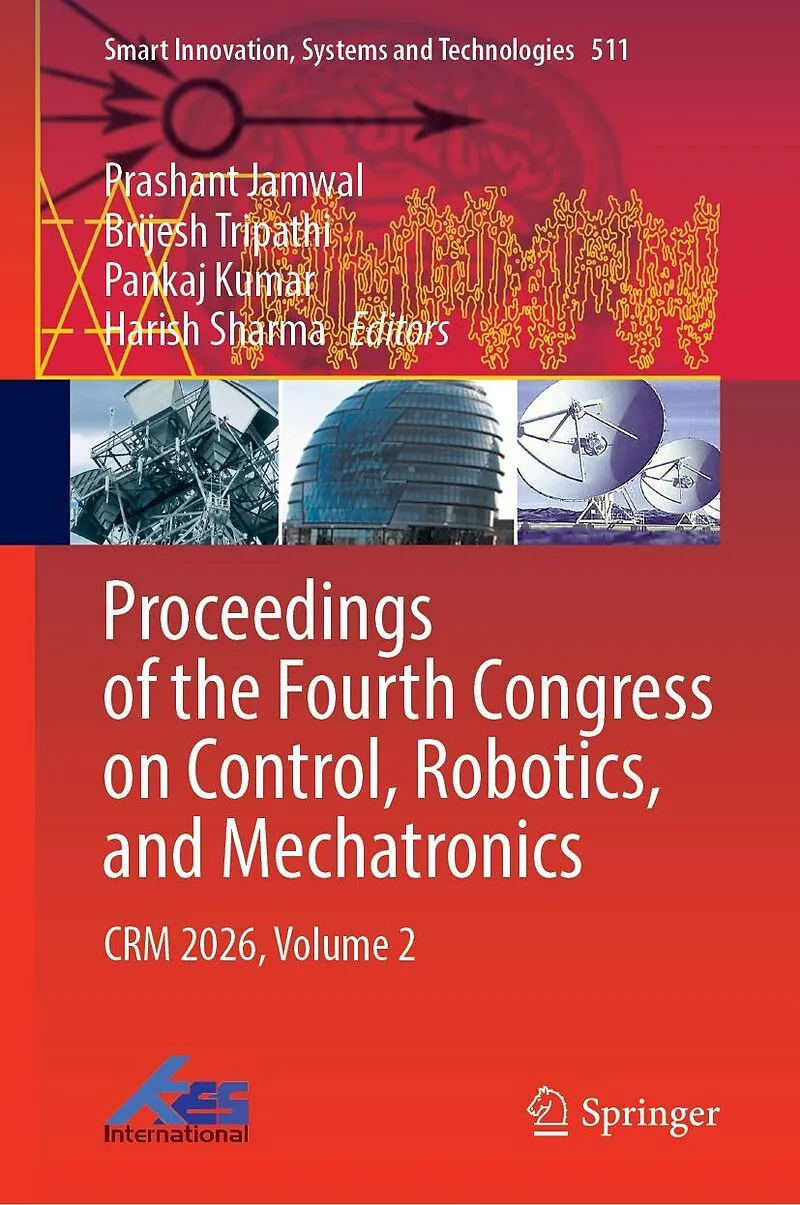
This book features high-quality research papers presented at the International Conference of Mechanical and Robotic Engineering Congress on Control, Robotics, and Mechatronics (CRM 2026), jointly organized by SR University, Warangal, India, and Soft Computing...
This book features high-quality research papers presented at the International Conference of Mechanical and Robotic Engineering Congress on Control, Robotics, and Mechatronics (CRM 2026), jointly organized by SR University, Warangal, India, and Soft Computing Research Society, India, during 2122 February 2026. This book discusses the topics such as combustion and fuels, controls and dynamics, fluid mechanics, I.C. engines and automobile engineering, machine design, mechatronics, rotor dynamics, solid mechanics, thermodynamics and combustion engineering, composite material, aerodynamics, aerial vehicles, missiles and robots, automatic design and manufacturing, artificial intelligence, unmanned aerial vehicles, autonomous robotic vehicles, evolutionary robotics, humanoids, hardware architecture, industrial robotics, intelligent control systems, microsensors and actuators, multi-robots systems, neural decoding algorithms, neural networks for mobile robots, space robotics, control theory and applications, model predictive control, variable structure control, and decentralized control.
Presents research works in the field of mechanical and robotic engineering Provides original works presented at CRM 2026 held in Warangal, India Serves as a reference for researchers and practitioners in academia and industry
Autorentext
Prof. Prashant K. Jamwal earned PhD degree and a post-doctoral fellowship from the University of Auckland, New Zealand. Earlier he had obtained M. Tech. from I.I.T., India, securing first position in all the disciplines and B. Tech. from MNREC, Allahabad, India. Presently, he is working as Professor at the school of engineering and design sciences, Nazarbayev University (NU), Astana, Kazakhstan and as adjunct professor at University of Canberra, Australia. He is actively pursuing research in Robotics and Artificial Intelligence, multi-objective evolutionary optimization, biomedical engineering, and Renewable energy. Over the past decade, he has applied his research in the development of medical robots for rehabilitation and surgical applications besides developing improved algorithms for cancer data analytics. Prof. Prashant received three prestigious World Bank Grants and has launched two start-up companies and established a Center of Excellence in Medical Research and Robotics.
Dr. Brajesh Tripathi received his PhD in Mechanical Engineering in 2008 from Indian Institute of Technology Kharagpur, India. He was a Post Doctorate Fellow at the Michigan State University, USA for two and half years and worked on a US government sponsored project on Computational Fluid Dynamics. Presently, he holds the Associate Professor positions at Rajasthan Technical University Kota. Dr. Tripathi received 06 research grants for various sponsored projects from GNIDA, NAL, BRNS, MHRD and AICTE. He has guided 08 PhD s and 26 M. Tech. Scholars. He has published more than 130 research articles in peer reviewed International Journals and Conferences.
Dr. Pankaj Kumar is the Professor and head of Mechanical Engineering Department, SR University, Warangal. In 2011, he received a Teaching Assistant Fellowship from the Ministry of Human Resource Development of India. He received his Ph.D. from IIT(ISM) Dhanbad. Dr. Pankaj has more than 15 years of experience in the design, fabrication, and characterization of micro to nanoscale components using unconventional techniques. His current research includes Additive Manufacturing, Micromachining, Composite materials processing technology, Nano-materials, and Sustainable Manufacturing, Biotechnology. He has published over 50 research articles in various international journals (Elsevier, Taylor, and Francis, Springer, IOP Science, Wiley) and conferences, 07 books, 20 book chapters, and 15 patents. He won the best paper award at the International Conference on Research Trends in Science, Technology, Engineering & Management 2019. He is in Editorial Board members PLOS ONE Journal. He is reviewer of many international journals. He has also given many invited talks at universities, workshops, and faculty development programs.
Harish Sharma is an Associate professor at Rajasthan Technical University, Kota in Department of Computer Science & Engineering. He has worked at Vardhaman Mahaveer Open University Kota, and Government Engineering College Jhalawar. He received his B.Tech and M.Tech degree in Computer Engg. from Govt. Engineering College, Kota and Rajasthan Technical University, Kota in 2003 and 2009 respectively. He obtained his Ph.D. from ABV - Indian Institute of Information Technology and Management, Gwalior, India. He is secretary and one of the founder member of Soft Computing Research Society of India. He is a life time member of Cryptology Research Society of India, ISI, Kolkata. He is an Associate Editor of International Journal of Swarm Intelligence (IJSI) published by Inderscience. He has also edited special issues of the many reputed journals like Memetic Computing , Journal of Experimental and Theoretical Artificial Intelligence , Evolutionary Intelligence etc.
Inhalt
Alzheimer's Disease Progress Classification Using CNN Optimized by Modified Sinh Cosh Optimizer.- CadCraft: Enhancing CAD Automation Through Fine-Tuned Large Language Models and Error Classification Frameworks.- YOLOv12-Based Real-Time Street Light Fault Diagnosis Using Drone-Captured Imagery and Edge AI on Jetson Nano.- Design and Implementation of Static Walking Gait Control for a 3D-Printed Humanoid Lower Limb.- Learning-Guided Incident Response: An ML-Powered Security Operations Model for High-Fidelity Threat Detection and Autonomous Remediation.- High-Recall Melanoma Detection using Dual-Attention EfficientNet-B4 and Siamese Networks.- Federated Learning for Privacy-Preserving Intrusion Detection in IOT Enabled Cyber-Physical Systems: A Systematic Review of Techniques, Challenges, and Future Trends.- DDS-VC: Zero Shot Voice Conversion Using Content Based Dynamic Timbre Fusion System.- Hybrid Structural and Textual Similarity Analysis for Flowchart Plagiarism Detection.- Enhancing Model Generalization and Clinical Integration in AI-Driven Blood Clot Detection Systems.- AI framework for Tuberculosis Diagnosis using Chest X-rays.- Improving Reliability of LLMs in Insurance Through Structured Prompting and Retrieval Grounding.- Hybrid Ensemble Learning for Real-Time Phishing URL Detection.- A Dynamic Fatigue Digital Twin of Robotic Joints Under Multi-Source Vibrations.- Bark Based Tree Species Identification and CO Absorption Estimation with Thinai-Based Ecological Mapping.- Etc.