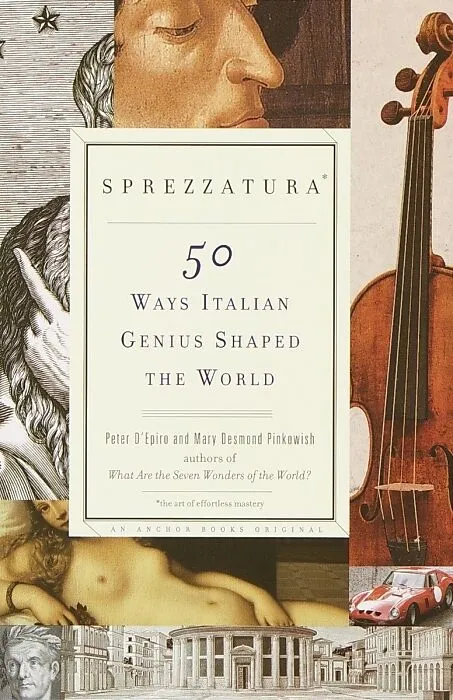
Sprezzatura
Beschreibung
Informationen zum Autor Peter D'Epiro and Mary Desmond Pinkowish Klappentext A witty, erudite celebration of fifty great Italian cultural achievements that have significantly influenced Western civilization from the authors of What Are the Seven Wonders of the...Format auswählen
- Poche format BCHF 26.70

Wird oft zusammen gekauft
Andere Kunden kauften auch
Beschreibung
Informationen zum Autor Peter D'Epiro and Mary Desmond Pinkowish Klappentext A witty, erudite celebration of fifty great Italian cultural achievements that have significantly influenced Western civilization from the authors of What Are the Seven Wonders of the World? "Sprezzatura, or the art of effortless mastery, was coined in 1528 by Baldassare Castiglione in The Book of the Courtier. No one has demonstrated effortless mastery throughout history quite like the Italians. From the Roman calendar and the creator of the modern orchestra (Claudio Monteverdi) to the beginnings of ballet and the creator of modern political science (Niccolò Machiavelli), Sprezzatura highlights fifty great Italian cultural achievements in a series of fifty information-packed essays in chronological order.One Rome gives the world a calendar--twice Caesar called in the best scholars and mathematicians of his time and, out of the systems he had before him, formed a new and more exact method of correcting the calendar, which the Romans use to this day, and seem to succeed better than any nation in avoiding the errors occasioned by the inequality of the solar and lunar years. --Plutarch, Lives, "Life of Julius Caesar" (c. a.d. 100) Despite current use of about forty traditional or religious calendars (such as the Jewish, Islamic, Hindu, and Chinese), it is the calendar of Julius Caesar, as slightly modified by Pope Gregory XIII, that functions as the worldwide civil norm. Yet it was a long, tortuous road that led to nearly universal adoption of this rational and elegant tool for measuring the length of the year. In its earliest known form, the Roman calendar had only 10 months and 304 days, leaving 61 days in winter uncounted and unaccounted for. This peculiar method of reckoning time was attributed to Rome's legendary founder and first king, Romulus (traditionally reigned 753-717 b.c.). In those days, January and February didn't yet exist (at least in the calendar), since Roman farmers didn't have much fieldwork to do in that dead part of the year after the last crops had been harvested and stored. After a two-month hiatus, the new year began in March with preparation of the ground for the next season's crop. Although Ovid, in his long poem on the Roman calendar, the Fasti, quips that Romulus was better at war than at astronomy, at least some of us might wish that "the year of Romulus" had prevailed, with all those discretionary days at the end. It was too good to last. The religious lawgiver Numa Pompilius, legendary second king of Rome, was credited with introducing, in about 700 b.c., the months of January and February at the end of the Roman year, lengthening it by 51 days. However, this 355-day year of what came to be called the Roman republican calendar was more probably brought to the city by the Etruscan Tarquinius Priscus (616-579 b.c.), traditionally Rome's fifth king. The main purpose of this calendar was to ensure proper observance of forty-five religious festivals and to indicate on which days public business could or could not be conducted. Four months had 31 days, February had 28, and the rest had 29. In the attempt to rectify the discrepancy between this lunar 355-day year and the solar year, an extra month called Mercedonius, which had 27 and 28 days alternately, was intercalated every other year after February 23. (February 24 through 28 were apparently not observed in years with intercalations.) This meant that any four-year cycle contained 1,465 days, with the year averaging 366.25 days. First way too short, now a tad too long. Compounding the problem, the intercalations were often haphazard, as a result of ignorance or political motives. (An artificially short year meant less time in office for magistrates who had made themselves unpopular with the pontif...
Autorentext
Peter D'Epiro and Mary Desmond Pinkowish
Klappentext
A witty, erudite celebration of fifty great Italian cultural achievements that have significantly influenced Western civilization from the authors of What Are the Seven Wonders of the World?
"Sprezzatura,” or the art of effortless mastery, was coined in 1528 by Baldassare Castiglione in The Book of the Courtier. No one has demonstrated effortless mastery throughout history quite like the Italians. From the Roman calendar and the creator of the modern orchestra (Claudio Monteverdi) to the beginnings of ballet and the creator of modern political science (Niccolò Machiavelli), Sprezzatura highlights fifty great Italian cultural achievements in a series of fifty information-packed essays in chronological order.
Leseprobe
One
Rome gives the world a calendar--twice
*Caesar called in the best scholars and mathematicians of his time and, out of the systems he had before him, formed a new and more exact method of correcting the calendar, which the Romans use to this day, and seem to succeed better than any nation in avoiding the errors occasioned by the inequality of the solar and lunar years.*
--Plutarch, Lives, "Life of Julius Caesar" (c. a.d. 100)
Despite current use of about forty traditional or religious calendars (such as the Jewish, Islamic, Hindu, and Chinese), it is the calendar of Julius Caesar, as slightly modified by Pope Gregory XIII, that functions as the worldwide civil norm. Yet it was a long, tortuous road that led to nearly universal adoption of this rational and elegant tool for measuring the length of the year.
In its earliest known form, the Roman calendar had only 10 months and 304 days, leaving 61 days in winter uncounted and unaccounted for. This peculiar method of reckoning time was attributed to Rome's legendary founder and first king, Romulus (traditionally reigned 753-717 b.c.). In those days, January and February didn't yet exist (at least in the calendar), since Roman farmers didn't have much fieldwork to do in that dead part of the year after the last crops had been harvested and stored. After a two-month hiatus, the new year began in March with preparation of the ground for the next season's crop.
Although Ovid, in his long poem on the Roman calendar, the Fasti, quips that Romulus was better at war than at astronomy, at least some of us might wish that "the year of Romulus" had prevailed, with all those discretionary days at the end. It was too good to last. The religious lawgiver Numa Pompilius, legendary second king of Rome, was credited with introducing, in about 700 b.c., the months of January and February at the end of the Roman year, lengthening it by 51 days. However, this 355-day year of what came to be called the Roman republican calendar was more probably brought to the city by the Etruscan Tarquinius Priscus (616-579 b.c.), traditionally Rome's fifth king.
The main purpose of this calendar was to ensure proper observance of forty-five religious festivals and to indicate on which days public business could or could not be conducted. Four months had 31 days, February had 28, and the rest had 29. In the attempt to rectify the discrepancy between this lunar 355-day year and the solar year, an extra month called Mercedonius, which had 27 and 28 days alternately, was intercalated every other year after February 23. (February 24 through 28 were apparently not observed in years with intercalations.) This meant that any four-year cycle contained 1,465 days, with the year averaging 366.25 days. First way too short, now a tad too long.
Compounding the problem, the intercalations were often haphazard, as a result of ignorance or political motives. (An artificially short year meant less time in office for magistrates who had made themselves unpopular with the pontiffs, the priests responsible for ordering the intercalations.)
Lunar calendars like early Rome's are notoriously troublesome. A year of 12 lunar months, or lunations, each averaging 29.5 days, consists of only 354 days. (The Roman republican calendar adde…