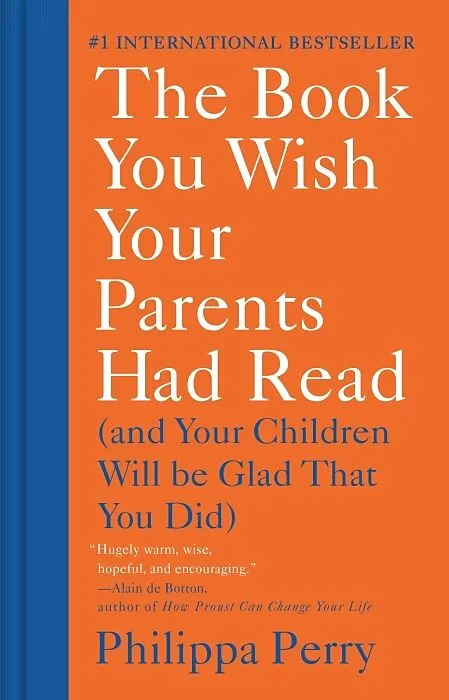
The Book You Wish Your Parents Had Read
Beschreibung
“If you''re determinedly not a self-help kind of reader (like me), make an exception for [this book]. And if you''re not a parent, don''t dismiss it. The message is one of non-judgmental kindness.”―Vogue (London)/b> b>How can we have better r...Format auswählen
- Fester EinbandCHF 20.50

Wird oft zusammen gekauft
Andere Kunden kauften auch
Beschreibung
**“If you''re determinedly not a self-help kind of reader (like me), make an exception for [this book]. And if you''re not a parent, don''t dismiss it. The message is one of non-judgmental kindness.”―Vogue (London)/b> b>How can we have better relationships?/b> In this instant Sunday Times bestseller, leading psychotherapist Philippa Perry reveals the vital do''s and don''ts of relationships. This is a book for us all. Whether you are interested in understanding how your upbringing has shaped you, looking to handle your child''s feelings or wishing to support your partner, you will find indispensable information and realistic tips in these pages. Philippa Perry''s sane, sage and judgement-free advice is an essential resource on how to have the best possible relationships with the people who matter to you most.
Praise for The Book You Wish Your Parents Had Read:
“[H]onest, warm, and judgment-free. . . this is essential for all parents, from those first expecting to empty nesters. It's never too early or too late to improve the relationship with your children, and, as the title suggests, they'll be glad you did.”
***--Booklist* (starred review)**
“Healing from, and learning not to perpetuate, difficult upbringings is the linchpin of this practical, self-care–centered parenting guide . . . Perry’s kind but professional tone results in a helpful manual that will appeal to new parents who want an expert on board as they take the time to be reflective in their parenting.”
***--Publishers Weekly
“Accessible, compassionate.”
--Bookpage*
"It is hard to read fast, not just because Perry’s text is punctuated by exercises...but because it prompts so many realisations, or insights, or clearly names things that have until now existed just beyond one’s awareness. And it provides tools, straightforward and manageable if not always easy, that can be implemented at once. I am grateful for it."
***--The Guardian* (UK)**
Autorentext
Philippa Perry has been a psychotherapist for the past twenty years. She is also a freelance writer, and a TV and radio presenter. She has worked on several documentaries, and has also written two other books, Couch Fiction, a Graphic Tale of Psychotherapy and How to Stay Sane. She lives in London with her husband, the artist Grayson Perry, and they have a grown-up daughter, Flo.
Klappentext
"A beautifully comprehensive look at what it might mean to be a sane and emotionally intelligent parent . . . hugely warm, wise, hopeful and encouraging."--Alain de Botton, author of How Proust Can Change Your Life
Instant #1 Sunday Times Bestseller
Every parent wants their child to be happy and every parent wants to avoid screwing them up (the way their parents did!). But how do you do that?
In this absorbing, clever, and warm book, renowned psychotherapist Philippa Perry tells us what really matters and what behavior it is important to avoid--the vital dos and don'ts of parenting.
Her approach begins with parents themselves and their own psychological make-up and history--and how that in turn influences one's parenting.
Instead of mapping out the "perfect" plan, Perry offers a big-picture look at the elements that lead to good parent-child relationships. This refreshing judgement-free book will help you to:
• Understand how your own upbringing may affect your parenting
• Accept that you will make mistakes and learn what you can do about them
• Break negative cycles and patterns
• Handle your own and child's feelings
• Understand what different behaviors communicate
Full of sage and sane advice, The Book You Wish Your Parents Had Read is one every parent will want to read and every child will wish their parents had.
A PAMELA DORMAN BOOKS/VIKING LIFE TITLE
Zusammenfassung
****More than 1.3 million copies sold worldwide!
“A wonderful book”―**Richard Osman
“If you're determinedly not a self-help kind of reader (like me), make an exception for [this book]. And if you're not a parent, don't dismiss it. The message is one of non-judgmental kindness.”―Vogue (London)
How can we have better relationships?**
In this instant Sunday Times bestseller, leading psychotherapist Philippa Perry reveals the vital do's and don'ts of relationships. This is a book for us all. Whether you are interested in understanding how your upbringing has shaped you, looking to handle your child's feelings or wishing to support your partner, you will find indispensable information and realistic tips in these pages. Philippa Perry's sane, sage and judgement-free advice is an essential resource on how to have the best possible relationships with the people who matter to you most.
Leseprobe
PART ONE
Your Parenting Legacy
The cliché is true: children do not do what we say; they do what we do. Before we even consider the behavior of our children, it's useful-essential, even-to look at their first role models. And one of them is you.
This section is all about you, because you will be a major influence on your child. In it, I'll give examples of how the past can affect the present when it comes to your relationship with your child. I will talk about how a child can often trigger old feelings in us that we then mistakenly act on in our dealings with them. I'll also be looking at the importance of examining our own inner critic so we do not pass too much of its damaging effects on to the next generation.
The past comes back to bite us (and our children)
A child needs warmth and acceptance, physical touch, your physical presence, love plus boundaries, understanding, play with people of all ages, soothing experiences, and a lot of your attention and your time. Oh, so that's simple then: the book can end here. Except it can't, because things get in the way. Your life can get in the way: circumstances, childcare, money, school, work, lack of time, and busyness . . . and this is not an exhaustive list, as you know.
What can get in the way more than any of this, however, is what was given to us when we ourselves were babies and children. If we don't look at how we were brought up and the legacy of that, it can come back to bite us. You might have found yourself saying something along the lines of: "I opened my mouth and my mother's words came out." Of course, if theirs were words that made you feel wanted, loved, and safe as a child, that would be fine. But so often they are the words that did the opposite.
What can get in the way are things like our own lack of confidence, our pessimism, our defenses, which block our feelings, and our fear of being overwhelmed by feelings. Or when it comes specifically to relating to our children, it could be what irritates us about them, our expectations for them, or our fears for them. We are but a link in a chain stretching back through millennia and forward until who knows when.
The good news is you can learn to reshape your link, and this will improve the life of your children and their children, and you can start now. You don't have to do everything that was done to you; you can ditch the things that were unhelpful. If you are a parent or are going to be one, you can unpack and become familiar with your childhood, examine what happened to you, how you felt about it then, how you feel about it now, and, after having done that unpacking and taken a good look at it all, put back only what you need.
If, when you were growing up, you were, for the most part, respected as a unique and valuable individual, shown unconditional love, and given enough positive attention, and you had rewarding relationships with your family members, you will have receiv…