
IHR WARENKORB IST AKTUELL LEER.
Haben Sie noch nichts passendes gefunden? Stöbern Sie durch unser komplettes Sortiment.
Oder melden Sie sich an bzw. registrieren Sie sich.
- Kostenlose Lieferung
- Kauf auf Rechnung
- Ex Libris Tiefpreis
- Filiallieferung und 650+ Abholorte
- Rabatt-Bons als Club-Mitglied
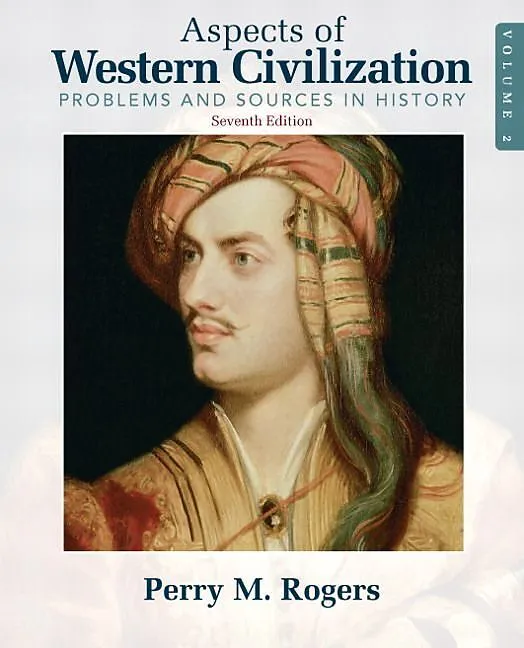
Aspects of Western Civilization: Problems and Sources in History, Volume 2
Beschreibung
This reader is appropriate as a main text or a supplementary text for introductory-level survey courses in Western Civilization and European History and Civilization. Aspects of Western Civilization : Problems and Sources in History, Volume 2, 7/e, challenges...
Format auswählen
- Kartonierter EinbandCHF 99.05

Wird oft zusammen gekauft
Andere Kunden kauften auch
Beschreibung
This reader is appropriate as a main text or a supplementary text for introductory-level survey courses in Western Civilization and European History and Civilization.
**
Aspects of Western Civilization : Problems and Sources in History, Volume 2, 7/e, challenges students with basic questions regarding historical development, human nature, moral action, and practical necessity. This collection of diverse primary sources explores a wide variety of issues and is organized around seven major themes: the Power Structure, Social and Spiritual Values, the Institution and the Individual, Imperialism, Revolution and Historical Transition, the Varieties of Truth, and Women in History.
Autorentext
Perry M. Rogers received his B.A. from San Jose State University, his M.A. from the University of California, Los Angeles, and his Ph.D. from the University of Washington where he specialized in ancient history with fields in medieval history, and Early Modern Europe. He has been a professor of Roman history at the Ohio State University and has held an adjunct position in the Liberal Arts at the Pontifical College Josephinum for several years. He remains Chair of the History Department at Columbus School for Girls, an independent, college preparatory school in Columbus, Ohio. Rogers’s two-volume publications for Pearson/Prentice Hall include Aspects of Western Civilization (7th edition), Aspects of World History, and The Human Spirit: Sources in the Western Humanities.
Inhalt
PREFACEPART I: FOUNDATIONS OF THE MODERN WORLD Chapter 1: The Age of the Renaissance and Reformation SECTION I: THE RENAISSANCE MOVEMENT The Humanist Movement Oration on the Dignity of Man (1486), Pico della Mirandola The Soul of Man (1474), Marcilio Ficino The Political Life of Florence The Rule of Cosimo de'Medici, Vespasiano The Prince: Everyone Sees What You Appear to Be, Few Perceive What You Are Niccolò Machiavelli SECTION II: THE REFORMATION ERA The Lutheran Reformation How Many Sins Are Committed in a Single Day? (1517), Johann Tetzel Salvation Through Faith Alone, Martin Luther The Ninety-five Theses (1517), Martin Luther Here I Stand: Address at the Diet of Worms (1521), Martin Luther The Edict of Worms (1521), Emperor Charles V In the Wake of LutherJohn Calvin and the Genevan Reformation On the Necessity of Reforming the Church (1544), John Calvin Predestination: Institutes of the Christian Religion (1536), John Calvin The Catholic Reformation Spiritual Exercises (1548), Ignatius Loyola The Council of Trent: Profession of Faith The Tridentine Index of Books (1564) Chapter 2: I Am the State: The Development of Absolutism in England and France The English Revolution (1649-1689) The Struggle for Constitutional Government (1650-1660) The Mortal God: Leviathan (1651), Thomas Hobbes The Instrument of Government (December 16, 1653) Cromwell Denies the Crown (May 8, 1657), Oliver Cromwell The Reflection in the Mirror: Oliver Cromwell: The Lord Protector To You Our Country Owes Its Liberties John Milton Guilty of Crimes for which Hell-Fire Is Prepared, Edward Hyde The Restoration and the Glorious Revolution (1660-1689) A Force Sufficient to Defend Us from the Violence of Those Evil Counsellors, William of Orange The Bill of Rights (1689) The Absolutism of Louis XIV The Theory of Divine-Right Monarchy The Ideal Absolute State (1697), Jean Domat Politics and Scripture (1679), Jacques Benigne Bossuet
The Sun King and the Practice of Absolute Rule Vanity Was His Ruin, The Duke of Saint-Simon Letters to His Heirs: Allow Good Sense to Act, King Louis XIV A Frightful Plot: The Revocation of the Edict of Nantes, The Duke of Saint-Simon The Artistic Vision: The Palace of Versailles A Celebration of Greatness, Jean Colbert Visible Majesty, King Louis XIV Chapter 3: Dare to Know!: The Scientific Revolution Science and the Church The Heliocentric Statement (ca. 1520), Nicolaus Copernicus On the Movement of the Earth (1543), Nicolaus Copernicus Science and the Bible: They Would Have Us Abandon Reason (1615), Galileo Galilei The Reflection in the Mirror: Galileo Absolved: The Resolution Science and Faith Are Both Gifts from God (1993) Pope John Paul II The Foundations of Modern Science The Advancement of Learning (1605), Sir Francis Bacon I Think, Therefore I Am: Discourse on Method (1637), René Eescartes Against the Grain: On the Circulation of the Blood (1628) A Motion, As It Were, In a Circle William Harvey Principles of AnalysisInduction and God: Optics (1704) Sir Isaac Newton
Chapter 4: The Enlightenment and the Revolution of the Mind
Thoughts on the Human Condition and Human Progress
The Blank Slate of the Mind: An Essay Concerning Human Understanding (1690) John Locke
Against the Grain: On Crimes and Punishments (1764)
The Greatest Happiness of the Greatest Number, Cesare Beccaria
Thoughts on Religion
GodA Cause Contradicted by Its Effects: Common Sense (1770), Baron d'Holbach
On Universal Toleration, Voltaire
If God Did Not Exist, He Would Have to Be Invented, Voltaire
Thoughts on Education
Introduction to the Encyclopedia (1751), Jean Le Rond d'Alembert
We Did Not Live Entirely in Vain (1764), Denis Diderot
Thoughts on Government: The Political Framework
Second Treatise of Civil Government (1690), John Locke
The Spirit of the Laws (1748), Baron de montesquieu
The Social Contract (1762), Jean Jacques Rousseau
The Declaration of Independence (1776), Thomas Jefferson
Thoughts on Women: The Social Framework
Woman: Especially Constituted to Please Man, Jean Jacques Rousseau
A Vindication of the Rights of Women (1792), Mary Wollstonecraft
Thoughts on Commerce: The Economic Framework
The Wealth of Nations (1776), Adam Smith
PART II : THE ERA OF REVOLUTION
Chapter 5: Liberty, Equality, Fraternity!: The French Revolution
Conditions of Society on the Eve of Revolution
The Corruption of the French Court, Marquis d'Argenson
Ancient Oaks Mutilated by Time , Marquis de Bouille
The Grievances of Carcassonne
Beggars, Rags, and Misery, Arthur Young
The Outbreak of Revolution (17891791)
What Is the Third Estate? (January 1789), the Abbé Aieyès
Women of the Third Estate: We Ask to Be Enlightened (January 1789)
The Tennis Court Oath (June 29, 1789)
The Fall of the Bastille (July 14, 1789)
Declaration of the Rights of Man (August 27, 1789)
Against the Grain: The Flip Side of Liberty
Declaration of the Rights of Woman (1791), Olympe de Gouges
Reflections on the Revolution (1790), Edmund Burke
The Radicalization of the Revolution (17921794)
The Fall of Louis XVI (1792-1793)
The Execution of Louis XVI (January 21, 1793), Henry Edgeworth de Firmont
Proclamation of the Convention to the French People (January 23, 1793)
Reflections on Louis XVI, Mme Roland
The Reflection in the Mirror: A Revolutionary Reality Check
An Update on the Political Rights of Women (1793)
The Reign of Terror (1793-1794)
You Would Exterminate All Your Enemies by the Guillotine! (December 20, 1793), Camille Desmoulins
The Artistic Vision: Jean-Claude Marat: The Martyr of the Revolution
The Death of Marat (1793), Jacques-Louis David
Virtue and Terror: Speech to the Convention (February 5, 1794), Maximilien Robespierre
The Administration of Terror (June 10, 1794)
The Execution of Robespierre (July 28, 1794), Durand de Maillane
Chapter 6: Paths of Glory: Napoleon and the Romantic Movement
The Napoleonic Era (1796-1815)
The Will to Power (1796-1802)
On the Realities of Power (1796), Napoleon Bonaparte
Suppression of the Newspapers (1800)
Articles for the Catholic Church (1802)
The Imperial Mantle (1804-1806)
The Only Salvation Lies in Hereditary Power (December 1804), Napoleon Bonaparte
Why the French Submitted to Napoleon's Rule (1804), Comtesse de Rémusa…