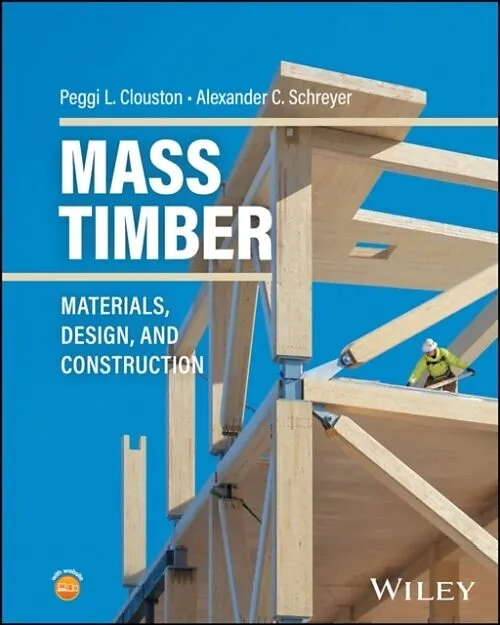
Mass Timber
Beschreibung
Autorentext Peggi L. Clouston is a Professor of Wood Mechanics and Timber Engineering at the University of Massachusetts in Amherst, MA, bringing decades of expertise in timber design, research, and education. Her research work centers on wood and bamboo compo...Format auswählen
- Fester EinbandCHF 150.00

Wird oft zusammen gekauft
Andere Kunden kauften auch
Beschreibung
Autorentext
Peggi L. Clouston is a Professor of Wood Mechanics and Timber Engineering at the University of Massachusetts in Amherst, MA, bringing decades of expertise in timber design, research, and education. Her research work centers on wood and bamboo composites, using computational and experimental methods to explore and develop cutting-edge technologies. A registered professional engineer (now non-practicing), she also helps shape the field as Associate Editor of the American Society of Civil Engineering (ASCE) Journal of Materials in Civil Engineering. Alexander C. Schreyer is a Senior Lecturer II and Director of the Building and Construction Technology (BCT) program at the University of Massachusetts in Amherst, MA. He teaches courses in wood properties, materials and methods, and BIM (Building Information Modeling). His other books are "Architectural Design with SketchUp" and "Fundamentals of Residential Construction," both also published by John Wiley & Sons.
Klappentext
The most comprehensive reference on building with mass timber, extensively covering its sustainability, materials, building conceptualization, structural design and construction processes Mass Timber: Materials, Design, and Construction is a one-stop resource book for mass timber construction with thorough textual descriptions, engaging images, many concept drawings, and discussion of state-of-the-art construction practices. The book draws from a large pool of images from the every-day to cutting-edge mass timber construction projects and includes extensive details of recently constructed buildings. Written by a renowned team of experts with over three decades of professional, research, and teaching experience, Mass Timber: Materials, Design, and Construction includes information on:
- Sustainability and climate-related benefits of mass timber
- Historical applications and products leading up to the current day
- Mass timber materials such as cross-laminated timber (CLT), glue-laminated timber (glulam), nail- and dowel-laminated timber (NLT and DLT), structural composite lumber (PSL and LVL) and the many fastener types used with such materials
- Resiliency considerations for wood such as decay, fire, weathering, and its protection during construction
- Building conceptualization, covering building codes and systems as well as preliminary design considerations
- Structural design principles for gravity and lateral loads as well as connection design and detailing
- Construction processes, covering procurement, scheduling and lead time, estimating, risk management, on-site storage, and hoisting Mass Timber: Materials, Design, and Construction is an excellent classroom or studio companion for students in architecture, engineering, and construction, and a valuable desk reference for any professional in these and related fields.
Inhalt
Forewords xiii
Preface xv
Acknowledgements xxi
About the Companion Website xxiii
Part 1: The Evolution of Mass Timber 1
Chapter 1: From Cedar Longhouses to Mass Timber High Rises 3
1.1 Indigenous Builders 5
1.2 Greek and Roman Builders 6
1.3 Medieval Builders 9
1.4 Industrial Revolution Builders 13
1.5 New Wood Materials 16
1.6 A (Mass-)Timber Renaissance: 20th and 21st Centuries 17
1.7 Key Buildings and Wood Structures 21
1.8 The Future of Mass Timber 24
Review Questions 28
Exercises 29
Key Terms and Concepts 29
Web Links 30
Selected References 30
Chapter 2: Forests, Mass Timber, and Climate Change 33
2.1 The Global Carbon Cycle 35
2.2 State of the World's Forests 40
2.3 Sustainable Forest Management 43
2.4 Life Cycle Assessment 47
2.5 Circular Construction 53
Review Questions 53
Exercises 54
Key Terms and Concepts 56
Web Links 56
Selected References 57
Part 2: Mass Timber Materials, Products, and Properties 59
Chapter 3: Wood as a Building Material 61
3.1 Tree Structure 62
3.2 Wood Grain and Cell Structure 69
3.3 Mechanical Properties 72
3.4 Wood and Water 77
3.5 Durability and Protection of Wood 81
Review Questions 93
Exercises 93
Key Terms and Concepts 94
Web Links 95
Selected References 95
Chapter 4: From Log to Graded Lumber 97
4.1 Solid Sawn Wood 98
4.2 Dimension Lumber 102
4.3 Lumber Grading 103
Review Questions 113
Exercises 114
Key Terms and Concepts 115
Web Links 116
Selected References 116
Chapter 5: From Lumber to Laminate - Mass Timber Products 117
5.1 Mass Timber Components: Laminations and Adhesives 118
5.2 Glued Laminated Timber (Glulam) 125
5.3 Cross- Laminated Timber (CLT) 135
5.4 Nail- Laminated Timber (NLT) and Dowel- Laminated Timber (DLT) 142
5.5 Wood- Concrete Composites 147
5.6 Structural Composite Lumber 149
Review Questions 152
Exercises 153
Key Terms and Concepts 154
Web Links 155
Selected References 155
Chapter 6: Mass Timber Fasteners 157
6.1 Screws 158
6.2 Nails 163
6.3 Drift Pins (Dowels) and Bolts 165
6.4 Pre- Engineered Parts and Connections 166
6.5 Custom Parts and Connections 168
6.6 Wood- Concrete Shear Connectors 172
6.7 Glued Connections 175
6.8 Corrosion Protection for Fasteners 176
Review Questions 178
Exercises 178
Key Terms and Concepts 179
Web Links 179
Selected References 180
Part 3: Mass Timber Building Conceptualization 181
Chapter 7: Mass Timber in the Building Codes 183
7.1 International Building Code and State Codes 185
7.2 Detailing Mass Timber Construction 192
7.3 Design Specifications and Product Standards 195
Review Questions 196
Exercises 196
Key Terms and Concepts 197
Web Links 197
Selected References 198
Chapter 8: Mass Timber Building Systems and Their Layout 199
8.1 Wood- Specific Layout Concepts (Mass Timber Typologies) 200
8.2 Building- Level Layout Concepts 205
8.3 Lateral Load- Resisting Concepts 217
8.4 Detail- Level Concepts 220
8.5 HVAC and MEP Integration Concepts 231
8.6 Exterior Wall and Façade Concepts 233
8.7 Protection Strategies 235
Review Questions 242
Exercises 242
Key Terms and Concepts 243
Web Links 244
Selected References 244
Part 4: Mass Timber Building Structural Design 245
Chapter 9: Structural Design Methodology for Mass Timber 247
9.1 The National Design Specification for Wood Construction 248
9.2 Design Methods (ASD and LRFD) 251
9.3 Where Reference Design Values Come From 258
9.4 Adjustment Factors for Mass Timber 258
9.5 Example Calculation of Adjusted Design Values 274
Review Questions 276
Exercises 277
Key Terms and Concepts 279
Web Links 279
Selected References 279
Chapter 10: Design of Mass Timber Beams and Panels for Gravity Loads 281
10.1 Beam Behavior 283
10.2 Design Procedure 298
10.3 Design Examples (ASD) 309
10.4 Preliminary Design Aids 325
Review Questions 329
Exercises 329
Key Terms and Concepts 331
Web Links 331
Selected References 332
Chapter 11: Design of Mass Timber Columns and Walls for Gravity Loads 335
11.1 Axial Compression Members 336
11.2 Combined Axial Compression and Bending Members 353
Review Questions 360
Exercises 361
Key Terms and Concepts 361
Web Links 362
Selected References 362
Chapter 12: Mass Timber Systems for Lateral Loads 363
12.1 Lateral Loads 364
12.2 Lateral Force- Resisting Systems (LFRS) 368
12.3 Lateral Load Transfer 369
12.4 Diaphragms 374
12.5 Shear Walls 380
12.6 Braced Frames 385
12.7 Moment Frames 389
Review Questions 391
Exercises 392
Key Terms and Concepts 394
Web Links 395
Selected References 395
Chapter 13: Design of Mass Timber Connections 397
13.1 Connection Detailing 398
13.2 Bearing Connections 403
13.3 Lateral Shear Connections 410
13.4 Withdrawal and Axial Connections 432
Review Questions 438
Exercises 439
Key Terms and Concepts 441
Web Links 441
Selected References 44…