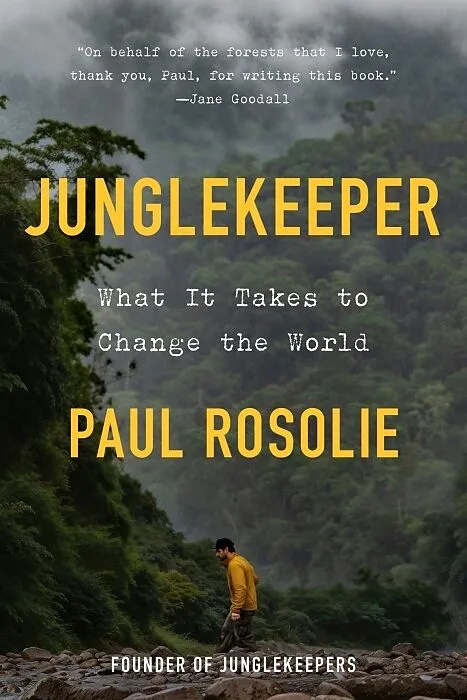
Junglekeeper
Beschreibung
Most people assume that the world has been explored and true adventure is dead: This book is one man’s rebuttal. Explorer and conservationist Paul Rosolie shares his incredible life in the Amazon rainforest--and what we can learn from the people fighting...Format auswählen
- Fester EinbandCHF 31.60

Wird oft zusammen gekauft
Andere Kunden kauften auch
Beschreibung
Most people assume that the world has been explored and true adventure is dead: This book is one man’s rebuttal. Explorer and conservationist Paul Rosolie shares his incredible life in the Amazon rainforest--and what we can learn from the people fighting to protect it. “On behalf of the forests that I love, thank you, Paul, for writing this book.”--Jane Goodall Deep in the Peruvian jungle, there exists a corner of the world that remains untouched--one teeming with giant anacondas, where the haunting cries of howler monkeys send brightly colored macaws shooting across the canopy. It’s an ecosystem of stupendous biodiversity, uncontacted tribes, and adventures that most people don’t even dare to dream of. When he first set foot in the jungle, Rosolie was a dyslexic kid from Brooklyn who struggled to graduate from high school but had an undeniable calling to the outdoors. He was lucky enough to meet the indigenous naturalist Juan Julio Durand, and together, over two decades, they have created Junglekeepers, an organization that has found a way to halt deforestation and protect more than 110,000 acres--inspiring millions along the way by documenting their progress online. But this work takes grit, and years in, Rosolie and Durand are past their “barefoot machete days,” grappling with chain saws, massive fires, illegal miners, and the worst of humanity. Here, Rosolie brings you up close and personal with one of the wildest places on the planet and tells the incredible story of “first contact” with one of the most mysterious uncontacted tribes on Earth: the Mashco Piro. This book is about the profound power of saying yes: yes to one’s calling, yes to sticking with your dream when it comes at a high cost, and yes to taking a stand to save what might otherwise be gone in a generation. It’s a story of calling, connectedness, and hope.
Autorentext
Paul Rosolie is a naturalist, explorer, author, and award-winning wildlife filmmaker. For the last twenty years, he has specialized in protecting threatened ecosystems and species in countries ranging from Brazil and Peru to India and Indonesia. He is the founder of Junglekeepers, an organization that focuses on protecting threatened habitats in western Amazonia. To date, Junglekeepers has protected more than 100,000 acres of primary forest.
Klappentext
**NEW YORK TIMES BESTSELLER • Most people assume that the world has been explored and true adventure is dead: This book is one man’s rebuttal. Explorer and conservationist Paul Rosolie shares his incredible life in the Amazon rainforest—and what we can learn from the people fighting to protect it.
“On behalf of the forests that I love, thank you, Paul, for writing this book.”—Jane Goodall**
Deep in the Peruvian jungle, there exists a corner of the world that remains untouched—one teeming with giant anacondas, where the haunting cries of howler monkeys send brightly colored macaws shooting across the canopy. It’s an ecosystem of stupendous biodiversity, uncontacted tribes, and adventures that most people don’t even dare to dream of.
When he first set foot in the jungle, Rosolie was a dyslexic kid from Brooklyn who struggled to graduate from high school but had an undeniable calling to the outdoors. He was lucky enough to meet the indigenous naturalist Juan Julio Durand, and together, over two decades, they have created Junglekeepers, an organization that has found a way to halt deforestation and protect more than 110,000 acres—inspiring millions along the way by documenting their progress online. But this work takes grit, and years in, Rosolie and Durand are past their “barefoot machete days,” grappling with chain saws, massive fires, illegal miners, and the worst of humanity. Here, Rosolie brings you up close and personal with one of the wildest places on the planet and tells the incredible story of “first contact” with one of the most mysterious uncontacted tribes on Earth: the Mashco Piro.
This book is about the profound power of saying yes: yes to one’s calling, yes to sticking with your dream when it comes at a high cost, and yes to taking a stand to save what might otherwise be gone in a generation. It’s a story of calling, connectedness, and hope.
Leseprobe
The Rivers in Our Veins
There was once a little forest stream about an hour’s boat drive from the research station. It slithered beneath the canopy like a little blue snake—from a bird’s-eye view it was invisible. A hard-to-access, seldom-visited capillary of the great Amazon River. You already know what this place looks like in your mind: a hidden, vine-draped jungleland, shadowed by umbrella leaves, dappled with butterflies, and humming with wild beauty. That’s the spot JJ and I used to love to explore.
We’d head out in the morning with a boat and fishhooks, machetes and no shoes. Well, sometimes we brought shoes, but when we did, we left them in the boat, the way one leaves shoes outside before entering a temple.
The stream was small, never more than thirty feet across, often as little as ten, and not very deep. Most of the way up we could walk it like a path. Sure, there were pools at the bends, but we stayed away from those, knowing that’s where the largest crocs, the longest anacondas, and all the stingrays were hiding. For the most part we could see the streambed as we went. White sand. Soft on the feet. The water was cool and swift and full of little fish eager to swarm-feed on our dead skin if we gave them the chance. The tree branches met overhead like the ceiling of a great emerald-green cathedral.
We tried to formulate a theory as to why the trees here were so exceptionally tall, even for Amazonia. There were towering buttress-rooted Spanish cedars and pillar-straight quinillas with crocodile-skin bark, gargantuan kapok trees, manchinga, remo caspi, and gnarled matapalos. This was true old growth. In between the giants were myriad saplings striving upward and competing for light. Branches held bromeliads the size of small elephants. Vines interlaced the canopy, and up in the loftiest branches, cacti and orchids bloomed where butterflies and rare bees doted over their high-altitude habitat. This was true primary forest. A jungle that had never been cut. An ecosystem in its most abundant and diverse iteration, a constant state of biological climax.
One November day, we were picking our way along the stream and stopping to look at small wonders. We were barefoot and shirtless and each had a machete so sharp it could sing. There was no reason for snacks or water bottles on an all-day hike: JJ would find all the food we needed along the way, and the water of this stream was so clear and clean, we could drink any time we pleased.
JJ told me how his father, Santiago, was once searching deep in the jungle for vines to harvest for ayahuasca, when he found an anaconda in a stream not unlike the one we were walking in. The giant snake had almost finished swallowing an entire tapir (an animal roughly the size of a small cow).
JJ told many stories as we went. Every so often we would pause for a teaching moment in the present. Like when JJ spotted jaguar tracks on the beach beside us.
“Lookadis!” JJ said, motioning with his machete.
“Big one,” I said.
JJ smiled condescendingly. “No. Look. Mira.”
I studied the sand and tried to imagine what JJ saw. He can put his mind inside another animal and tell you what it wants and where it is going.
There were two jaguar prints, front paws, just by the water’s edge, deeper at the toes.
“That’s where he leaned forward to drink,&rd…