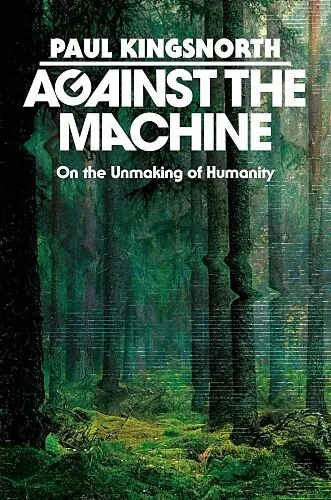
Against the Machine
Beschreibung
Autorentext Paul Kingsnorth is an English writer and thinker living in the west of Ireland. He is the author of ten books of fiction, non-fiction and poetry, including the novel The Wake, which was longlisted for the Man Booker Prize. Klappentext NEW...Format auswählen
- Fester EinbandCHF 33.50
Wird oft zusammen gekauft
Andere Kunden kauften auch
Beschreibung
Autorentext
Paul Kingsnorth is an English writer and thinker living in the west of Ireland. He is the author of ten books of fiction, non-fiction and poetry, including the novel The Wake, which was longlisted for the Man Booker Prize.
Klappentext
**NEW YORK TIMES BESTSELLER
How a force that’s hard to name, but which we all feel, is reshaping what it means to be human**
In Against the Machine, “furiously gifted” (The Washington Post) novelist, poet, and essayist Paul Kingsnorth presents a wholly original—and terrifying—account of the technological-cultural matrix enveloping all of us. With masterful insight into the spiritual and economic roots of techno-capitalism, Kingsnorth reveals how the Machine, in the name of progress, has choked Western civilization, is destroying the Earth itself, and is reshaping us in its image. From the First Industrial Revolution to the rise of artificial intelligence, he shows how the hollowing out of humanity has been a long game—and how your very soul is at stake.
It takes effort to remain truly human in the age of the Machine. Writing in the tradition of Wendell Berry, Jacques Ellul and Simone Weil, Kingsnorth reminds us what humanity requires: a healthy suspicion of entrenched power; connection to land, nature and heritage; and a deep attention to matters of the spirit. Prophetic, poetic, and erudite, Against the Machine is the spiritual manual for dissidents in the technological age.
Leseprobe
I
The Dream of the Rood
Let me tell you a story.
This story begins in a garden, at the very beginning of all things. All life can be found in this garden: every living being, every bird and animal, every tree and plant. Humans live here too, and so does the creator of all of it, the source of everything, and he is so close that he can be seen and heard and spoken to. Everything walks in the garden together. Everything is in communion. It is a picture of integration.
At the centre of this garden grows a tree, the fruit of which imparts hidden knowledge. The humans-the last creatures to be formed by the creator-will be ready to eat this fruit one day, and when they do they will gain its knowledge and be able to use that knowledge wisely for the benefit of themselves and of all other things that live in the garden. But they are not ready yet. The humans are still young, and unlike the rest of creation they are only partially formed. If they ate from the tree now, the consequences would be terrible.
Do not eat that fruit, the creator tells them. Eat anything else you like, but not that.
We know the next part of the story because it is still happening to us all the time. Why should you not eat the fruit? says the voice of the tempting serpent, the voice from the undergrowth of our minds. Why should you not have the power that you are worthy of? Why should this creator keep it all for himself? Why should you listen to him? He just wants to keep you down. Eat the fruit. It's your right. You're worth it!
So we eat the fruit, and we see that we are naked, and we become ashamed. Our mind is filled with questions; the gears inside it begin to whir and turn and suddenly now here is us and them, here is humanity and nature, here is people and God. A portcullis of words descends between us and the other creatures in the garden, and we can never go home again. We fall into dis-integration and we fall out of the garden forever. Armed angels are set at the gates; even if we find our way back to the garden again, we cannot re-enter. The state of questless ease that was our birthright is gone. We chose knowledge over communion; we chose power over humility.
The Earth is our home now.
This Earth is a broken version of the garden, of our original integration with creator and creation. On Earth we must toil to break the soil, to plant seeds, to fight off predators. We will sicken and die. Everything is eating everything else. There is war and dominion and misery. There is beauty and love and friendship too, but all of it ends in death. These are the consequences of our pursuit of knowledge and power, but we keep pursuing them because we know no other means to escape from our exile. We keep building towers and cities and forgetting where we came from. Outside the garden, we are homeless and can never be still. We forget the creator and worship ourselves. All of this happens inside us every day.
There comes a time when the creator takes pity. After so many centuries of this, after so many years of humans missing the mark, of wandering from the path, of civilisations rising and falling and warring and dying, of eating the fruit again and again, the creator stages an intervention. He comes to Earth in human form to show us the way back home. Most people don't listen, naturally, and we all know how the story ends. God himself walks on Earth and what does humanity do? We torture and kill him.
But the joke is on us, because it turns out that this was the point all along. The way of this creator is not the way of power but of humility, not of conquest but of sacrifice. When he comes to Earth he comes not as warlord, king or high priest, but as a barefoot artisan in an obscure desert province. He walks with the downtrodden and the rejected, he scorns wealth and power, and through his death he conquers death itself, releasing us from our bondage. He gives us a way out, a way back home. But we have to work at it. The path back to the garden can only be found by giving up the vainglory, the search for power and the unearned knowledge which got us exiled in the first place. The path is the path of renunciation, of love and of sacrifice. To get back to the garden, we have to go through the cross.
Now imagine that a whole culture is built around this story. Imagine that this culture survives for over a thousand years, building layer upon layer of meaning, tradition, innovation and creation, however imperfectly, on these foundations.
Then imagine that this culture dies, leaving only ruins.
If you live in the West, you do not have to imagine any of this. You are living among those ruins, and you have been all your life. Many of them are still beautiful-intact cathedrals, Bach concertos-but they are ruins nonetheless. They are the remains of something called 'Christendom', a 1,500-year civilisation into which this particular sacred story seeped, informing every aspect of life, bending and changing and transforming everything in its image. No aspect of daily life was unaffected by this story: The organisation of the working week; the cycle of annual feast days and rest days; the payment of taxes; the moral duties of individuals; the very notion of individuals, with 'God-given' rights and duties; the attitude to neighbours and strangers; the obligations of charity; the structure of families; and most of all, the wide picture of the universe-its structure and meaning, and our human place within it.
Current arguments about the state of 'the West' usually begin with disputes about what it actually is, and the answer you receive to that question will depend on who you talk to. For liberals, the West is the 'Enlightenment' and everything that followed-parliamentary democracy, human rights, individualism, freedom of speech. For conservatives, it might signal a set of cultural values such as traditional attitudes to family life, religion and national identity, and probably broad support for capitalist economics. For the kinds of post-modern leftists who have dominated the culture for some time now, the West-assuming they will concede that it even exists-is largely a front for colonisation, empire, racism and various other historical horrors.
All of these things could be true at the same time, but each is also a fairly recent development. The West is a lot older than liberalism, con…