
IHR WARENKORB IST AKTUELL LEER.
Haben Sie noch nichts passendes gefunden? Stöbern Sie durch unser komplettes Sortiment.
Oder melden Sie sich an bzw. registrieren Sie sich.
- Kostenlose Lieferung
- Kauf auf Rechnung
- Ex Libris Tiefpreis
- Filiallieferung und 650+ Abholorte
- Rabatt-Bons als Club-Mitglied
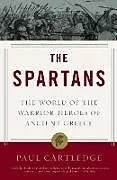
The Spartans
Beschreibung
Zusatztext Cartledge displays a marvelous ability to make the readers care about the Laconic warriors . . . and the society that shaped them. USA Today Cartledge brings [the Spartans] to life again with verve [and] style. Milwaukee Journal-Sentinel The history...Format auswählen
- Poche format BCHF 21.10
Wird oft zusammen gekauft
Andere Kunden kauften auch
Beschreibung
Zusatztext Cartledge displays a marvelous ability to make the readers care about the Laconic warriors . . . and the society that shaped them. USA Today Cartledge brings [the Spartans] to life again with verve [and] style. Milwaukee Journal-Sentinel The history and atmosphere of Sparta are well conveyed by Cartledge. The New York Review of Books A fine overview of the rise and fall of a singular culture! spiced with anecdotes! quotations! brisk summary! and real insight. Seattle Times The Spartans presented in this book could change the popular image of ancient history! making it more compelling and accessible. The Times Literary Supplement Informationen zum Autor Paul Cartledge Klappentext A compelling narrative exploring the culture and civilization of the most famous "warrior people": the Spartans of ancient Greece! told by the world's leading expert. The narrative also details the lives of such illustrious and mythmaking figures as Lycurgus! King Leonidas! Helen of Troy (and Sparta)! and Lysander. Illustrations. Maps. Chapter 1 UNDER THE SIGN OF LYCURGUS The image of Sparta as a dour, barracks-like camp hardly prepares the first-time visitor for the glorious spectacle that unfolds as one emerges from the uplands abutting Arcadia to the north and enters down the Eurotas valley into the Spartan plain. Stretching before one are two parallel mountain chains, that of Taygetus on the west reaching to 2,404 metres at the peak, and that of Parnon on the east (1,935 metres at its peak). The alluvial plain itself, and its continuation south in the Eurotas valley that runs out into the sea in the Laconian Gulf, constitute one of the most fertile and desirable pieces of land in all southern Greece. Soil, climate and man conspire to yield and garner sometimes two harvests of grain in a single year. Olives and grapevines, the other two staples of the so-called Mediterranean diet, flourish here too - as of course does the forest of citrus trees, but they are a post-Classical import, reminding us that the terrain and vegetation we see today are not necessarily those enjoyed by the inhabitants of two and a half millennia ago. Hardly surprisingly, this region, known in historical times as Lacedaemon, was believed also to have been the seat of a great king in the ancient Greeks' heroic age - what we scholars more prosaically call the Mycenaean or Late Bronze Age ( c. 1500-1100 BC). An attempt has been made very recently (see biography of Helen p. 48) to relocate the palace of Homer's Menelaus from Sparta to Pellana further north in Laconia, but that flies in the face not only of ancient legend and religious worship but also of topographical geopolitics. Any real Late Bronze Age Menelaus must have had his palace in or near the site of historical Sparta - perhaps actually where a large settlement, including a building qualifying as a 'mansion', has been scrupulously excavated by the British School at Athens. However, no contemporary palace on the scale of those excavated at Mycenae (seat of Homer's Agamemnon, brother of Menelaus) and Pylos (capital of garrulous old Nestor) has yet come to light in Laconia - and perhaps never will. It is important not to read Homer as a straight history textbook, however archaeologically productive that mistake has undoubtedly been. HELEN Helen of Troy - or Helen of Sparta? She was, of course, both. A local girl, daughter of Tyndareus, according to one version of her myth, but yet, according to another version, daughter of great father Zeus and born miraculously from an egg because her mother Leda had been visited by Zeus in the disguise of a swan. Her unsurpassed beauty made her a natural prize for the ambitious Menelaus, son of Atreus of Mycenae, whose older son Agamemnon took He...
Autorentext
Paul Cartledge
Klappentext
A compelling narrative exploring the culture and civilization of the most famous "warrior people": the Spartans of ancient Greece, told by the world's leading expert. The narrative also details the lives of such illustrious and mythmaking figures as Lycurgus, King Leonidas, Helen of Troy (and Sparta), and Lysander. Illustrations. Maps.
Zusammenfassung
The Spartans were a society of warrior-heroes who were the living exemplars of such core values as duty, discipline, self-sacrifice, and extreme toughness. This book, written by one of the world’s leading experts on Sparta, traces the rise and fall of Spartan society and explores the tremendous influence the Spartans had on their world and even on ours. Paul Cartledge brings to life figures like legendary founding father Lycurgus and King Leonidas, who embodied the heroism so closely identified with this unique culture, and he shows how Spartan women enjoyed an unusually dominant and powerful role in this hyper-masculine society. Based firmly on original sources, The Spartans is the definitive book about one of the most fascinating cultures of ancient Greece.
Leseprobe
**Chapter 1
UNDER THE SIGN OF LYCURGUS**
The image of Sparta as a dour, barracks-like camp hardly prepares the first-time visitor for the glorious spectacle that unfolds as one emerges from the uplands abutting Arcadia to the north and enters down the Eurotas valley into the Spartan plain. Stretching before one are two parallel mountain chains, that of Taygetus on the west reaching to 2,404 metres at the peak, and that of Parnon on the east (1,935 metres at its peak). The alluvial plain itself, and its continuation south in the Eurotas valley that runs out into the sea in the Laconian Gulf, constitute one of the most fertile and desirable pieces of land in all southern Greece. Soil, climate and man conspire to yield and garner sometimes two harvests of grain in a single year. Olives and grapevines, the other two staples of the so-called Mediterranean diet, flourish here too - as of course does the forest of citrus trees, but they are a post-Classical import, reminding us that the terrain and vegetation we see today are not necessarily those enjoyed by the inhabitants of two and a half millennia ago.
Hardly surprisingly, this region, known in historical times as Lacedaemon, was believed also to have been the seat of a great king in the ancient Greeks' heroic age - what we scholars more prosaically call the Mycenaean or Late Bronze Age (c. 1500-1100 BC). An attempt has been made very recently (see biography of Helen p. 48) to relocate the palace of Homer's Menelaus from Sparta to Pellana further north in Laconia, but that flies in the face not only of ancient legend and religious worship but also of topographical geopolitics. Any real Late Bronze Age Menelaus must have had his palace in or near the site of historical Sparta - perhaps actually where a large settlement, including a building qualifying as a 'mansion', has been scrupulously excavated by the British School at Athens. However, no contemporary palace on the scale of those excavated at Mycenae (seat of Homer's Agamemnon, brother of Menelaus) and Pylos (capital of garrulous old Nestor) has yet come to light in Laconia - and perhaps never will. It is important not to read Homer as a straight history textbook, however archaeologically productive that mistake has undoubtedly been.
HELEN
Helen of Troy - or Helen of Sparta? She was, of course, both. A local girl, daughter of Tyndareus, according to one version of her myth, but yet, according to another version, daughter of great father Zeus and born miraculously from an egg because her mother Leda had been visited by Zeus in the disguise of a swan. Her unsurpassed beauty made her a natural prize for the ambitious Menelaus, son of Atreus of Mycenae, whose older son Agamemnon took Helen's sister Clytemnestra for his bride. However, that beauty also captivated an unwelcome visitor to Sparta: Paris, prince of Troy in Asia, overlooking the straits of the Dardanelles, who - aided crucially by the Cyprus-born love goddes…