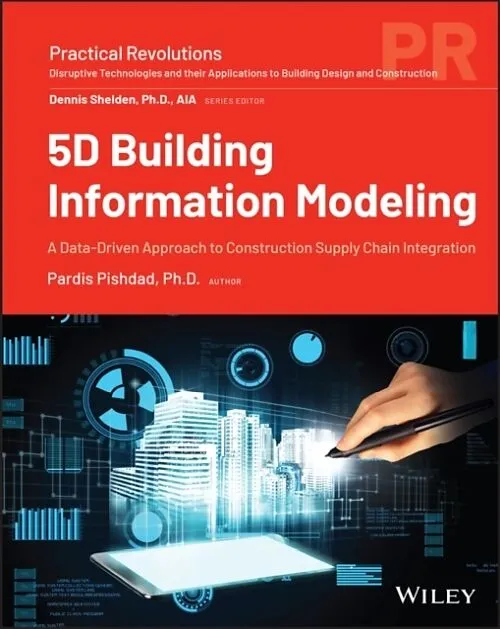
5D Building Information Modeling
Beschreibung
Autorentext Pardis Pishdad, PhD, is a Professor at Georgia Tech, in the College of Design, School of Building Construction, and a globally recognized scholar in Integrated Project Delivery (IPD), collaboration and trust-building, Building Information Modeling ...Format auswählen
- Kartonierter EinbandCHF 61.60

Wird oft zusammen gekauft
Andere Kunden kauften auch
Beschreibung
Autorentext
Pardis Pishdad, PhD, is a Professor at Georgia Tech, in the College of Design, School of Building Construction, and a globally recognized scholar in Integrated Project Delivery (IPD), collaboration and trust-building, Building Information Modeling (BIM), and technological integration.
Dr. Pishdad is the founder and director of the Smart Built-Environment Ecosystem (Smart BEES) Lab, which conducts research at the intersection of cyber, physical, and behavioral systems. Her work focuses on integrating data, processes, and stakeholders across the project life cycle to improve efficiency and enable the sustainable design, construction, and operation of smart built environments. Her scholarly publications examine ways to enhance productivity through integration, digitalization, industrialization, and automation.
Dr. Pishdad holds a PhD in Environmental Design and Planning from Virginia Tech and master's degrees in civil engineering (Virginia Tech), design studies with a focus on project management (Harvard University), and architecture (University of Tehran).
Series Editor Dennis Shelden, PhD, is an expert in the application of digital technology to building design, construction, and operations. He is a Director of CASE and an Associate Professor in the School of Architecture at Rensselaer.
Klappentext
A roadmap to 5D+ BIM implementation with a focus on real-world use cases 5D Building Information Modeling: Data-Driven Construction Supply Chain Integration is a valuable guide for architectural, engineering, and construction professionals seeking to learn how to implement this technology to optimize work efficiency. Beginning with a brief introduction to BIM and its history, the book highlights the unleveraged power of 5D+ in ameliorating the inefficiencies associated with fragmented construction supply chains. It covers the benefits of applying data-driven BIM to integrate supply chains and illustrates how the integration of 5D+ BIM serves as a technology, set of processes, and standardized classification system that streamlines the flows of information, material, and money.
- A thorough introduction to building information modeling with defined business value propositions
- Comprehensive case studies of 5D+ implementation and demonstrations of how structured data and standard practices can help increase efficiency
- A detailed roadmap and framework for BIM, including technology, standards, workflow processes, and contracts
- Complete treatments of emerging technologies and practices poised to transform construction supply chain management Intended for architects, engineers, contractors, owners, facility managers, suppliers, manufacturers, and consultants, 5D+ Building Information Modeling will also benefit academics, undergraduate and graduate students studying related fields.
Inhalt
CHAPTER 1: INTRODUCTION 9
1.1 Overview, Purpose, and Structure of the Book 9
Guiding Questions 10
1.2 Construction Industry and Its Current State of Inefficiency 10
1.3 Productivity Booster and Opportunities for Improvement 11
1.4 Significant Role of Construction Supply Chain Integration in Construction Productivity 12
1.5 Role of BIM in Enhancing Supply Chain Integration and Boosting Productivity 13
1.6 Construction Supply Chain Integration (CSCI) 14
1.7 Main Research Areas of Construction Supply Chain Integration 16
1.7.1 Adoption of Manufacturing Theories 16
1.7.2 Benefits of Construction Supply Chain Integration 16
1.7.3 Successful implementation 16
1.7.4 Digitization and utilization of Information and Communications Technology 16
1.7.5 Contract and relationship governance 17
1.7.6 Sustainability 17
1.8 Discussion and Conclusion 17
CHAPTER 2: BACKGROUND OF CONSTRUCTION SUPPLY CHAIN MANAGEMENT, PROBLEMS, AND FRAMEWORK OF POTENTIAL SOLUTIONS 19
Guiding Questions 19
2.1 Construction Supply Chain Management: Definition and Significance 19
2.1.1 Definition of Construction Supply Chain Management 19
2.1.2 Significance 19
2.2 Construction Supply Chain Issues: Broken Supply Chain of Data, Products, and Money 20
2.2.1 Lack of Accessibility to Data 20
2.2.2 Lack of Traceability of Products in the Supply Chain 20
2.2.3 Dis-connectivity of Payment Application & the Single Source of Truth 20
2.3 Solution for Seamless Flow of Data, Products, and Money 21
2.3.1 Flows in the Construction Supply Chain 21
2.3.2 Achieving Seamless Data Flow 22
2.3.3 Achieving Seamless Product Flow 48
2.3.4 Achieving Seamless Money Flow 50
2.3.5. Achieving Construction Supply Chain Integration 51
2.4 BIM Addressing Supply Chain Challenges 52
2.4.1 Definition of BIM 52
2.4.2 State of BIM Adoption 53
2.5 Future Vision: A Framework for Integrated Supply Chain Empowered by Emerging Technologies, like Blockchain, IoT, GIS 54
2.5.1 Learning from Other Industries: Models for Integration 54
2.5.2 Why BIM Matters in the Supply Chain 55
2.5.3 The Evolving Role of the CM/GC: From Coordinator to Data Merchant 55
2.5.4 BIM Implementation Maturity: From Chaos to Civilization 55
2.5.5 Asset Tracking, Naming Conventions, and Systematic Templates 55
2.5.6 A Cultural Shift Driven by Value 55
2.5.7 What Gets Measured Gets Managed: Feedback and Continuous Improvement 55
2.5.8 What Gets Measured Gets Managed: Performance Feedback and Learning 56
2.5.9 Program Validation and Budget-Driven Design: A Lifecycle Approach 56
2.6 Discussion and Conclusion 57
CHAPTER 3: 5D BIM CURRENT STATE OF ART AND PRACTICE 59
Guiding Questions 59
3.1 Applicable Industry Standards for 5D BIM 59
3.1.1. Industry Foundation Classes (IFC) 61
3.1.2. Level of Development (LOD) 62
3.1.3. The buildingSMART Data Dictionary (bsDD) 62
3.1.4. Information Delivery Manual (IDM) 62
3.1.5. Model View Definitions (MVD) 63
3.1.6. Rules of Measurement 63
3.1.7. Classification Systems 64
3.2 Key Resources and Collaborative Implementation 66
3.2.1. BIM Costing Library 66
3.2.2. BIM Object Library 66
3.2.3. 5D BIM Collaborative Implementation 66
3.3 Integrated Benefits of 5D BIM 67
3.4 5D BIM State of the Practice: Study of Three 5D BIM Tools 68
3.4.1. RIB iTWO/ MTWO 68
3.4.2. Destini Profiler 70
3.4.3. Vico Office 71
3.4.4. Synthesis of Common Practices vs. Case Studies 73
3.5 Pathways to Full Automation in 5D BIM 74
3.6 Discussion and Conclusion 75
CHAPTER 4: LIFE CYCLE IMPLEMENTATION OF 5D BUILDING INFORMATION MODELING 76
Guiding Questions 76
4.1 Introduction 76
4.2 5D BIM cost estimation during preconstruction 76
4.2.1 Detailed cost estimation and bill of quantities 77
4.2.2 5D BIM cost control during construction and manufacturing 77
4.2.3 5D BIM as-built cost data recording postconstruction 77
4.3 Implementation guidelines for 5D BIM 78
4.3.1 5D BIM implementation in the United States 78
4.3.2 5D BIM implementation in the United Kingdom (UK) 79
4.4 Data collection methodology 80
4.5 Case Studies 81
4.6 Case Study 1 82
4.6.1 Cost Estimating 82
4.6.2 Cost data 83
4.6.3 Mechanisms for quality Control 84
4.6.4 Multidisciplinary model 84
4.6.5 Cloud-based software/ Collaboration with Stakeholders 84
4.6.6 Guidelines for implementation of 5D BIM 84
4.6.7 Cost control during design and construction 85
4.6.8 Interoperability of Pay applications 85
4.6.9 Challenges Encountered in 5D practice 86
4.7 Case Study 2 87
4.7.1 Cost estimation 88
4.7.2 Cost data 88
4.7.3 Mechanisms for quality Control 88
4.7.4 Multidisciplinary model 88
4.7.5 Cloud-based software/ Collaboration with stakeholders 89
4.7.6 Guidelines for implementation of 5D BIM 89
4.7.7 Cost control during design and construction 89
4.7.8 Interoperability of pay applications 90
4.7.9 Challenges Encountered in 5D practice 90
4.8 Case Study 3 91
4.8.1 Cost estimation during conceptual design 92
4.8.2 Cost data 92
4.8.…