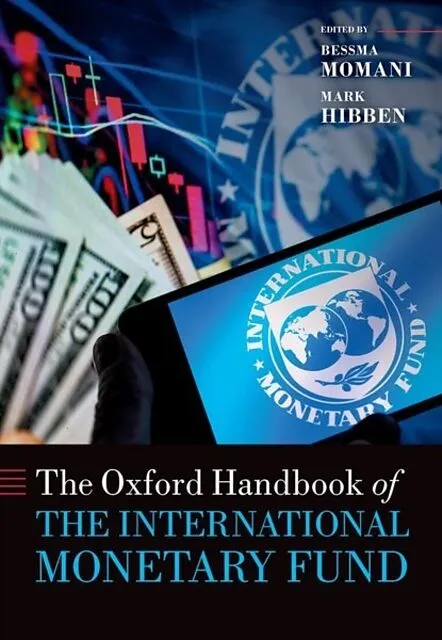
Oxford Handbook of the International Monetary Fund
Beschreibung
Autorentext Dr. Bessma Momani is Associate Vice-President, International and Full Professor in the Department of Political Science at the University of Waterloo. She is a senior fellow at the Centre for International Governance Innovation, a Fulbright Scholar,...Format auswählen
- Fester EinbandCHF 224.80

Wird oft zusammen gekauft
Andere Kunden kauften auch
Beschreibung
Autorentext
Dr. Bessma Momani is Associate Vice-President, International and Full Professor in the Department of Political Science at the University of Waterloo. She is a senior fellow at the Centre for International Governance Innovation, a Fulbright Scholar, a Governor on the board of the International Development Research Centre, and a member of the advisory board of the Canadian International Council. She has worked as a consultant to the International Monetary Fund, both in the communications office and the Independent Evaluation Office, and to Global Affairs Canada (GAC) as a 2021 Visiting Scholar in its International Assistance Research and Knowledge Division. Dr. Mark Hibben is Associate Professor of Political Science at Saint Joseph's College of Maine. His research interests include the politics of development, with a specific focus on the International Monetary Fund and World Bank. Book publications include the co-authored (with Bessma Momani) What is Wrong with the IMF and How to Fix It (Polity) and Poor States Power, and the Politics of IMF Reform: Drivers of Change in the Post-Washington Consensus (Palgrave Macmillan). His work is also published in The Review of International Organizations, Journal of International Organizational Studies, and The Journal of International Relations and Development.
Klappentext
This handbook aims to uncover the challenges faced by the International Monetry Fund by providing diverse perspectives and proposing policy recommendations that the Fund could undertake to better navigate the complex landscape of 21st-century global governance.
Inhalt
Part I: History
1: Atish R. Ghosh: The IMF: Origins, the Bretton Woods System, and Five Major Debates
2: James M. Boughton: The IMF In The Post-Bretton Woods Era (1973-Present)
Part Ii: Formal Operations
3: Susanne Lütz: IMF Lending
4: Martin S. Edwards: IMF Surveillance: Mapping an Unfinished Journey
5: Jung Yeon Kim: IMF Capacity Development
Part III: Actors
6: Lisa Martin: States
7: Randall Stone: Markets and Financiers
8: John Abraham: Epistemic Communities and IMF Policy
9: Nadia Daar: Transforming IMF-Civil Society Relations
Part IV: IGO Partners
10: Matthias Kranke: Building Partnerships: The IMF and other International Organizations
11: Liam Clegg: The IMF and World Bank: Exploring the Limits of Institutional Collaboration
12: Stephen G. Cecchetti: Collaboration in Financial Regulatory Reform: The IMF, the Financial Stability Board, and the Standard Setting Bodies
Part V: Ideas And Policy Instruments
13: Ali Burak Güven: What has Replaced the Washington Consensus? Tracing Policy Change in the IMF
14: Michael Breen: The IMF, Financial Regulation, and Capital Controls
15: Ayse Kaya: How Much Does the IMF Care About Inequality? Dynamics of Fragmented Institutional Change and Mission-Consistent Adaptation
16: Cornel Ban: From Volcker to Volcker: IMF Monetary Policy Doctrine and Practice
17: Ben Clift: IMF Fiscal Policy: Reconciling New Challenges to Existing Priorities
Part VI: Broadening Macro-Critical Concerns
18: Rishi Goyal And Ratna Sahay: Getting Serious About Mainstreaming Gender at the IMF
19: Prakash Loungani, Hites Ahir And Akos Mate: The IMF's Work on Labor Markets
21: Rishikesh Ram Bhandary And Keven P. Gallagher: Advancing Climate Policy at the IMF
22: Kevin Farnsworth And Zoë Irving: Inclusive Growth: What Role for Social Policy in IMF Discourse?
23: Rhoda Weeks-Brown: Anti-Corruption Work at the IMF:At the Cross-Roads.
Part VII: Internal Challenges
24: Kathryn C. Lavelle: The United States and the IMF: An Evolving Relationship
25: Bessma Momani: Diversifying the IMF and its Culture
26: Mark Hibben: IMF Uniformity of Treatment: In Name Only?
27: Te-Anne Robles: Navigating Risk and Uncertainty within the IMF Technocratic Trap
Part VIII: External Headwinds
28: Richard Clark: The Populist Challenge
29: Anton Malkin And Lisha Wang: Reluctant Revisionism: The IMF as a Ballast in China's Global Financial Diplomacy
30: Merih Angin And Saliha Metinsoy: Europe Unresolved
31: Aldo Caliari: Debt Concerns of Low-Income and Emerging Market Countries
32: Paul White: Global Market Integration, Crisis Management and the Limits of the Macro-Social Turn
Part IX: The Imf And 21st Century Global Governance
33: Christian Kennedy-Hernandez: An IMF for the Global South
34: Ceyla Pazarbasioglu And Neil Meads: IMF Crisis Management: Lessons from the GFC and the Pandemic
35: Augosto Lopez-Claros: Strengthening the IMF for the 21st Century
36: Eugenia C. Heldt And Orfeo Fioretos: The IMF and the Future of the Liberal International Order