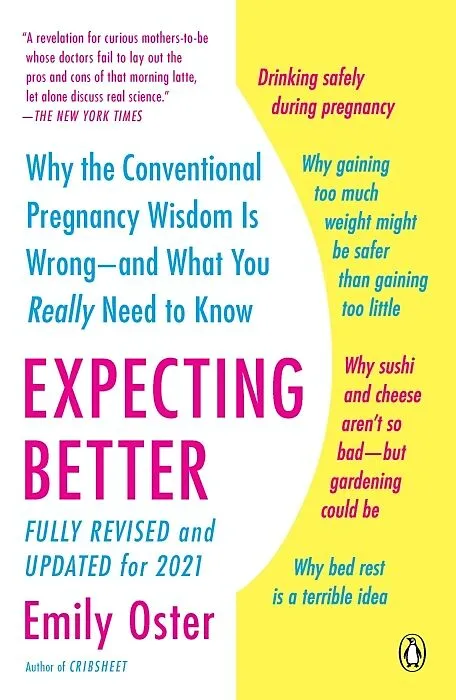
Expecting Better
Beschreibung
Newly Revised for 2019 What to Expect When You're Expecting meets Freakonomics : an award-winning economist disproves standard recommendations about pregnancy to empower women while they're expecting. From the author of Cribsheet , a data-driven decision makin...Format auswählen
- Kartonierter EinbandCHF 19.50

Wird oft zusammen gekauft
Andere Kunden kauften auch
Beschreibung
Newly Revised for 2019 What to Expect When You're Expecting meets Freakonomics : an award-winning economist disproves standard recommendations about pregnancy to empower women while they're expecting. From the author of Cribsheet , a data-driven decision making guide to the early years of parenting Pregnancy--unquestionably one of the most profound, meaningful experiences of adulthood--can reduce otherwise intelligent women to, well, babies. Pregnant women are told to avoid cold cuts, sushi, alcohol, and coffee without ever being told why these are forbidden. Rules for prenatal testing are similarly unexplained. Moms-to-be desperately want a resource that empowers them to make their own right choices. When award-winning economist Emily Oster was a mom-to-be herself, she evaluated the data behind the accepted rules of pregnancy, and discovered that most are often misguided and some are just flat-out wrong. Debunking myths and explaining everything from the real effects of caffeine to the surprising dangers of gardening, Expecting Better is the book for every pregnant woman who wants to enjoy a healthy and relaxed pregnancy--and the occasional glass of wine.
“A revelation for curious mothers-to-be whose doctors fail to lay out the pros and cons of that morning latte, let alone discuss real science. And it makes for valuable homework before those harried ob-gyn appointments, even for lucky patients whose doctors are able to talk about the rationale behind their advice.” —New York Times
“A book . . . that pregnant women won't want to miss.” —Parents Magazine
“Emily Oster is the non-judgmental girlfriend holding our hand and guiding us through pregnancy and motherhood. She has done the work to get us the hard facts in a soft, understandable way.” ****—Amy Schumer
“Oster's advice cuts through the emotion, myth, fear of malpractice litigation and looks at the numbers. A mother herself, Oster's interest isn't just curiosity, it's the same thing that motivates every new mom . . . and Oster's ability to break down the data into informed analysis is a refreshing break from the hysterical hearsay that often dominates the conversation.” —Babyzone
“Gives moms-to-be a big helping of peace of mind!” —Harvey Karp M.D., bestselling author of The Happiest Baby on the Block
“It took someone as smart as Emily Oster to make it all this simple. She cuts through the thicket of anxiety and received wisdom, and gives us the facts. Expecting Better is both enlightening and calming. It almost makes me want to get pregnant.” —Pamela Druckerman, New York Times bestselling author of Bringing Up Bébé
Autorentext
Emily Oster is a professor of economics at Brown University and the author of Expecting Better, Cribsheet, The Family Firm, and The Unexpected. She writes the newsletter ParentData and her work has been featured in The New York Times, The Wall Street Journal, The Washington Post, The Atlantic, and Bloomberg.com. She has two children.
Klappentext
****Fully revised and updated for 2025, from the bestselling author of Cribsheet, The Family Firm, and The Unexpected
“A revelation for curious mothers-to-be whose doctors fail to lay out the pros and cons of that morning latte, let alone discuss real science.” —The New York Times
“Emily Oster is the non-judgmental girlfriend holding our hand and guiding us through pregnancy and motherhood. She has done the work to get us the hard facts in a soft, understandable way.” —Amy Schumer
The award-winning economist named one of TIME Magazine’s 100 most influential people disproves standard recommendations about pregnancy to empower women while they're expecting.
Pregnancy—unquestionably one of the most profound, meaningful experiences of adulthood—can reduce otherwise intelligent women to, well, babies. Pregnant women are told to avoid cold cuts, sushi, alcohol, and coffee without ever being told why these are forbidden. Rules for prenatal testing are similarly unexplained. Parents-to-be desperately want a resource that empowers them to make their own right choices.
When award-winning economist Emily Oster was a mom-to-be herself, she evaluated the data behind the accepted rules of pregnancy, and discovered that most are often misguided and some are just flat-out wrong. Debunking myths and explaining everything from the real effects of caffeine to the surprising dangers of gardening, Expecting Better is the book for every pregnant woman who wants to enjoy a healthy and relaxed pregnancy—and the occasional glass of wine.
Leseprobe
Introduction
In the fall of 2009 my husband, Jesse, and I decided to have a baby. We were both economics professors at the University of Chicago. We’d been together since my junior year of college, and married almost five years. Jesse was close to getting tenure, and my work was going pretty well. My thirtieth birthday was around the corner.
We’d always talked about having a family, and the discussion got steadily more serious. One morning in October we took a long run together and, finally, decided we were ready. Or, at the very least, we probably were not going to get any more ready. It took a bit of time, but about eighteen months later our daughter, Penelope, arrived.
I’d always worried that being pregnant would affect my work—people tell all kinds of stories about “pregnancy brain,” and missing weeks (or months!) of work for morning sickness. As it happens, I was lucky and it didn’t seem to make much difference (actually having the baby was another story).
But what I didn’t expect at all is how much I would put the tools of my job as an economist to use during my pregnancy. This may seem odd. Despite the occasional use of “Dr.” in front of my name, I am not, in fact, a real doctor, let alone an obstetrician. If you have a traditional view of economics, you’re probably thinking of Ben Bernanke making Fed policy, or the guys creating financial derivatives at Goldman Sachs. You would not go to Alan Greenspan for pregnancy advice.
But here is the thing: the tools of economics turn out to be enormously useful in evaluating the quality of information in any situation. Economists’ core decision-making principles are applicable everywhere. Everywhere. And that includes the womb.
When I got pregnant, I pretty quickly learned that there is a lot of information out there about pregnancy, and a lot of recommendations. But neither the information nor the recommendations were all good. The information was of varying quality, and the recommendations were often contradictory and occasionally infuriating. In the end, in an effort to get to the good information—to really figure out the truth—and to make the right decisions, I tackled the problem as I would any other, with economics.
At the University of Chicago I teach introductory microeconomics to first-year MBA students. My students would probably tell you the point of the class is to torture them with calculus. In fact, I have a slightly more lofty goal. I want to teach them decision making. Ultimately, this is what microeconomics is: decision science—a way to structure your thinking so you make good choices.
I try to teach them that making good decisions—in business, and in life—requires two things. First, they need all the information about the decision—they need the right data. Second, they need to think about the right way to weigh the pluses and minuses of the decision (in class we call this costs and benefits) for them personally. The key is that even with the same data, th…