
IHR WARENKORB IST AKTUELL LEER.
Haben Sie noch nichts passendes gefunden? Stöbern Sie durch unser komplettes Sortiment.
Oder melden Sie sich an bzw. registrieren Sie sich.
- Kostenlose Lieferung
- Kauf auf Rechnung
- Ex Libris Tiefpreis
- Filiallieferung und 650+ Abholorte
- Rabatt-Bons als Club-Mitglied
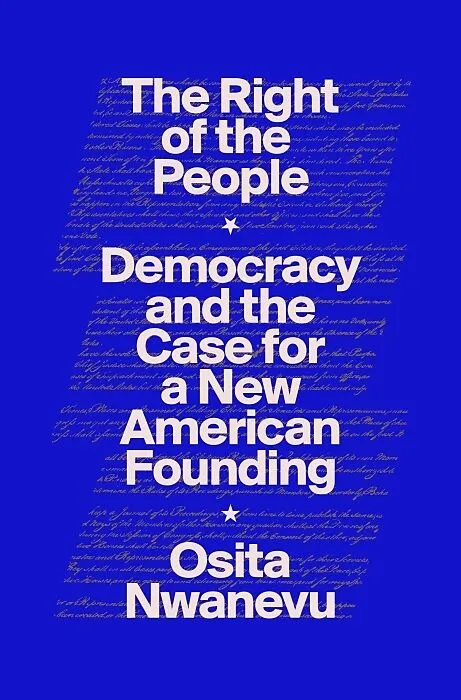
The Right of the People
Beschreibung
An upcoming book to be published by Penguin Random House. Autorentext Osita Nwanevu Klappentext NATIONAL BESTSELLER • A bold case for reimagining the American project and making American democracy real—from a formidable new voice in political journa...Format auswählen
- Livre ReliéCHF 31.10

Wird oft zusammen gekauft
Andere Kunden kauften auch
Beschreibung
An upcoming book to be published by Penguin Random House.
Autorentext
Osita Nwanevu
Klappentext
NATIONAL BESTSELLER • A bold case for reimagining the American project and making American democracy real—from a formidable new voice in political journalism
“The first thing I’ve read that provides a rigorous vision of how to refound this nation if we manage to survive the current threats to these core values.”—Chris Hayes, #1 New York Times bestselling author of The Sirens’ Call
Frustrated with our political dysfunction, wearied by the thinness of contemporary political discourse, and troubled by the rise of anti-democratic attitudes across the political spectrum, journalist Osita Nwanevu has spent the Trump era examining the very meaning of democracy in search of answers to questions many have asked in the wake of the 2024 election: Are our institutions fundamentally broken? How can a country so divided govern itself? Does democracy even work as well as we believe?
The Right of the People offers us challenging answers: while democracy remains vital, American democracy is an illusion we must make real by transforming not only our political institutions but the American economy. In a text that spans democratic theory, the American Founding, our aging political system, and the dizzying inequalities of our new Gilded Age, Nwanevu makes a visionary case for a political and economic agenda to fulfill the promise of American democracy and revive faith in the American project.
“Nearly two hundred fifty years ago, the men who founded America made a fundamental break not just from their old country but from the past—casting off an order that had subjugated them with worn and weak ideas for the promise of true self-governance and greater prosperity in a new republic,” Nwanevu writes. “With exactly their sense of purpose and even higher, more righteous ambitions for America than they themselves had, we should do the same now—work as hard as we can in the decades ahead to ‘institute new Government’ for the benefit of all and not just the few.”
Leseprobe
Chapter 1
The Meaning of Democracy
What is democracy, really? Let’s start with the basics, as most people understand them: A democracy is a form of government in which people come together every so often to decide, usually through elections, what should be done and who should do it. Elected officials—representatives, mayors, governors, presidents, whoever they may be—are then responsible for carrying out the will of the people. If they don’t—or if they do and the people change their minds about what they want—they get voted out and other candidates get voted in. All of this should happen freely and fairly—no one’s vote should be forced, and every vote should be counted equally by impartial authorities. And a framework of basic political freedoms should accompany and support the democratic process—people should have the right to speak openly about politics, to seek out information, and to organize themselves politically without undue interference.
This is an outline of democratic society that has long been intuitive to ordinary Americans and scholars of democracy alike. For instance, Robert Dahl, one of the twentieth century’s preeminent political scientists and democratic theorists, argued that democratic countries have six simple characteristics: empowered elected officials; “free, fair, and frequent” elections; free expression; access to diverse sources of information; the freedom of political association; and “inclusive citizenship,” by which he meant the granting of full political rights to all adult citizens. Today, Freedom House, an American nonprofit that studies and promotes democracy abroad, describes democratic government as a system “based on the will and consent of the governed, institutions that are accountable to all citizens, adherence to the rule of law, and respect for human rights.” Each year, it awards countries “democracy scores” that measure whether they have free and fair elections and how well they protect political rights and civil liberties.
Similarly, the Economist Intelligence Unit, which compiles an annual “Democracy Index,” says that democracy, at a minimum, means “government based on majority rule and the consent of the governed; the existence of free and fair elections; the protection of minority rights; and respect for basic human rights.” The Intelligence Unit ranks countries in its Index based on a slightly more complex set of factors than Freedom House’s—the health of a country’s electoral process and the state of its civil liberties are taken into account, but so are how well its government actually functions, how actively its citizens participate in politics, and the state of “political culture,” by which they mean whether citizens engage in the political process civilly and peaceably.
That’s a longer list of boxes to check off than we began with, but most Americans would probably consider the Index’s metrics reasonable. A government too dysfunctional to implement the policies people voted for wouldn’t be very democratic after all, and a political system in which hardly anyone ever voted—or in which elections could be regularly overturned by violence—would hardly be much of a democracy either. Still, as basic as the Index’s requirements might seem, only around 15 percent of the countries in the world today—containing only about 7 percent of the world’s population—are “full democracies” by its standards. (Congratulations to Canada, Germany, Japan, the United Kingdom, and their peers.) Around 28 percent of countries—with about 38 percent of the world’s population—are what the Index calls “flawed democracies,” a category that has included the United States since 2016. While our report card shows high marks for political participation, civil liberties, and even our electoral process—President Trump’s coup attempt evidently notwithstanding—gridlock, polarization, and new voting restrictions have been dragging us down lately.
The Index’s analysis of our current political situation is hard to argue with. But is it really fair to say American democracy is “flawed” overall? That depends on whether we buy the way the Index, and most of us, have chosen to define democracy in the first place.
Defining Democracy
As obvious as the norms underpinning electoral democracy might seem to us today, we should remember that the very concept of democracy was forged in societies with norms and political practices we’d find unrecognizable. Anthropologists believe early human bands of hunter-gatherers also made decisions by a kind of group consensus—albeit through processes led, surprise, surprise, by male elders. From there, the historical record suggests isolated pockets of proto-democratic governance sprang up just about everywhere humans settled—from the Middle East to the Americas. But the word democracy itself comes to us from Ancient Greek—demos meant the people, kratos meant power, and demokratia described the form of popular rule that probably governed about half of Greek city-states by the third century b.c.
Athens is the most famous of them. Historians believe democracy in Greece began with elections of a kind—there were city-states where leaders were voted in, but they ruled like kings. Then, in the sixth and fifth centuries b.c., political…