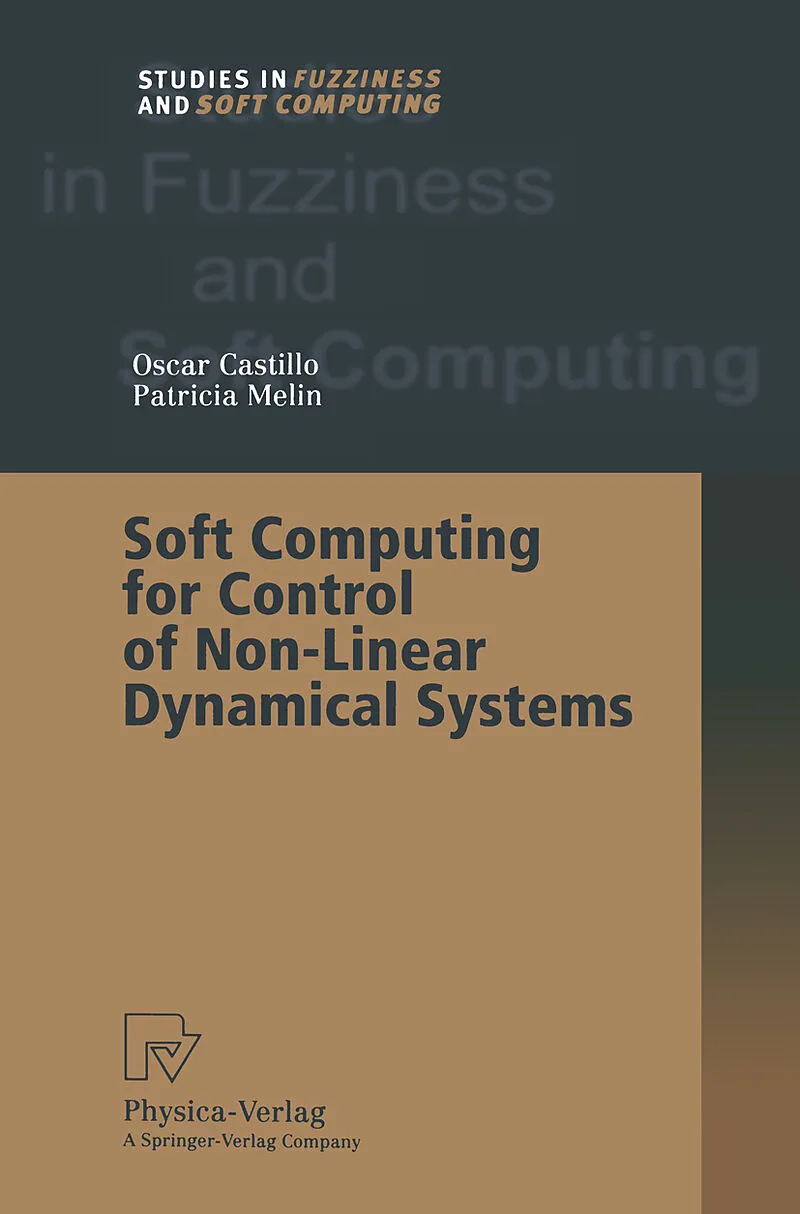
Soft Computing for Control of Non-Linear Dynamical Systems
Beschreibung
This book presents a unified view of modelling, simulation, and control of non linear dynamical systems using soft computing techniques and fractal theory. Our particular point of view is that modelling, simulation, and control are problems that cannot be cons...Format auswählen
- Kartonierter EinbandCHF 69.20
- Fester EinbandCHF 102.00

Wird oft zusammen gekauft
Andere Kunden kauften auch
Beschreibung
This book presents a unified view of modelling, simulation, and control of non linear dynamical systems using soft computing techniques and fractal theory. Our particular point of view is that modelling, simulation, and control are problems that cannot be considered apart, because they are intrinsically related in real world applications. Control of non-linear dynamical systems cannot be achieved if we don't have the appropriate model for the system. On the other hand, we know that complex non-linear dynamical systems can exhibit a wide range of dynamic behaviors ( ranging from simple periodic orbits to chaotic strange attractors), so the problem of simulation and behavior identification is a very important one. Also, we want to automate each of these tasks because in this way it is more easy to solve a particular problem. A real world problem may require that we use modelling, simulation, and control, to achieve the desired level of performance needed for the particular application.
Mathematical concepts are used in combination with soft computing techniques to realize robust and adaptive control of dynamical systems Presentation of the latest achievements in combining soft computing techniques and their applications
Autorentext
Patricia Melin holds the Doctor in Science degree (Doctor Habilitatus D.Sc.) in Computer Science from the Polish Academy of Sciences. She is a Professor of Computer Science in the Graduate Division, Tijuana Institute of Technology, Tijuana, Mexico, since 1998. In addition, she is serving as Director of Graduate Studies in Computer Science and head of the research group on Hybrid Neural Intelligent Systems (2000-present). She is past President of NAFIPS (North American Fuzzy Information Processing Society) 2019-2020. Prof. Melin is the founding Chair of the Mexican Chapter of the IEEE Computational Intelligence Society. She is member of the IEEE Neural Network Technical Committee (2007 to present), the IEEE Fuzzy System Technical Committee (2014 to present) and is Chair of the Task Force on Hybrid Intelligent Systems (2007 to present) and she is currently Associate Editor of the Journal of Information Sciences and IEEE Transactions on Fuzzy Systems. She is member of NAFIPS, IFSA, and IEEE. She belongs to the Mexican Research System with level III. Her research interests are in Modular Neural Networks, Type-2 Fuzzy Logic, Pattern Recognition, Fuzzy Control, Neuro-Fuzzy and Genetic-Fuzzy hybrid approaches. She has published over 300 journal papers, 20 authored books, 50 edited books, and more than 300 papers in conference proceedings, for a total of more than 800 publications with h-index of 86 in Google Scholar. She is Editor-in-Chief of the Advances in Fuzzy Systems journal (Wiley). She has served as Guest Editor of several Special Issues in the past, in journals like: Applied Soft Computing, Intelligent Systems, Information Sciences, Non-Linear Studies, JAMRIS, Fuzzy Sets and Systems. She has been recognized as Highly Cited Researcher in 2017 and 2018 by Clarivate Analytics because of having multiple highly cited papers in Web of Science. Martha Ram rez holds the B.S. in Computer Science, M.S. in Computer Science, and the Ph.D. in Computer Science from Tijuana Institute of Technology. Currently she works at Tecnologico Nacional de Mexico in Mexico City. Her current research interests include hybrid intelligent systems, neural networks and fuzzy systems. She has published more 10 papers in time series prediction, classification and clustering using supervised and unsupervised neural network models, in addition to type-1 and type-2 fuzzy logic for aggregation of responses in ensembles and modular neural networks. Oscar Castillo holds the Doctor in Science degree (Doctor Habilitatus) in Computer Science from the Polish Academy of Sciences (with the Dissertation "Soft Computing and Fractal Theory for Intelligent and Manufacturing"). He is a Professor of Computer Science in the Graduate Division, Tijuana Institute of Technology, Tijuana, Mexico. In addition, he is serving as Research Director of Computer Science and head of the research group on Hybrid Fuzzy Intelligent Systems. Currently, he is President of HAFSA (Hispanic American Fuzzy Systems Association) and Past President of IFSA (International Fuzzy Systems Association). Prof. Castillo is also Chair of the Mexican Chapter of the Computational Intelligence Society (IEEE). He is also a member of NAFIPS, IFSA and IEEE. He belongs to the Mexican Research System (SNI Level 3). His research interests are in Type-2 Fuzzy Logic, Fuzzy Control, Neuro-Fuzzy and Genetic-Fuzzy hybrid approaches. He has published over 300 journal papers, 20 authored books, 100 edited books, 300 papers in conference proceedings, and more than 300 chapters in edited books, in total more than 1180 publications (according to Scopus) with h index of 97 and more than 31000 citations according to Google Scholar. He has been Guest Editor of several successful Special Issues in the past, like in the following journals: Applied Soft Computing, Intelligent Systems, Information Sciences, Soft Computing, Non-Linear Studies, Fuzzy Sets and Systems, JAMRIS and Engineering Letters. He is currently Associate
Klappentext
The book describes the application of soft computing techniques to modelling, simulation and control of non-linear dynamical systems. Hybrid intelligence systems, which integrate different techniques and mathematical models, are also presented. The book covers the basics of fuzzy logic, neural networks, evolutionary computation, chaos and fractal theory. It also presents in detail different hybrid architectures for developing intelligent control systems for applications in robotics, reactors, manufacturing, aircraft systems and economics.
Inhalt
1 Introduction to Control of Non-Linear Dynamical Systems.- 2 Fuzzy Logic.- 2.1 Fuzzy Set Theory.- 2.2 Fuzzy Reasoning.- 2.3 Fuzzy Inference Systems.- 2.4 Type-2 Fuzzy Logic Systems.- 2.5 Fuzzy Modelling.- 2.6 Summary.- 3 Neural Networks for Control.- 3.1 Backpropagation for Feedforward Networks.- 3.2 Adaptive Neuro-Fuzzy Inference Systems.- 3.3 Neuro-Fuzzy Control.- 3.4 Adaptive Model-Based Neuro-Control.- 3.5 Summary.- 4 Genetic Algorithms and Simulated Annealing.- 4.1 Genetic Algorithms.- 4.2 Simulated Annealing.- 4.3 Applications of Genetic Algorithms.- 4.4 Summary.- 5 Dynamical Systems Theory.- 5.1 Basic Concepts of Dynamical Systems.- 5.2 Controlling Chaos.- 5.3 Summary.- 6 Hybrid Intelligent Systems for Time Series Prediction.- 6.1 Problem of Time Series Prediction.- 6.2 Fractal Dimesion of an Object.- 6.3 Fuzzy Logic for Object Classification.- 6.4 Fuzzy Estimation of the Fractal Dimension.- 6.5 Fuzzy Fractal Approach for Time Series Analysis and Prediction.- 6.6 Neural Network Approach for Time Series Prediction.- 6.7 Fuzzy Fractal Approach for Pattern Recognition.- 6.8 Summary.- 7 Modelling Complex Dynamical Systems with a Fuzzy Inference System for Differential Equations.- 7.1 The Problem of Modelling Complex Dynamical Systems.- 7.2 Modelling Complex Dynamical Systems with the New Fuzzy Inference System.- 7.3 Modelling Robotic Dynamic Systems with the New Fuzzy Interence System.- 7.4 Modelling Aircraft Dynamic Systems with the New Fuzzy Inference System.- 7.5 Summary.- 8 A New Theory of Fuzzy Chaos for Simulation of Non-Linear Dynamical Systems.- 8.1 Problem Description.- 8.2 Towards a New Theory of Fuzzy Chaos.- 8.3 Fuzzy Chaos for Behavior Identification in the Simulation of Dynamical Systems.- 8.4 Simulation of Dynamical Systems.- 8.5 Method for AutomatedParameter Selection Using Genetic Algorithms.- 8.6 Method for Dynamic Behavior Identification Using Fuzzy Logic.- 8.7 Simulation Results for Robotic Systems.- 8.8 Summary.- 9 Intelligent Control of Robotic Dynamic Systems.- 9.1 Problem Description.- 9.2 Mathematical Modelling of Robotic Dynamic Systems.- 9.3 Method for Adaptive Model-Based Control.- 9.4 Ad…


