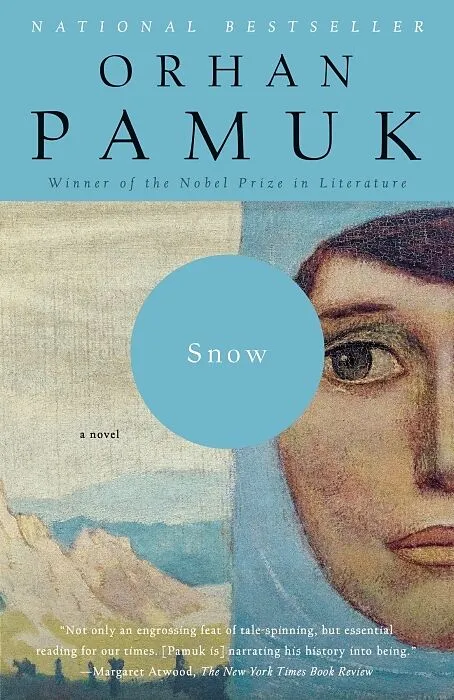
Snow
Beschreibung
Zusatztext Not only an engrossing feat of tale-spinning, but essential reading for our times. [Pamuk is] narrating his country into being. Margaret Atwood, The New York Times Book Review A great and almost irresistibly beguiling . . . novelist. . . . [ Snow is...Format auswählen
- Kartonierter EinbandCHF 19.75

Wird oft zusammen gekauft
Andere Kunden kauften auch
Beschreibung
Zusatztext Not only an engrossing feat of tale-spinning, but essential reading for our times. [Pamuk is] narrating his country into being. Margaret Atwood, The New York Times Book Review A great and almost irresistibly beguiling . . . novelist. . . . [ Snow is] enriched by . . . mesmerizing mixes: cruelty and farce, poetry and violence, and a voice whose timbres range from a storyteller's playfulness to the dark torment of an explorer, lost. The New York Times A major work . . . conscience-ridden and carefully wrought, tonic in its scope, candor, and humor . . . . with suspense at every dimpled vortex . . . . Pamuk [is Turkey's] most likely candidate for the Nobel Prize." John Updike, The New Yorker From the Golden Horn, with a wicked grin, the political novel makes a triumphant return. Harper's Powerful . . . Astonishingly timely . . . A deft melding of political intrigue and philosophy, romance and noir . . . [Snow] is forever confounding our expectations. Vogue A novel of profound relevance to the present moment. [The] debate between the forces of secularism and those of religious fanaticism . . . is conducted with subtle, painful insight into the human weakness that can underlie both impulses. The Times (London) A work of art a lternating between the snowstorm's hush and philosophical conversations reminiscent of Dostoyevsky's great novels, Snow proves a Étimely and gripping read. Minneapolis Star-Tribune Marvelous as quiet and transformative as a blizzard and as coldly beautiful. St. Petersburg Times In Snow , Pamuk uses his powers to show us the critical dilemmas of modern Turkey. How European a country is it? How can it respond to fundamentalist Islam? And how can an artist deal with these issues? ... The author's high artistry and fierce politics take our minds further into the age's crisis than any commentator could. Orhan Pamuk is the sort of writer for whom the Nobel Prize was invented. Daily Telegraph Part political thriller, part farce, Snow is [Pamuk's] most dazzling fiction yet. One of the top books of the year." Village Voice It comes as no surprise that political prescience should be yet another of the many gifts of Turkish novelist Orhan Pamuk. With Snow , Pamuk gives convincing proof that the solitary artist is a better bellwether than any televised think-tanker ... The work is a melancholy farce full of rabbit-out-of-a-hat plot twists that, despite the locale, looks uncannily like the magic lantern show of misfire, denial and pratfall that appears daily in our newspapers. Independent on Sunday Pure magic Snow is excellent. San Francisco Chronicle 'How much can we ever know about love and pain in another's heart? How much can we hope to understand those who have suffered deeper anguish, greater deprivation and more crushing disappointments than we ourselves have known?' Such questions haunt the poet Ka . . . [in] this novel, as much about love as it is about politics. The Observer Snow has already been a bestseller in Turkey - given Pamuk's stature as a novelist and the novel's content it could hardly fail to be. But what makes it a brilliant novel is its artistry. Pamuk keeps so many balls in the air that you cannot separate the inquiry into the nature of religious belief from the examination of modern Turkey, the investigation of East-West relations, and the nature of art itself ... All this rolled into a gripping political thriller. Spectator Brilliant Pamuk writes with such grace and deep respect for his conflicted characters that this rich novel passes like a dream, encompassing every aspect of love and belief. People Richly ...
Autorentext
Orhan Pamuk
Klappentext
Dread, yearning, identity, intrigue, the lethal chemistry between secular doubt and Islamic fanaticism-these are the elements that Orhan Pamuk anneals in this masterful, disquieting novel. An exiled poet named Ka returns to Turkey and travels to the forlorn city of Kars. His ostensible purpose is to report on a wave of suicides among religious girls forbidden to wear their head-scarves. But Ka is also drawn by his memories of the radiant Ipek, now recently divorced. Amid blanketing snowfall and universal suspicion, Ka finds himself pursued by figures ranging from Ipek's ex-husband to a charismatic terrorist. A lost gift returns with ecstatic suddenness. A theatrical evening climaxes in a massacre. And finding god may be the prelude to losing everything else. Touching, slyly comic, and humming with cerebral suspense, Snow is of immense relevance to our present moment.
Zusammenfassung
NATIONAL BESTSELLER • Touching, slyly comic, and humming with cerebral suspense—a masterful novel of "political intrigue and philosophy, romance and noir" (Vogue) and the lethal chemistry between secular doubt and Islamic fanaticism from the Nobel Prize winner.
An exiled poet named Ka returns to Turkey and travels to the forlorn city of Kars. His ostensible purpose is to report on a wave of suicides among religious girls forbidden to wear their head-scarves. But Ka is also drawn by his memories of the radiant Ipek, now recently divorced.
Amid blanketing snowfall and universal suspicion, Ka finds himself pursued by figures ranging from Ipek’s ex-husband to a charismatic terrorist. A lost gift returns with ecstatic suddenness. A theatrical evening climaxes in a massacre. And finding god may be the prelude to losing everything else.
Leseprobe
The silence of snow, thought the man sitting just behind the bus driver. If this were the beginning of a poem, he would have called the thing he felt inside him the silence of snow.
He’d boarded the bus from Erzurum to Kars with only seconds to spare. He’d just come into the station on a bus from Istanbul—a snowy, stormy, two-day journey—and was rushing up and down the dirty wet corridors with his bag in tow, looking for his connection, when someone told him the bus for Kars was leaving immediately.
He’d managed to find it, an ancient Magirus, but the conductor had just shut the luggage compartment and, being “in a hurry,” refused to open it again. That’s why our traveler had taken his bag on board with him; the big dark-red Bally valise was now wedged between his legs. He was sitting next to the window and wearing a thick charcoal coat he’d bought at a Frankfurt Kaufhof five years earlier. We should note straightaway that this soft, downy beauty of a coat would cause him shame and disquiet during the days he was to spend in Kars, while also furnishing a sense of security.
As soon as the bus set off, our traveler glued his eyes to the window next to him; perhaps hoping to see something new, he peered into the wretched little shops and bakeries and broken-down coffeehouses that lined the streets of Erzurum’s outlying suburbs, and as he did it began to snow. It was heavier and thicker than the snow he’d seen between Istanbul and Erzurum. If he hadn’t been so tired, if he’d paid a bit more attention to the snowflakes swirling out of the sky like feathers, he might have realized that he was traveling straight into a blizzard; he might have seen at the start that he was setting out on a journey that would change his life forever and chosen to turn back.
But the thought didn’t even cross his mind. As evening fell, he lost himself in the light still lingering in the sky above; in the snowflakes whirling ever more wildly in the wind he saw nothing of the impending blizzard but rather a promise, a sign pointing the way back to the happiness and purity he had known, once, as a child. Our traveler had spent his years of happiness and childhood in Istanbul; he’d returned a week ago, for the first time in twelve years, to attend his mother’s funeral, and having stayed there four days he decided to take this trip to Kars. Years later, he would still…