Beschreibung
Experiments showinga rapid and reversible change ofcolor s eem likemagic and are always fascinating. The process involved, photochromism, has a few real and many potential applications. Photochromic glasses thatdarken int he s unlight (protecting eyes from exc...Experiments showinga rapid and reversible change ofcolor s eem likemagic and are always fascinating. The process involved, photochromism, has a few real and many potential applications. Photochromic glasses thatdarken int he s unlight (protecting eyes from excessive light intensity) and bleach ind im lighta re today a part ofe v eryday life. Organic photochromic compounds in plastic ophthalmic lenses, more comfortable to wear, are now competing with silversalts in glasses, despite the longer lifetime oft he inorganic system. This successful commercial application has given a new impetus to research in the general field of photo chromism, which had its most recent revival in the early eighties. The storyo forganic photochromism with its ups anddowns, from the breakthroughs oft he pioneering periodi n the fifties, through the hardtimes dueto the drawbacks of photodegradation, tot he recent successes is in many ways a saga. The upsurges in this domain were marked by an increasing flow of articles in scientific journals andt he publication of several books (in 1971, 1990, and 1992) that have collectedt he important accumulatedknowledge. Over this period, a considerable number ofpatents have been issued. International meetings have accompanied this activity, the most recent being held in 1993 (ISOP 93 atLes Embiez Island, France) and in 1996 (ISOP 96 inClearwater, Florida). Remark ably, these meetings had good representation from both academia and industry. The next ISOP is planned for 1999 in Fukuoka, Japan.
Klappentext
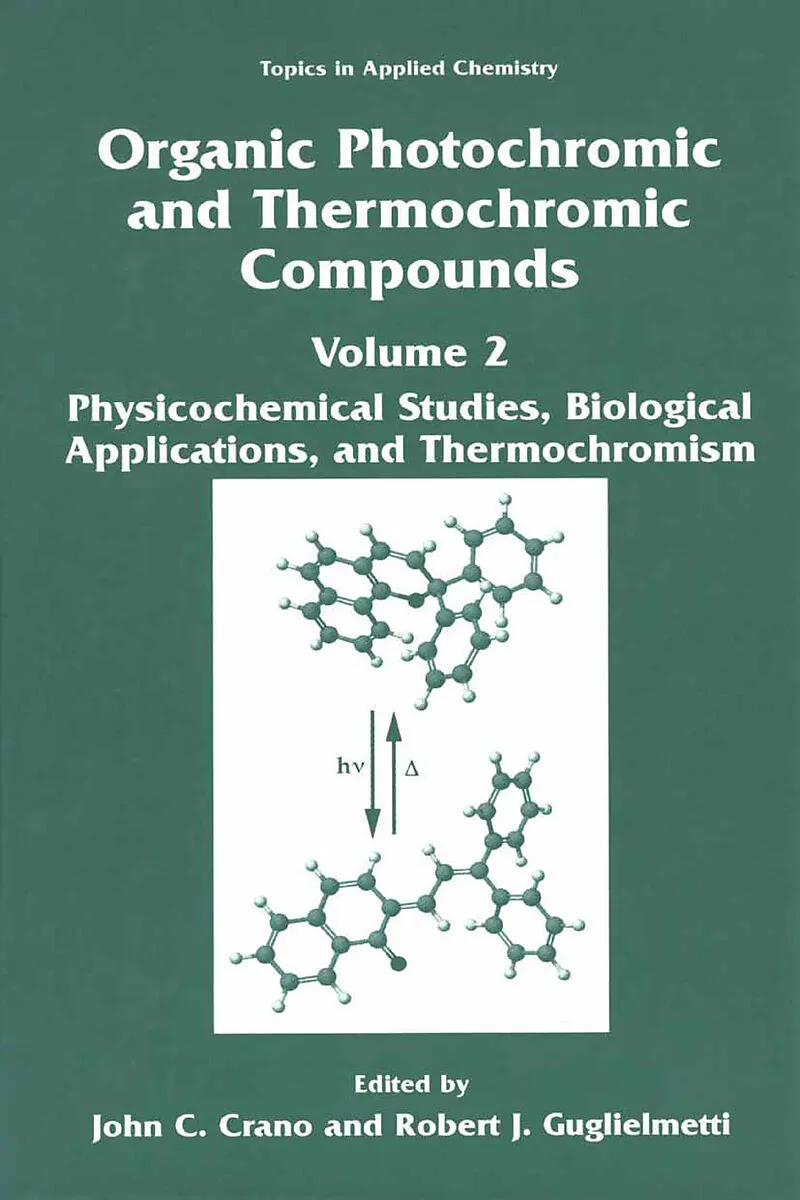
This book, Organic Photochromic and Thermochromic Compounds, is the fourth major treatise on photochromism involving organic molecules and derived systems. The first such book was edited by G.H. Brown in the Weissberger series in 1971, the second was edited by H. Dürr and H. Bouas-Laurent in the Elsevier series in 1990. A third book, edited by C.B. McArdle, should be added to the list, which focuses on the very important topic of the behavior of photochromic systems in polymer matrices. The current book is a result of the large increase in the number of publications and patents concerning photochromic compounds and their use in various applications (e.g. ophthalmic lenses, security printing, etc.) during the last 10 years. As a result of this increased interest, two successful International Symposia on Photochromism have been held: the first, ISOP93, in France on Embiez Island near Bandol (September 12-16, 1993) and the second, ISOP96, in the United States in Clearwater, Florida (September 8-12, 1996). The number of countries represented at each of these symposia (17 and 16, respectively) attests to the international scope of the photochromic research community. This global interest is also exemplified by the authors of the chapters within this book. The second volume of this new review is focused on the physico-chemical properties and photochromic behavior of the best-known systems, which have led to new developments in the known photochromic series or the discovery of new families. Chapters are included on the most appropriate physico-chemical methods by which photochromic substances can be studied (spectrokinetic studies on photostationary states, Raman spectroscopy, EPR, chemical computations and molecular modeling, X-ray diffraction analysis). In addition, special topics such as interaction between photochromic compounds and polymer matrices, photodegradation mechanisms, and potential biological applications have been treated. The last chapter, on thermochromic materials, is included to emphasize the chemical similarities between photochromic and thermochromic materials. In general, the literature cited within the chapters covers publications through 1995.
Inhalt
Photochromic Polymers.- Photodegradation of Organic Photochromes.- Photokinetics under Continuous Irradiation.- EPR and Radical Processes.- Molecular Modeling Calculations.- The Enantiomers of 2-Donor-Substituted Benzopyrans and Benzo-1,4-oxazines and Their Thermal Racemization.- Structural Studies by X-Ray Diffraction.- New Trends in Raman Studies of Organic Photochromes.- Biological Applications Supramolecular Chemistry.- Thermochromism of Organic Compounds.