Beschreibung
This book offers a comprehensive collection of 33 research contributions presented at the 13th International Conference on Soft Computing for Problem Solving (SocProS 2025): Artificial Intelligence for Viksit Bharat, held at the Indian Institute of Technology...
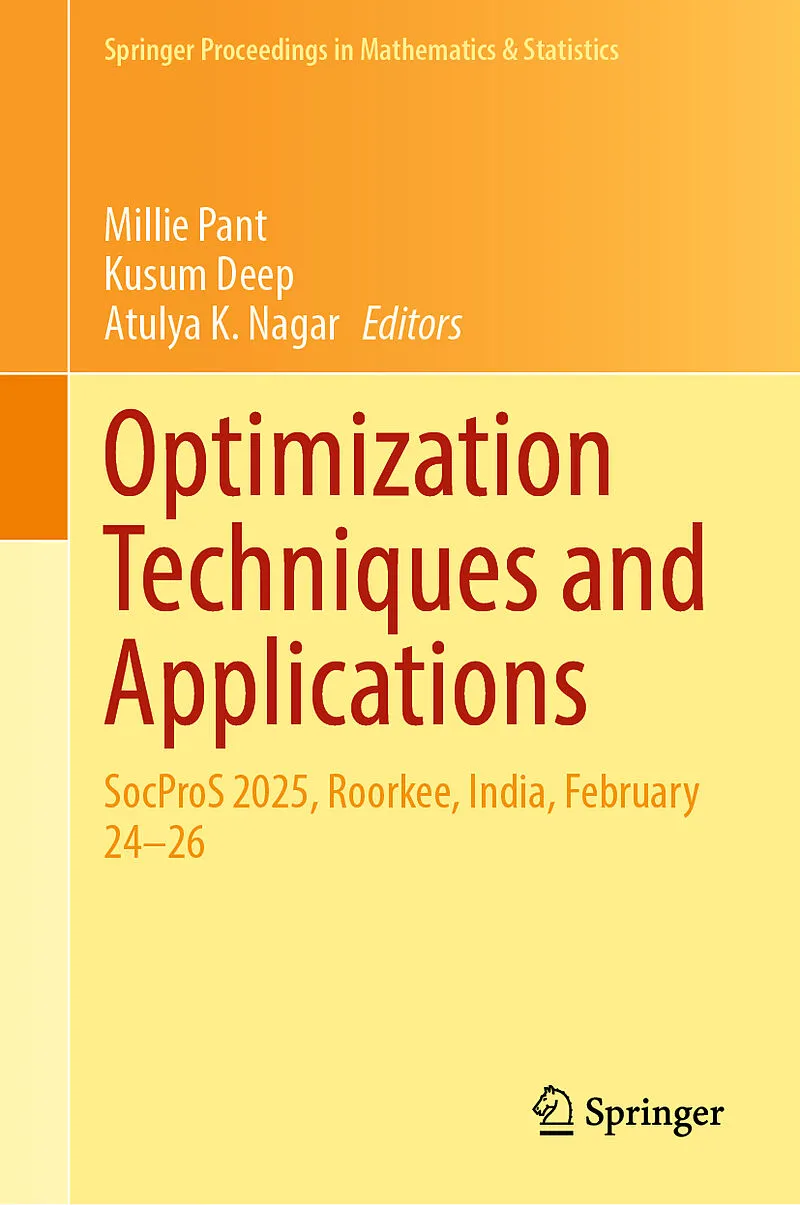
This book offers a comprehensive collection of 33 research contributions presented at the 13th International Conference on Soft Computing for Problem Solving (SocProS 2025): Artificial Intelligence for Viksit Bharat, held at the Indian Institute of Technology Roorkee, Uttrakhand, India, from 24th to 26th February 2025. It focusses on the powerful interplay between advanced mathematical methods and optimization techniques. The book features research on diverse topics, such as fractional calculus, swarm intelligence, fuzzy logic, neutrosophic theory, decision-making models and resource optimization in engineering systems.
Focusing on topics related to optimization in energy production and consumption, the book emphasizes applications that directly relate to SDG 7 (Affordable and Clean Energy). It also discusses application in smart networks, inventory management, metro rail construction, financial market modeling and sustainable practices. Special attention is given to metaheuristic algorithms, multi-objective optimization problems, predictive modeling and the analytical solutions of complex differential systems. It serves as a valuable reference for researchers and practitioners in applied mathematics, computer science, engineering optimization and operations research. The book bridges theoretical foundations with practical solutions to modern, real-world problems, emphasizing interdisciplinary approaches and computational techniques.
This book offers a comprehensive collection of 33 research contributions presented at the 13th International Conference on Soft Computing for Problem Solving (SocProS 2025): Artificial Intelligence for Viksit Bharat, held at the Indian Institute of Technology Roorkee, Uttrakhand, India, from 24th to 26th February 2025. It focusses on the powerful interplay between advanced mathematical methods and optimization techniques. The book features research on diverse topics, such as fractional calculus, swarm intelligence, fuzzy logic, neutrosophic theory, decision-making models and resource optimization in engineering systems.
Focusing on topics related to optimization in energy production and consumption, the book emphasizes applications that directly relate to SDG 7 (Affordable and Clean Energy). It also discusses application in smart networks, inventory management, metro rail construction, financial market modeling and sustainable practices. Special attention is given to metaheuristic algorithms, multi-objective optimization problems, predictive modeling and the analytical solutions of complex differential systems. It serves as a valuable reference for researchers and practitioners in applied mathematics, computer science, engineering optimization and operations research. The book bridges theoretical foundations with practical solutions to modern, real-world problems, emphasizing interdisciplinary approaches and computational techniques.
Discusses optimization algorithms in particle swarm optimization, differential evolution, genetic algorithms and TLBO Provides comparative study on metaheuristic techniques for applications in energy, transportation and financial modeling Focuses on sustainable optimization under environmental constraints and green technology adoption
Autorentext
Millie Pant is Professor in the Department of Applied Mathematics and Scientific Computing at the Indian Institute of Technology Roorkee, Uttrakhand, India. She specializes in data science and artificial intelligence, with significant contributions to optimization algorithms and their applications. She has a robust publication record and has guided numerous Ph.D. and M.Tech. students, reflecting her commitment to research and education in advanced mathematical and computational methods.
Kusum Deep is Full Professor (HAG) in the Department of Mathematics as well as Joint Faculty at the Mehta Family School of Data Science and Artificial Intelligence at the Indian Institute of Technology Roorkee, Uttrakhand, India. Also, she is Visiting Professor, Liverpool Hope University, UK; University of Technology Sydney, Australia; and University of Wollongong, Australia. With B.Sc. Hons and M.Sc. from the Centre for Advanced Studies, Panjab University, Chandigarh, India, she is an M.Phil. Gold Medalist. She earned her PhD from the University of Roorkee, now the Indian Institute of Technology (IIT) Roorkee, in 1988. She has been a national scholarship holder and a Post-Doctoral from Loughborough University, UK, assisted by International Bursary funded by the Commission of European Communities, Brussels. She has won numerous awards like the Khosla Research Award, the UGC Career Award, the Starred Performer of IITR Faculty, Best Paper Awards by the Railway Bulletin of Indian Railways, special facilitation in memory of late Prof. M. C. Puri, the AIAP Excellence Award. She is one of the four women from the IIT Roorkee to feature in the ebook, Women in STEM-2021, celebrating the contributions made by 50 Indian women in STEM published by the Confederation of Indian Industries. According to Stanford University, she falls within the top 2% of the scientists in the world for 2019 and 2020. In 2021, she bagged the prestigious POWER grant awarded by SERB-DST, the Government of India.
Atulya K. Nagar is the Foundation Chair Professor in the School of Mathematics, Computer Science and Engineering as well as Pro Vice-Chancellor (Research) at Liverpool Hope University, United Kingdom. He received a prestigious Commonwealth Fellowship for pursuing his doctorate (DPhil) in applied nonlinear mathematics, which he earned from the University of York (UK) in 1996. He holds BSc (Hons), MSc and MPhil (with distinction) in mathematical physics from the MDS University of Ajmer, Rajasthan, India. He is a fellow of the Institute of Mathematics and Its Applications (FIMA) and a fellow of the Higher Education Academy (FHEA). His research expertise is in the area of applied nonlinear analysis, natural computing and systems engineering.
Inhalt
Chapter 1. Rayleigh Wave in Nonlocal Fractional Order Thermoelastic Solid Half Space under Hydrostatic Initial Stress.- Chapter 2. MSD-YOLOViT10: Optimized Underwater Marine Species Detector.- Chapter 3. Leveraging Machine Learning to Optimize Financial Markets.- Chapter 4. Development of a Robust Multispectrum Surveillance System Using Geman McClure Norm Based Fractional Order Variational Optical Flow Model.- Chapter 5. Analysis for an unreliable retrial queueing system under threshold-based recovery using ANFIS approach.- Chapter 6. Adaptive Learning EJaya for Constrained Optimization Problem.- Chapter 7. Efficient Multi-Objective Particle Swarm Optimization for Noisy Environments.- Chapter 8. Defending NLPP Solution Approaches: A Rebuttal to Bhatia et al. (2022) Mehar approach to solve neutrosophic linear programming problems using possibilistic mean.- Chapter 9. Generalized probabilistic hesitant fuzzy aggregation operator based MCDM method to evaluate water quality.- Chapter 10. Multi-Item Substitutable Inventory Model for Green and Regular Products with Environmental Sustainability under Inflationary Environment.- Chapter 11. Solvability of Abstract Second-Order Differential Systems with State-Driven Delays.- Chapter 12. Improved TLBO: A Novel Approach for Solving Complex Optimization Problems.- Chapter 13. Genetic Algorithm Integrated DEA for Academic Assessment of a Higher Education Institution.- Chapter 14. An Improved Fuzzy Clustering Technique for Nucleus Segmentation.- Chapter 15. Set pair analysis based algorithm for IVIF decision-making with mean and variance.- Chapter 16. ANFIS Simulation and Particle Swarm Optimization for Finite-Capacity Two-Stage Service Queueing Model.- Chapter 17. Controllability of third-order delayed integrodifferential systems: a fixed-point theorem based result.- Chapter 18. Fake News Detection Using Machine Learning with Particle Swarm Optimization-Based Feature S…
Tief- preis