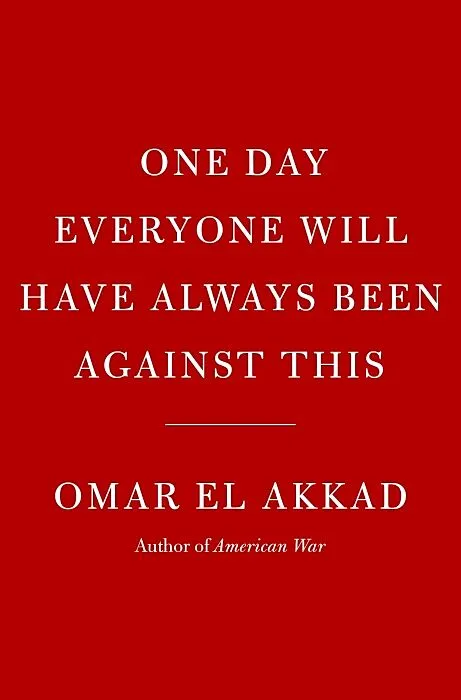
One Day, Everyone Will Have Always Been Against This
Beschreibung
From award-winning novelist and journalist Omar El Akkad comes a powerful reckoning with what it means to live in the heart of an Empire which doesn’t consider you fully human. On Oct 25th, after just three weeks of the bombardment of Gaza, Omar El A...Format auswählen
- Fester EinbandCHF 25.30
- Kartonierter Einband (Kt)CHF 26.80

Wird oft zusammen gekauft
Andere Kunden kauften auch
Beschreibung
From award-winning novelist and journalist Omar El Akkad comes a powerful reckoning with what it means to live in the heart of an Empire which doesn’t consider you fully human.
On Oct 25th, after just three weeks of the bombardment of Gaza, Omar El Akkad put out a tweet: “One day, when it’s safe, when there’s no personal downside to calling a thing what it is, when it’s too late to hold anyone accountable, everyone will have always been against this.” This tweet was viewed over 10 million times.
<One Day Everyone Will Have Always Been Against This< chronicles the deep fracture which has occurred for Black, brown, indigenous Americans, as well as the upcoming generation, many of whom had clung to a thread of faith in western ideals, in the idea that their countries, or the countries of their adoption, actually attempted to live up to the values they espouse.
This book is a reckoning with what it means to live in the west, and what it means to live in a world run by a small group of countries—America, the UK, France and Germany.  It will be< The Fire Next Time< for a generation that understands we’re undergoing a shift in the so-called ‘rules-based order,’ a generation that understands the west can no longer be trusted to police and guide the world, or its own cities and campuses. It draws on intimate details of Omar’s own story as an emigrant who grew up believing in the western project, who was catapulted into journalism by the rupture of 9/11.
This book is his heartsick breakup letter with the west. It is a breakup we are watching all over the U.S., on college campuses, on city streets, and the consequences of this rupture will be felt by all of us. His book is for all the people who want something better than what the west has served up. This is the book for our time....
Autorentext
OMAR EL AKKAD is an author and journalist. He was born in Egypt, grew up in Qatar, moved to Canada as a teenager, and now lives in the United States. He is a two-time winner of both the Pacific Northwest Booksellers Association Award and the Oregon Book Award for fiction. His books have been translated into thirteen languages. His debut novel, American War, was named by the BBC as one of one hundred novels that shaped our world.
Klappentext
**NEW YORK TIMES BESTSELLER • NATIONAL BOOK AWARD WINNER • A NEW YORK TIMES NOTABLE BOOK • PALESTINE BOOK AWARD WINNER • FINALIST FOR THE NATIONAL BOOK CRITICS CIRCLE AWARD FOR CRITICISM • From award-winning novelist and journalist Omar El Akkad comes a powerful reckoning with what it means to live in a West that betrays its fundamental values.
"[A] bracing memoir and manifesto." —The New York Times
"I can’t think of a more important piece of writing to read right now. I found hope here, and help, to face what the world is now, all that it isn’t anymore. Please read this. I promise you won’t regret it." —Tommy Orange, bestselling author of Wandering Stars and There There**
On October 25, 2023, after just three weeks of the bombardment of Gaza, Omar El Akkad put out a tweet: “One day, when it’s safe, when there’s no personal downside to calling a thing what it is, when it’s too late to hold anyone accountable, everyone will have always been against this.” This tweet has been viewed more than 10 million times.
As an immigrant who came to the West, El Akkad believed that it promised freedom. A place of justice for all. But in the past twenty years, reporting on the War on Terror, Ferguson, climate change, Black Lives Matter protests, and more, and watching the unmitigated slaughter in Gaza, El Akkad has come to the conclusion that much of what the West promises is a lie. That there will always be entire groups of human beings it has never intended to treat as fully human—not just Arabs or Muslims or immigrants, but whoever falls outside the boundaries of privilege. One Day, Everyone Will Have Always Been Against This is a chronicle of that painful realization, a moral grappling with what it means, as a citizen of the U.S., as a father, to carve out some sense of possibility in a time of carnage.
This is El Akkad’s nonfiction debut, his most raw and vulnerable work to date, a heartsick breakup letter with the West. It is a brilliant articulation of the same breakup we are watching all over the United States, in family rooms, on college campuses, on city streets; the consequences of this rupture are just beginning. This book is for all the people who want something better than what the West has served up. This is the book for our time.
Leseprobe
She is fog-colored when they find her, she believes she has ended. Like porters in service of some grotesque nobility, half a dozen men carry the stretcher out of something cavernous, something that used to be a home, and she, a girl of nine or ten, is whisked away. Sitting on the stretcher, dazed and bloodied, she looks off to the side. She appears to be searching. The men who carry the stretcher move with urgency, as if the doing of care, of gentleness, can undo what has happened to this girl, to this place, to the bodies yet to be dug from beneath the rubble. Someone nearby asks God for revenge. Perhaps God is here somewhere, also searching.
A soldier I met years ago, who made the study of industrial violence his hobby, once told me the first thing that kills when a bomb goes off isn’t shrapnel or fire. It’s the overpressure wave: air forced violently outward from the site of the blast. What you’re supposed to do, he said, is drop to the ground and cover your ears, breathe out, empty your lungs before the air collides with and flattens them. Of course, if you’re close enough, nothing you do or don’t do will make any difference at all. He said the force of the overpressure wave weakens in proportion to the cube of the distance from the site of impact, which is to say, the most effective thing you can do to avoid getting killed by a missile or a mine or a grenade is to be far away when it goes off.
How do you do that? I asked.
Do what?
Know when a thing like that is about to happen. Know to be far away.
Well, he said, and trailed off. A few minutes later he was telling the story of a freak accident his daughter had suffered as a toddler, how carrying her to the emergency room was the scariest thing he’d ever experienced. Even in his line of work, even with all he’d seen, the scariest thing.
As the men carry the girl out of what used to be her home, she asks if they’re going to take her to the cemetery. One of the men says, Mashallah, mashallah.
In literal translation, the word means: What God wills. A closer approximation of meaning—of one meaning—is something like: What has happened is what God willed. But English, tasked with a word like this, turns stiff and monophonic, and Mashallah is orchestral. To any ear that grew up on this language, it is clear that what the man means when he says this word is something else entirely. Something instantly familiar to generations who’ve heard it spilling out of the mouths of beaming grandmothers at the end of piano recitals and graduation ceremonies and at the first sight of a newborn. Used this way, it finds its principal purpose, as an expression of joy. Look at this wonderful thing God has done.
Mashallah.
Language, too, forces the air from the lungs.