
IHR WARENKORB IST AKTUELL LEER.
Haben Sie noch nichts passendes gefunden? Stöbern Sie durch unser komplettes Sortiment.
Oder melden Sie sich an bzw. registrieren Sie sich.
- Kostenlose Lieferung
- Kauf auf Rechnung
- Ex Libris Tiefpreis
- Filiallieferung und 650+ Abholorte
- Rabatt-Bons als Club-Mitglied
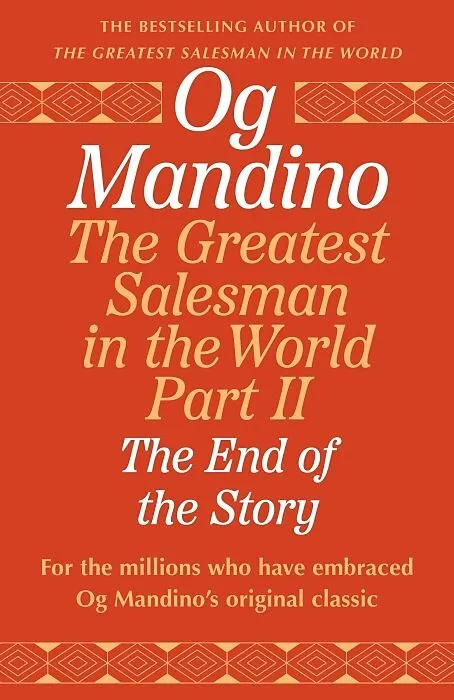
The Greatest Salesman in the World, Part II
Beschreibung
“The most important book of our generation . . . A flawless, priceless masterpiece.”--Denis Waitley, author of You are holding in your hands an almost impossible dream, finally becoming reality . . . the sequel to the inspirational classical that h...Format auswählen
- Kartonierter EinbandCHF 19.50

Wird oft zusammen gekauft
Andere Kunden kauften auch
Beschreibung
“The most important book of our generation . . . A flawless, priceless masterpiece.”--Denis Waitley, author of You are holding in your hands an almost impossible dream, finally becoming reality . . . the sequel to the inspirational classical that has touched more lives in the past two decades than any other motivational work in the world. More than nine million people continue to find solace and hope in And now, at last, the world will discover what happens to the greatest salesman when he finally emerges from his lonely retirement to commence a new career. At first he finds failure--until he receives a special gift from someone he has not seen in half a century. He then returns triumphantly to his homeland to write his own Ten Vows of Success to be shared with all who seek a better life--including you. <The Greatest Salesman in the World--Part II: The End of the Story< will touch the hearts of those millions who already know Hafid as a beloved friend--and introduce his wisdom to a vast new generation.
Autorentext
Og Mandino is one of the most widely read inspirational and self-help authors in the world. Former president of Success Unlimited magazine, Mandino was the first recipient of the Napoleon Hill Gold Medal Award for literary achievement. Og Mandino was a member of the Council of Peers Award for Excellence Speaker Hall of Fame and was honored with a Master of Influence Award by the National Speakers Association. Og Mandino died in 1996, but his books continue to inspire countless thousands all over the world.
Leseprobe
**Og Mandino Remembers . . . **
Other than Mickey Mantle hitting his five hundredth career home run, Dr. Christiaan Barnard performing the world’s first human heart transplant, and Barbra Streisand singing in Central Park, 1967 was not a very good year.
There were race riots in Cleveland, Newark, and Detroit. Israel and Arab nations engaged in a bloody six-day war. The People’s Republic of China exploded its first hydrogen bomb. American aircraft bombed Hanoi and three American astronauts were burned to death on their launching pad.
In the midst of all that angst and fear and while the world teetered on the brink of extinction, I enjoyed a great moment of pride that I shall never forget, that fall, when I finally held in my hands the first edition copy of my tiny book, The Greatest Salesman in the World.
Being published in such a chaotic year and against formidable new books by the likes of Gore Vidal, Isaac Bashevis Singer, Thornton Wilder, William Golding, and Leon Uris did not bode well for my first fictional effort. My parable about a camel boy in the time of Christ, an unlikely category in any era, appeared destined to suffer the same oblivion as most of the thousands of other new books being introduced that fall despite publisher Frederick Fell’s heroic efforts to publicize what he insisted was one of the most important books he had published in twenty-five years.
And then a miracle happened. Actually, two miracles. Insurance pioneer W. Clement Stone, to whom I had dedicated the book in gratitude for his help and friendship, was so touched by the story that he ordered ten thousand copies of The Greatest Salesman in the World for distribution to every employee and shareholder of his huge Combined Insurance Company. At the same time, Rich DeVos, co-founder of Amway International, began advising his thousands of distributors, in speeches across the country, that they should learn and apply the principles of success found in Og Mandino’s book.
Those two influential leaders planted their seeds well. Sparked by a growing band of readers who spontaneously contributed one of the most extensive word-of-mouth campaigns in publishing history, sales of the book increased each year to my great delight and amazement. By 1973 it had registered an almost unheard of thirty-six printings, sold more than 400,000 hardcover copies, and was being acclaimed by Paul Nathan of Publishers Weekly as “the bestseller that nobody knows.” Not once had it appeared on any national bestseller list until Bantam Books acquired the paperback rights, promoted it nationally, and published its first edition in 1974.
I am constantly touched by the wide spectrum of readers who have been influenced by my tale of how ten scrolls of success and happiness came into the possession of a courageous camel boy after he had made an accidental visit to a stable in Bethlehem, one evening. Prison convicts have written that they have memorized every word contained in their battered copies of Salesman, drug and alcohol withdrawal patients have admitted sleeping with their book under their pillows, Fortune 500 chief executive officers have distributed copies by the thousands to their subordinates while superstars such as Johnny Cash and Michael Jackson continue to sing its praise.
For someone who never imagined anyone would read his effort at writing, except perhaps his immediate family, it is difficult to comprehend that The Greatest Salesman in the World has now sold more than nine million copies in seventeen languages and it has now become the all-time bestselling book for salespeople in the entire world.
Through the years, my mail has often contained the suggestion that I should consider writing a sequel to my two-decade bestseller since, unlike my famous fictional creation, I have not retired. In the years since Salesman first saw the light of day, I have managed to produce twelve other books and I also continue to dash around the world giving speeches to large audiences of friends of Greatest Salesman on the subject of success.
At first I was completely negative toward the idea of bringing my salesman back for an encore. Writing that book changed my life and that of my family forever and I didn’t want to risk producing any sort of sequel that might dilute or harm the original in any way. Also, since I assumed that twenty years must have elapsed for my fictional hero, Hafid, as it had for me in real life, he would be at least age sixty in any sequel and I wasn’t certain how much I could do with an old boy like that. Then, one morning, while flying to Lisbon to keynote the North American Company’s annual gathering of its top producers, I suddenly realized that I’m a couple of years older than Hafid and here I am still writing and flying around the world giving talks and doing media interviews on radio and television, not to mention that I can still hit a golf ball over 250 yards. If I could still work and perform, so could he! That’s when I decided that the greatest salesman in the world should come out of retirement.
Whether you are an old friend of Hafid’s or this is your initial contact, I welcome you with love. Read and enjoy . . . and may the words and ideas you find here lighten your load and brighten your path as well as its predecessor has apparently done for so many.