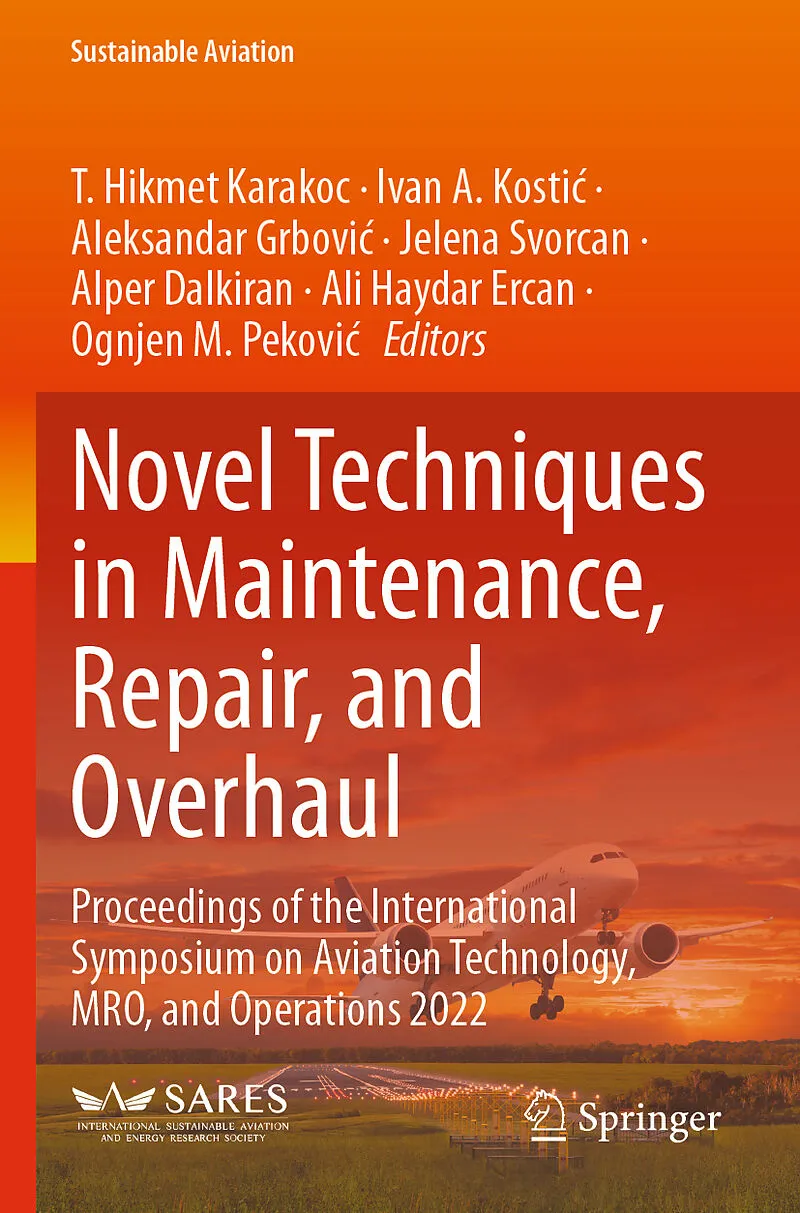
Novel Techniques in Maintenance, Repair, and Overhaul
Beschreibung
The International Symposium on Aircraft Technology, MRO, and Operations (ISATECH) is a multi-disciplinary symposium presenting research on current aerospace issues. The conference provides a platform offering insights on the latest trends in aircraft technolo...
Format auswählen
- Kartonierter EinbandCHF 228.80
- Fester EinbandCHF 228.80
- E-Book (pdf)CHF 260.00

Wird oft zusammen gekauft
Andere Kunden kauften auch
Beschreibung
The International Symposium on Aircraft Technology, MRO, and Operations (ISATECH) is a multi-disciplinary symposium presenting research on current aerospace issues. The conference provides a platform offering insights on the latest trends in aircraft technology, maintenance, repair, overhaul, and operations that offer innovative solutions to the aviation industry's challenges. Coverage includes the operational and MRO needs of hybrid, electric, all-electric, and fuel cell air vehicles adapted to new technology standards. ISATECH allows researchers, scientists, engineers, practitioners, policymakers, and students to exchange information, present new technologies and developments, and discuss future direction, strategies, and priorities.
Offers recent research on a wide array of topics Addresses current MRO issues in the aviation industry Complete proceedings of ISATECH 2022 held at the University of Belgrade
Autorentext
T. Hikmet Karakoc, Ph.D., graduated from Anadolu University, the Department of Mechanical Engineering. He received his M.Sc. degree in Mechanical Engineering from the Yildiz Technical University. He received his Ph.D. from Anadolu University, where he started his full-time teaching and received his Full Professorship. He is currently researching at the Eskisehir Technical University. He has a wide range of research interests, including sustainable aviation, aircraft propulsion systems, insulation, heating, ventilating, and air conditioning (HVAC), indoor air quality, gas turbines, cogeneration systems, renewable energy, energy economics, fuels, and combustion. He has participated in numerous industrial projects on these topics as a researcher, consultant, and project manager for over 30 projects and corporations. He also started a contest on special insulation applications among university students. He served as an Editor-in-Chief, guest editor, and editorial board member forinternational scientific journals. He published national and international papers in over 300 journals and 40 books. Professor Karakoc actively follows membership positions for the Chamber of Mechanical Engineers and many sectorial associations, international scientific organizations, and societies. He is an active Board of Directors member of the International Association for Green Energy. He is currently holding the presidency of the SARES organization, which is actively supporting scientists and students in the area of sustainable aviation. He also organizes four symposiums on aviation subject areas as a Founding Chair.
Ivan A. Kostic, Ph.D., is a Full Professor and Head of the Aerospace Department in the Faculty of Mechanical Engineering at the University of Belgrade. In addition, he is also a lecturer at the Serbian Military Academy of the University of Defence and was previously a lecturer at the Yugoslav Military Aeronautical Academy. He graduated from theUniversity of Belgrade, Faculty of Mechanical Engineering, Aerospace Department, where he obtained his Magister and Doctoral degrees. Professor Kostic teaches courses in aerodynamic design, applied aerodynamics, high speed aerodynamics, air vehicle design, flight dynamics, special topics in fluid mechanics, nonplanar lifting surfaces, airfoils and lifting surfaces of aircraft, aircraft weapon systems, and the theory of bombing and rocketing. He is the author or co-author of more than 150 publications, including scientific and technical papers in journals, conference proceedings, project reports, and books. Professor Kostic is a member of several domestic and international aeronautical associations. He holds his sport and private pilot licenses and has flying experience on single-engine aircraft and sailplanes.
Aleksandar Grbovic, Ph.D., has been a Full Professor in the Aeronautical Department of the Faculty of Mechanical Engineering at the University of Belgrade (UB-FME) since 2020. He graduated from UB-FME in 1994 and earned a Magister and Ph.D. from UB-FME in 2000 and 2012, respectively. His scientific field is aeronautics, focusing on engineering fracture mechanics and fatigue of aircraft structures. Professor Grbovic has supervised seven Ph.D. candidates and was a thesis defense committee member for an additional 15. He has contributed to developing several laboratory installations, including labs on numerical simulations and aircraft static and dynamic testing. He has published several chapters in monographs and more than 90 papers in international journals and conference proceedings. Professor Grbovic has worked on 20 engineering projects, numerous technical reports and reviews, and has delivered solutions to multiple problems in the Serbian aircraft industry and developing new constructions in the military sector.
Jelena Svorcan, Ph.D., is an Associate Professor in the Department of Aerospace Engineering in the Faculty of Mecha
Inhalt
Chapter 1. Influence of Thickness Ratio on the Aerodynamic Characteristics of a Family of Hybrid Semielliptical Dolphin Airfoils.- Chapter 2. The Effect of T6 Heat Treatment on AlSi12 Alloy.- Chapter 3. Outline the Possible Application of Artificial Intelligence in the Aircraft MRO Process Development.- Chapter 4. A Computational Study of the Heat Transfer Coefficient for Lithium-Ion Battery Temperature.- Chapter 5. Wind Tunnel Measurement of Pitch-Damping Derivative Using Forced Oscillation Technique.- Chapter 6. Optical Velocity Measurement and Fluid Flow Visualization Techniques.- Chapter 7. Numerical Investigation of Impinging Synthetic Jets on the Flow Field and Heat Transfer at Low Orifice-to-Plate Distances.- Chapter 8. Comparison of Flow Characteristics of Wake Regions of Single and Lined up in a Row Torpedo-Like Geometries at Uniform Flow Conditions.- Chapter 9. Accounting for the Effects of Experimental Setting in Propeller Flow Computation.- Chapter 10. Development andConstruction of a Radio-Controlled Aircraft with Distributed Electric Propulsion: Persian Sky-O.- Chapter 11. Improve Aircraft Pilots' Training Using Structural Failure Incidents: a Serious Game Approach.- Chapter 12. Neural Control of Space Trajectories with Pseudolinear Models.- Chapter 13. H-infinity Control of Orbital Trajectories with Stochastic Models.- Chapter 14. Numerical Analysis of Narrow-Body Fuselage Upper Panel Re-design.- Chapter 15. Structural and Flow Analysis of Launch Vehicle for Cubesats.- Chapter 16. Development of a Model of the TCAS Autonomous Diagnostic System Using Non-Contact Current Sensors.- Chapter 17. Testing and Integration of a Hydrogen Fuel Cell in a Hybrid-Electric Propulsion Rig for UAVs.- Chapter 18. Effects of the Partial Use of Diesel Fuel with Kerosene on the Exergetic Sustainability Performance of an UAV Jet Engine in Case of Emergency.- Chapter 19. Swarm Control of a Group of Unmanned Aerial Vehicle Under Fixed Consensus Topology.- Chapter 20. Aviation MRO Operators Assessment by SHELL Model.- Chapter 21. Wind Tunnel Operation and Testing in the 21st Century: The Case of VTI's Test Facilities.- Chapter 22. Comparative Analysis of Flow Fields Around NACA 23012 Airfoil at Three Characteristic Angles-of-Attack.- Chapter 23. Fuel Optimal Aircraft Conflict Resolution Under Various Wind Characteristics.- Chapter 24. Implicit LES Using New Slope Limiters.- Chapter 25. Nanoceramics as Reinforcement for Polymer Matrices and Composite Materials for Aircraft Structures.- Chapter 26. Evaluation of Architectural Structures in Electric Taxiing Systems.- Chapter 27. High-altitude Wind Resource Potential for AWE in Portugal.- Chapter 28. Conceptual Design, Development, Test and System Identification of a Novel Tri-Rotor Configuration for a VTOL Fixed Wing Aircraft.- Chapter 29. Measurement, Exploitation and Method Finalization of PIV Systems.- Chapter 30. Methodology for Testing Damaged Composite Helicopter Rotor Blades.- Chapter 31. Procedures in Testing the Mechanical Characteristics of Composite Structures and the …


