
IHR WARENKORB IST AKTUELL LEER.
Haben Sie noch nichts passendes gefunden? Stöbern Sie durch unser komplettes Sortiment.
Oder melden Sie sich an bzw. registrieren Sie sich.
- Kostenlose Lieferung
- Kauf auf Rechnung
- Ex Libris Tiefpreis
- Filiallieferung und 650+ Abholorte
- Rabatt-Bons als Club-Mitglied
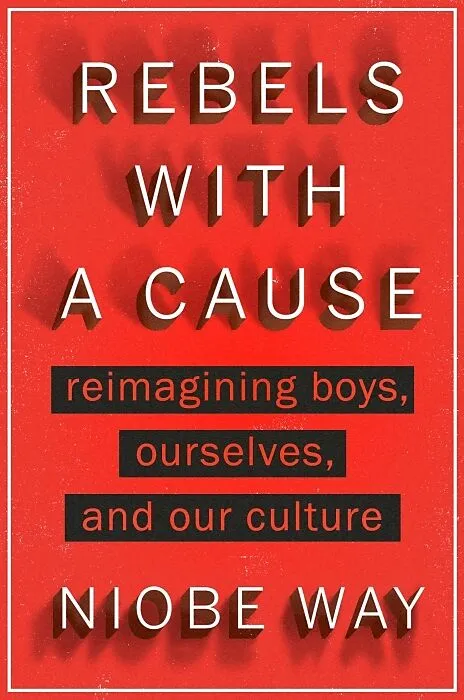
Rebels with a Cause
Beschreibung
A childhood development psychologist argues that the much-debated problem with men begins with subjecting boys to toxic masculine stereotypes—and explains how we can change direction. Boys are less sensitive than girls. Boys don''t need emotional int...Format auswählen
- Fester EinbandCHF 39.60
Wird oft zusammen gekauft
Andere Kunden kauften auch
Beschreibung
A childhood development psychologist argues that the much-debated problem with men begins with subjecting boys to toxic masculine stereotypes—and explains how we can change direction.
Boys are less sensitive than girls. Boys don''t need emotional intimacy. Boys are rational, intelligent, and competitive. Boys will be boys. . . . Assumptions like these maintain “boy culture.” This reality pushes boys into gendered roles that leave them disconnected from one another. It''s getting worse. In 1990, 3 percent of men reported having no close friends; now 15 percent do. This crisis of connection has led to “toxic masculinity,” “the epidemic of fatherlessness,” and, most sensationally, “the end of men,” while real boys all around us are experiencing more depression, anxiety, loneliness, and even suicide and violence.
As Niobe Way''s interviews with boys from all income levels prove, children have strong emotional and social skills. Preteen boys speak openly about their love for male friends, their desire to share deep secrets, and their need to discuss problems rather than avoid them. It is only as they grow older and are pressured to “man up” that these abilities are lost.
We can fix it! As Way shows with powerful heartrending stories, when teens resist “boy culture,” they experience higher self-esteem, friendship quality, and math achievement, along with lower levels of depression. A caring climate at home, in school, and in society that encourages connection and friendship makes the difference. Culture-war stories may get television ratings and politicians elected, but this book will help us nurture our boys.
Autorentext
Niobe Way is Professor of Developmental Psychology at NYU, the founder of the Project for the Advancement of Our Common Humanity (PACH; pach.org), creative advisor of agapi, and the Principal Investigator on the Listening Project. She was the President of the Society for Research on Adolescence (SRA), received her B.A. from U.C. Berkeley, her doctorate from the Graduate School of Education at Harvard University, and was an National Institute of Mental Health postdoctoral fellow at Yale University in the psychology department.
Her work focuses on social and emotional development and how cultural ideologies shape families and child development in the U.S. and China. She has been researching social and emotional development of adolescents for 35 years, and has authored or co-authored over one hundred peer reviewed journal articles and seven single authored, co-authored, or co-edited books.
Her latest co-edited book is The Crisis of Connection: Its Roots, Consequences, and Solution (NYU Press). She has also co-edited with Judy Chu, Adolescents Boys: Exploring Diverse Cultures of Boyhood (NYU Press). Her last single authored book is Deep Secrets: Boys’ Friendships and the Crisis of Connection (Harvard University Press), which was the inspiration for "Close" a movie that won the Grand Prix Award at Cannes Film Festival and was nominated for an Oscar for best foreign film. She is regularly featured in mainsteam media speaking on the topics of boys, friendships, loneliness, teenagers, gender stereotypes, masculinity, and the roots of violence.
Klappentext
"From NYU professor of developmental psychology Niobe Way, an in-depth exploration about what boys and young men teach us about themselves, us, and the toxic culture we have created, one in which we value money over people, toys over human connection, and academic achievement over kindness. Based on her longitudinal and mixed-method research over thirty-five years, Rebels with a Cause is a true call to action to change the culture so that we stop the vicious cycle of violence and blame. Dr. Niobe Way has spent her career researching social and emotional development and finds that boys and young men desperately want and need the same thing as everyone else: close friendships. Yet they and we grow up in a stereotyped "boy" culture, one that devalues and mocks those relationships, rather than recognizing that they're necessary for human survival. In Rebels with a Cause, Way takes her message one step beyond her previous book, Deep Secrets, which was the inspiration for an Oscar-nominated film Close, to reveal how these "rebels," as she calls the boys and young men in her research and in her classrooms, teach us about their and our crisis of connection, evidence of which is visible in our soaring rates of depression, anxiety, loneliness, suicide, and mass violence. They also teach us about the solutions to the crisis, which is to care, to listen with curiosity, and to take individual and collective responsibility for the damage we have done to them, to ourselves, and to the world around us. Way provides us not only with data-driven insight into the roots and consequences of this crisis of connection, but also offers us concrete and empirically tested strategies for creating a culture that better aligns with our human nature and our human needs. Her book reminds us that "it's not the rebels who cause the troubles of the world, it's the troubles that cause the rebels." The time to listen to and act on what young rebels have been telling us for almost a century is now"--
Leseprobe
1.
Human Nature
When my son was five years old, his father and I got divorced. I didn't want our home to be filled with sadness, so when I came home from work, I tried to look happy. One evening as I walked in the front door and gave my son a big smile, he said, "Mama, why do you smile when you are feeling sad?" I was startled. How did he know that I was faking my happiness? I didn't know what to say, so like most adults when asked uncomfortable questions by children, I changed the topic. Recently, a friend shared a story of her son at five years old, who asked her in a matter-of-fact voice, "Are you yelling at me, Mommy, because your mommy yelled at you?" Another mother told me that her eight-year-old son said, "It makes sense why you would be upset about spills. Your dad used to scream at you for spilling milk. I get it, Mom." Rather than taking graduate-level courses in psychology, perhaps we just need to listen to children.
Such extraordinary capacities to read the social and emotional world among boys and girls have been noted by parents and researchers alike for over a century. Evolutionary biologist Charles Darwin kept a journal of his children in their first years of life and noted their keen emotional observations and deeply caring nature. In March of 1842, Darwin noted about his two-year-old son, Doddy:
On my return from Shrewsbury after 10 days absence, Doddy appeared slightly shy,-I can hardly describe how this was shewn, except by his eyes being slightly averted from mine. He almost immediately came & sat on my knee, kissed me, & was then much excited . . . Doddy's observant nature is shewn by his daily telling . . . everyone, without omission, to have pudding, when their meat was finished, & to take a crust, when their pudding was finished.-Elizabeth remarked [about his] careful politeness at meals towards his guests, was like his granpapa the Doctor.
Darwin was particularly impressed by his son's ability to read the emotions of others. On March 23, he noted: "Doddy looking at full-face likeness of Isaac Walton in frontispiece of the Angler said 'like papa looking at Doddy' & then changed it into 'like papa laughing at Doddy.'-The plate [picture] is not at all like me, but it has the faintest smile about the eyes & is a full face." On March 26, Darwin writes: "Doddy was generous enough to give Anny [his little sister] the last mouthful of his gingerbread & today he again put his last crumb on the sofa for Anny to run to …