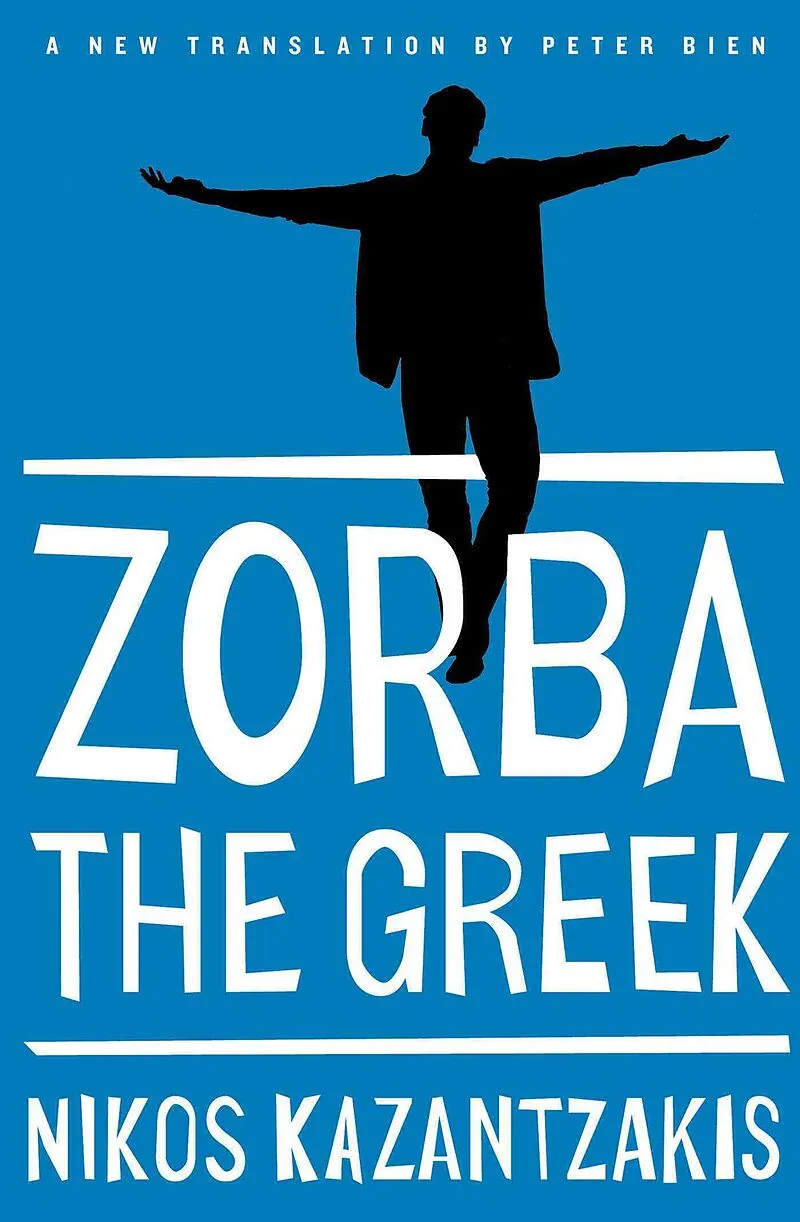
Zorba the Greek
Beschreibung
Informationen zum Autor Nikos Kazantzakis Klappentext First published in 1946, "Zorba the Greek," is, on one hand, the story of a Greek working man named Zorba, a passionate lover of life, the unnamed narrator who he accompanies to Crete to work in a lignite m...Format auswählen
- Kartonierter EinbandCHF 25.90
Beschreibung
Informationen zum Autor Nikos Kazantzakis Klappentext First published in 1946, "Zorba the Greek," is, on one hand, the story of a Greek working man named Zorba, a passionate lover of life, the unnamed narrator who he accompanies to Crete to work in a lignite mine, and the men and women of the town where they settle. On the other hand it is the story of God and man, The Devil and the Saints; the struggle of men to find their souls and purpose in life and it is about love, courage and faith.Zorba the Greek PROLOGUE I often wished to write The Saint's Life of Alexis Zorba, a laborer of advanced age whom I exceedingly loved. The great benefactors in my life have been journeys and dreams. Very few people, dead or alive, have helped me in my struggles; yet if I wished to single out those individuals who did engrave their traces most deeply upon my soul, I would presumably designate these four: Homer, Bergson, Nietzsche, and Zorba. The first was a serene, all-bright eye for me like the sun's disk, illuminating everything with redemptive brightness. Bergson released me from insoluble philosophical anguishes that had tormented my early youth. Nietzsche enriched me with new anguishes and showed me how to transform misfortune, sorrow, and uncertainty into pride. Zorba taught me to love life and not to fear death. If today I were to choose a spiritual guide from the whole wide worlda guru, as they say in India, a venerable father as the monks say at Mount Athosthe one I would choose without fail would be Zorba. He possessed precisely what a pen pusher needs for deliverance: the primitive glance that snatches nourishment lovingly from on high; the creative artlessness, renewed at each daybreak, that views everything unceasingly as though for the first time, bequeathing virginity to the everlastingly quotidian elements of wind, sea, fire, women, and bread; the sureness of hand, the freshness of heart, the gallant stalwart's ability to poke fun at his own soul for seeming to harbor a power higher than the soul; finally, that wild, throaty laugh welling up from a source deeper than a man's inner depths, a laugh that erupted redemptively at crucial moments from Zorba's elderly chest, exploding with sufficient power to demolish (and did demolish) all the barricadesmorality, religion, nationalismerected around themselves by wretched, lily-livered humans to let them hobble securely through their diminished mini-lives. I can hardly endure my rage and sorrow when I consider what nourishment my famished soul was fed by books and teachers for so many years, and then compare this to the leonine brainpower that Zorba fed me for just a few months. My life was fated to be ruined because I encountered this venerable father too late, when the portion of my inner self still capable of being saved was minimal. The great alterationthe definitive change of front, the conflagration and renewaldid not take place. The time was already too late. Thus Zorba, instead of becoming an exalted, authoritative model for my life, was sadly debased into a literary subject causing me to fill numerous sheets of paper with splotches! The doleful privilege of turning life into art leads many flesh-eating souls to disaster because ardent passion departs the breast when it finds an outlet of this sort. In such a case the soul experiences relief. It no longer fumes with rage, no longer needs to fight breast to breast, to intervene directly in life or action. Instead, it is pleased to admire its ardent passion as it ascends like smoke rings in the breeze and fades away. The soul not only takes pleasure in this relief; it also grows proud, for it believes that it is accomplishing something grand by supposedly eternalizing the ...
Autorentext
Nikos Kazantzakis
Klappentext
First published in 1946, "Zorba the Greek," is, on one hand, the story of a Greek working man named Zorba, a passionate lover of life, the unnamed narrator who he accompanies to Crete to work in a lignite mine, and the men and women of the town where they settle. On the other hand it is the story of God and man, The Devil and the Saints; the struggle of men to find their souls and purpose in life and it is about love, courage and faith.
Zusammenfassung
A stunning new translation of the classic book—and basis for the beloved Oscar-winning film—brings the clarity and beauty of Kazantzakis’s language and story alive.
First published in 1946, Zorba the Greek*, is, on one hand, the story of a Greek working man named Zorba, a passionate lover of life, the unnamed narrator who he accompanies to Crete to work in a lignite mine, and the men and women of the town where they settle. On the other hand it is the story of God and man, The Devil and the Saints; the struggle of men to find their souls and purpose in life and it is about love, courage and faith.
Zorba has been acclaimed as one of the truly memorable creations of literature—a character created on a huge scale in the tradition of Falstaff and Sancho Panza. His years have not dimmed the gusto and amazement with which he responds to all life offers him, whether he is working in the mine, confronting mad monks in a mountain monastery, embellishing the tales of his life or making love to avoid sin. Zorba’s life is rich with all the joys and sorrows that living brings and his example awakens in the narrator an understanding of the true meaning of humanity. This is one of the greatest life-affirming novels of our time.
Part of the modern literary canon, Zorba the Greek*, has achieved widespread international acclaim and recognition. This new edition translated, directly from Kazantzakis’s Greek original, is a more faithful rendition of his original language, ideas, and story, and presents Zorba as the author meant him to be.
Leseprobe
Zorba the Greek
PROLOGUE

I often wished to write “The Saint’s Life of Alexis Zorba,” a laborer of advanced age whom I exceedingly loved.
The great benefactors in my life have been journeys and dreams. Very few people, dead or alive, have helped me in my struggles; yet if I wished to single out those individuals who did engrave their traces most deeply upon my soul, I would presumably designate these four: Homer, Bergson, Nietzsche, and Zorba.
The first was a serene, all-bright eye for me like the sun’s disk, illuminating everything with redemptive brightness. Bergson released me from insoluble philosophical anguishes that had tormented my early youth. Nietzsche enriched me with new anguishes and showed me how to transform misfortune, sorrow, and uncertainty into pride. Zorba taught me to love life and not to fear death.
If today I were to choose a spiritual guide from the whole wide world—a “guru,” as they say in India, a “venerable father” as the monks say at Mount Athos—the one I would choose without fail would be Zorba. He possessed precisely what a pen pusher needs for deliverance: the primitive glance that snatches nourishment lovingly from on high; the creative artlessness, renewed at each daybreak, that views everything unceasingly as though for the first time, bequeathing virginity to the everlastingly quotidian elements of wind, sea, fire, women, and bread; the sureness of hand, the freshness of heart, the gallant stalwart’s ability to poke fun at his own soul for seeming to harbor a power higher than the soul; finally, that wild, throaty laugh welling up from a source deeper than a man’s inner depths, a laugh that erupted redemptively at crucial moments from Zorba’s elderly chest, exploding with sufficient power to demolish (and did demolish) all the barricades—morality, religion, nationalism—erected around themselves by wretched, lily-livered humans to let them hobble securely through their diminish…