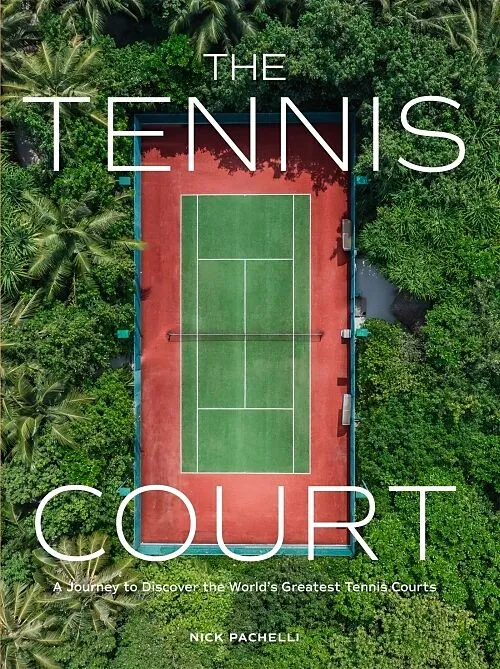

The Tennis Court
Beschreibung
Every one of the world's half a million tennis courts is, at its most basic, an identical blank canvas: a 78-foot by 36-foot rectangle, divided by a 3-foot-high net in its centre, and marked with eleven straight lines. But add in the elements of surface, space...Format auswählen
- Fester EinbandCHF 37.10

Wird oft zusammen gekauft
Andere Kunden kauften auch
Beschreibung
Every one of the world's half a million tennis courts is, at its most basic, an identical blank canvas: a 78-foot by 36-foot rectangle, divided by a 3-foot-high net in its centre, and marked with eleven straight lines. But add in the elements of surface, space, wind, acoustics, crowds, shadows, humidity, and even air density, and every tennis court is unique-a work of art. And some are masterpieces.Nick Pachelli curates and profiles 200 of the world's most beautiful, iconic, significant, alluring, and idiosyncratic tennis courts from across the globe, each breathtakingly photographed. He explores the heavyweights, including Wimbledon's All England Lawn Tennis Club, which employs a hawk to keep stray birds from soiling the meticulous lawns. Arthur Ashe, the Grandstand, and Court 17 in Flushing, Queens, where hundreds of thousands of tennis fans gather every summer for the US Open. And there's Court Philippe-Chatrier at Roland-Garros, whose clay seems to take on a different shade-burnt orange, burnt red, burgundy, umber-every time you see it.We visit far-flung treasures, such as Waiheke Tennis Club in New Zealand, where you'll need to take a plane, then a ferry, then a car or bus, and then walk before arriving there. Indoor marvels, including the Tennis Club de Belgique, which evokes the hushed, reverent feeling of a theater, with skylights illuminating the court and leaving the spectators in the shadows. Hidden jewels, such as the tiny Tennis Club San Stin in Venice, a secret, single outdoor clay court tucked away behind a villa and a 15-foot wall shrouded with vines.There are urban courts, including the Knickerbocker Field Club, deep in the heart of Flatbush, Brooklyn. Academies, like Rafael Nadal's tennis temple in Mallorca, Spain. And the extreme: a single court completely isolated in the wilds of Scotland; a court in northern Spain revealed when the tide goes out, the sand hardens, and the metallic plates that serve as lines re-emerge; and a court in Kenya made out of termite mounds.Throughout, Pachelli not only conducts a masterful, once-in-a-lifetime tour of the world's best courts, but in his writing does something equally immersive: He captures the real passion-some might say obsession-that tennis inspires. Because it's on the court, no matter how grandiose or mundane, whether in an exotic locale or around the corner, where tennis players truly see themselves. Where we come face-to-face with our temperament, our drive, our frustration, our bliss, our longing....
Vorwort
A fresh approach to a beloved sport, The Tennis Court is a photographic journey of the 200 most breathtaking tennis courts around the world.
Autorentext
Nick Pachelli was raised on dry, hot tennis courts in the American Southwest, and has had a racquet in his hand since age six. He played the junior circuit in almost every state across the west and attended tennis academies in Florida and California before stopping short of a college tennis career due to injury. He eventually returned and now plays adult tournaments worldwide, mostly on the Gay and Lesbian Tennis Association World Tour. Since 2017 he's written profiles and features on tennis for the New York Times, Esquire, the Guardian, Vice, and ESPN, among other outlets.
Klappentext
*A fresh approach to a beloved sport, The Tennis Court* is a photographic journey of the 200 most breathtaking tennis courts around the world.
“Nick Pachelli takes us on court in every corner of the world with a sharp eye for what makes our game and the people who champion it so special.”
—Billie Jean King, sports icon and equality advocate**
Every one of the world’s half a million tennis courts is, at its most basic, an identical blank canvas: a 78-foot by 36-foot rectangle, divided by a 3-foot-high net in its center, and marked with eleven straight lines. But add in the elements of surface, space, wind, acoustics, crowds, shadows, humidity, and even air density, and every tennis court is unique—a work of art. And some are masterpieces.
 
Nick Pachelli curates and profiles 200 of the world’s most beautiful, iconic, significant, alluring, and idiosyncratic tennis courts from across the globe, each breathtakingly photographed. He explores the heavyweights, including Wimbledon’s All England Lawn Tennis Club, which employs a hawk to keep stray birds from soiling the meticulous lawns. Arthur Ashe, the Grandstand, and Court 17 in Flushing, Queens, where hundreds of thousands of tennis fans gather every summer for the US Open. And there’s Court Philippe-Chatrier at Roland-Garros, whose clay seems to take on a different shade—burnt orange, burnt red, burgundy, umber—every time you see it.
 
We visit far-flung treasures, such as Waiheke Tennis Club in New Zealand, where you’ll need to take a plane, then a ferry, then a car or bus, and then walk before arriving there. Indoor marvels, including the Tennis Club de Belgique, which evokes the hushed, reverent feeling of a theater, with skylights illuminating the court and leaving the spectators in the shadows. Hidden jewels, such as the tiny Tennis Club San Stin in Venice, a secret, single outdoor clay court tucked away behind a villa and a 15-foot wall shrouded with vines.
 
There are urban courts, including the Knickerbocker Field Club, deep in the heart of Flatbush, Brooklyn. Academies, like Rafael Nadal’s tennis temple in Mallorca, Spain. And the extreme: a single court completely isolated in the wilds of Scotland; a court in northern Spain revealed when the tide goes out, the sand hardens, and the metallic plates that serve as lines reemerge; and a court in Kenya made out of termite mounds.
 
Throughout, Pachelli not only conducts a masterful, once-in-a-lifetime tour of the world’s best courts, but in his writing does something equally immersive: He captures the real passion—some might say obsession—that tennis inspires. Because it’s on the court, no matter how grandiose or mundane, whether in an exotic locale or around the corner, where tennis players truly see themselves. Where we come face-to-face with our temperament, our drive, our frustration, our bliss, our longing.
Zusammenfassung
A fresh approach to a beloved sport, The Tennis Court is a photographic journey of the 200 most breathtaking tennis courts around the world. "Nick Pachelli takes us on court in every corner of the world with a sharp eye for what makes our game and the people who champion it so special."-Billie Jean King, sports icon and equality advocate
Inhalt
Courts include: 
Rod Laver Arena, Melbourne, Australia
Kia Stadium, Melbourne, Australia
Memorial Drive Tennis Club, Adelaide, Australia
Dubai Tennis Center, Dubai, UAE
Royal Tennis Club de Marrakech, Marrakech, Morrocco
Qizhong Stadium, Shanghai, China
Ariake Coliseum, Tokyo, Japan
Beans Dome, Kobe, Japan
Kooyong Tennis Club, Melbourne, Australia
Royal South Yarra Tennis Club, Melbourne, Australia
Coopers Park Tennis Courts, Sydney, Australia
Wodonga Tennis Center, Wodonga, Australia
Governor's house of Tasmania, Australia
Waiheke Tennis Club, Waiheke, New Zealand
Parnell Lawn Tennis, Auckland, New Zealand
Queenstown Tennis Club, Queenstown, New Zealand
Royal Kings Park, Perth, Australia
Loton Park Tennis Center, Perth, Australia
Fremantle Lawn Tennis Club, Perth, Australia
Cheval Blanc, Noonu Atoll, Maldives
Soneva Fushi, Eydhafushi, Maldives
Vakkaru, Baa Atoll, Maldives
Kandima, Maldives
Ozen Life Maadho, Maldives
Niyama Maldives Priv islands, Maldives
Ritz Maldives, Maldives
Anantara Kihavah, Maldives
Victoria Park, Hong Kong, HK
LRC Hong Kong Tennis, Hong Kong, HK
Manila Polo Club "Shell Courts,” Manila, Philippines
Valle Verde Country …