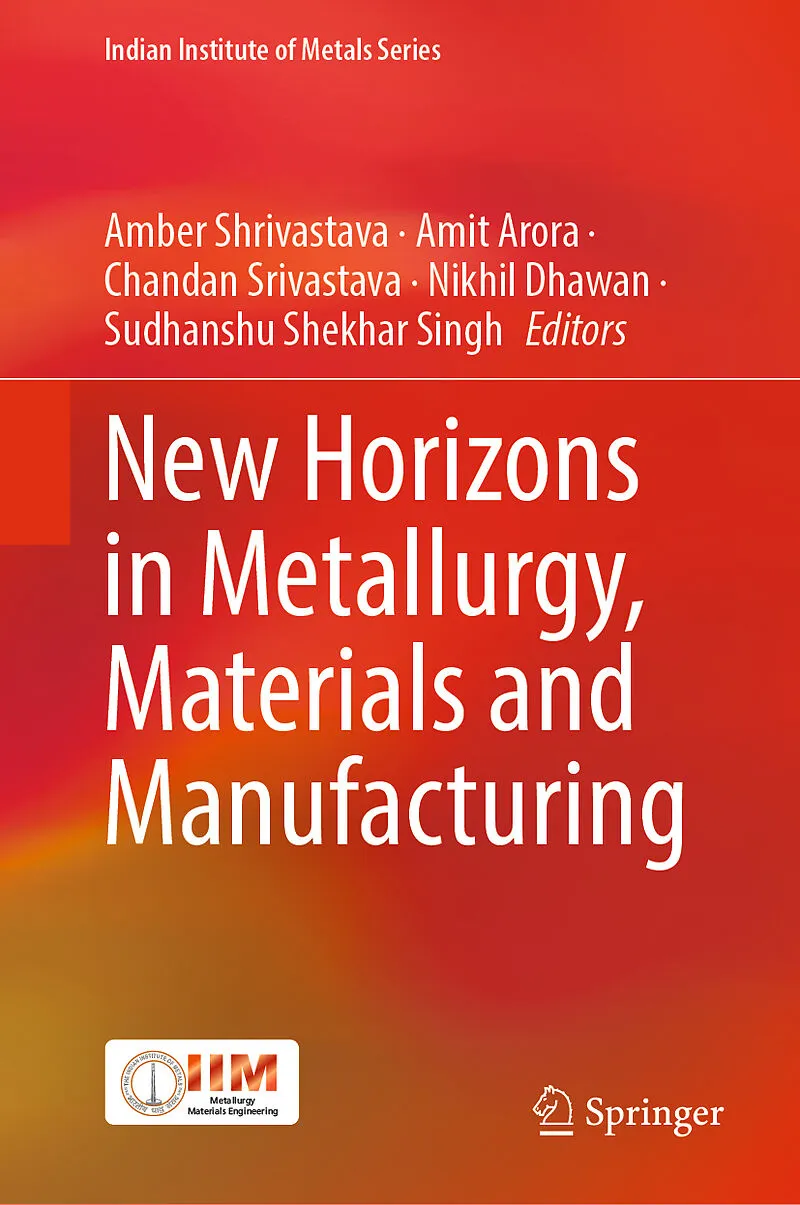
New Horizons in Metallurgy, Materials and Manufacturing
Beschreibung
This book presents an overview of the evolution and opportunities associated with traditional as well as upcoming fields in the areas of materials, metallurgy, and manufacturing. There are a lot of interesting fields at this trijunction, such as alloy design,...
Format auswählen
- Fester EinbandCHF 165.60
- E-Book (pdf)CHF 118.00
- Kartonierter EinbandCHF 121.20

Wird oft zusammen gekauft
Andere Kunden kauften auch
Beschreibung
This book presents an overview of the evolution and opportunities associated with traditional as well as upcoming fields in the areas of materials, metallurgy, and manufacturing. There are a lot of interesting fields at this trijunction, such as alloy design, bio-materials, composites, high entropy alloys, sensors, electronic materials, and materials degradation. The progress in these fields is further fuelled by the advances in the analysis and fabrication techniques such as correlative microscopy, additive manufacturing, and surface engineering. This book discusses the above topics/fields covering advanced analysis techniques, fabrication methods, and various technological applications. Every chapter walks through the basics of the respective field and comprehensively discusses the current developments and future avenues, to arrive at a point where the reader acquires an overall view of the field. Special emphasis is given to the scientific fundamentals and application potential,in a way that readers of all backgrounds can get benefited. The chapters connect the current developments with the future avenues, to help the researchers foresee the future technologies, in their respective fields. This text will appeal to experienced researchers, practitioners, and students alike.
Highlights topics related to materials, metallurgy, and manufacturing together Includes chapters from world renowned researchers from across the world Helps researchers to find the suitable path in the fields of material, metallurgy, and manufacturing
Autorentext
Professor Amber Shrivastava is assistant professor in mechanical engineering department at IIT Bombay, since 2016. Previously, Prof. Shrivastava worked at Corporate Technology Centre of A O Smith at Milwaukee, USA. Dr Shrivastava received his Ph.D. in mechanical engineering from the University of Wisconsin-Madison. He received M.S. in mechanical engineering from Idaho State University. He graduated with Bachelor's in Marine Engineering from Marine Engineering and Research Institute, Kolkata. Thereafter, he worked as a licenced marine engineer for 4 years. His current research interest lies in the area of joining processes in manufacturing, friction stir technologies, joining of dissimilar materials, additive manufacturing, manufacturing process automation, and sustainable manufacturing. As principal investigator, Dr Shrivastava has received and led sponsored projects from government agencies like DST, ISRO, etc. as well as industries.
Professor Amit Arora is an Associate Professor of Materials Engineering at the Indian Institute of Technology Gandhinagar (IITGN), India. He leads the Advanced Materials Processing Research Group at IITGN. Prof. Arora received his Ph.D. in Materials Science and Engineering from The Pennsylvania State University, University Park, USA, in 2011. He worked on heat transfer and material flow modeling of friction stir welding process and developed several numerical models for simulation of this solid-state welding method. Before joining the doctoral program, he was working with IBM India Pvt Ltd as Associate System Engineer. Prof. Arora received B.Tech. (Hons.) in Metallurgical and Materials Engineering and M.Tech. in Metallurgical Engineering (Dual Degree) in 2005 from Indian Institute of Technology (IIT) Kharagpur. The broad research area of Prof. Arora includes various advanced material processing and simulation, such as friction stir welding and processing, additive manufacturing, laser material interaction, surface modification. Prof. Arora has worked on several sponsored projects from SERB, BRNS, DST, DTE-Gujarat, and MHRD. He has also been awarded Excellence-in-Research Award from IIT Gandhinagar and Dept. of Atomic Energy Young Scientist Research Award from the Board for Research in Nuclear Sciences. Prof. Arora was also awarded Indian Patent for fabrication process of polymer reinforced metal matrix composites.
Dr. Amit Arora completed his B. Tech. and M. Tech. (Dual Degree) in Metallurgical and Materials Engineering from IIT Kharagpur in 2005. He received Ph.D. in Materials Science and Engineering from The Pennsylvania State University in August 2011. He has worked on heat transfer and material flow modeling of friction stir welding for his Ph.D. thesis. His main research focus is physical understanding of the joining processes, heat transfer and material flow modeling, and advanced material processing. Currently, Dr. Arora is working as Assistant Professor of Materials Scienceand Engineering at IIT Gandhinagar and leading Advanced Materials Processing Research Group.
Chandan Srivastava received Ph.D. (2009) in Materials Science from the University of Alabama, Tuscaloosa, Alabama, USA. He is currently working as a Professor in the Department of Materials Engineering at the Indian Institute of Science, Bangalore, India. Prof. Chandan Srivastava's research focuses on microstructure-property correlations in metallic systems. Three representative research topics of his work are: (a) understanding the evolution of morphology, microstructure, texture, and corrosion behavior of electrodeposited metallic coatings as a function of the deposition variables, additive volume fraction, and alloying additions, (b) understanding the atomistic mechanism of degradation of compositionally complex multi-component alloys in severely corrosive environments, and (c) size-dependent phase stability and microstructures in nano-solids.
Professor Nikhil Dhawan is working as Associate Professor at the Department of Metallurgical and Materials Engineering, Indian Institute of Technology, IIT-Roorkee, INDIA. He received Outstanding Young Faculty award from the Indian Institute of Technology, Roorkee. He was awarded Mineral Engineering International (MEI) global Young Person award for his work in recycling electronic waste to recover metals. Nikhil Dhawan obtained a Bachelor of Engineering (Metallurgical Engineering) with First Class Honors from Punjab Engineering College, Chandigarh, in 2008. His Ph.D. in Metallurgical Engineering (Modeling of crushed ore agglomeration for heap leach operations, AMIRA P-986 project) was conferred by the University of Utah, the USA, in 2013. He has his credit to seven sponsored research projects funded by various government organizations and has authored 90 referred international journal articles and 25 international conference papers) and 2 book chapters with an h-index of20. His research work is focused on the extraction of bases and rare earth values from red mud, fly ash, electronic waste (discarded CFLs, hard disks), lithium and cobalt from lithium-ion batteries, copper and gold values (printed circuit boards), potassium values from silicate rocks, and enrichment/hydrogen reduction of low-grade banded iron ores for steel vision 2030. He has been elected as a Member of the Indian National Young Academy of Sciences (INYAS). He has received the AC Datta MESA Award (Institution of Engineers, 2016) and Khare award (2016) from the Indian Institute of Mineral Engineers (IIME) in the research domain. Received the IOM3 Billiton Gold Medal for the best paper published in Transactions C: Mineral Processing & Extractive Metallurgy. He was a Member of the* Technology Information, Forecasting, and Assessment Council study steering committee on "Technology solutions for maximum value recovery from Electronic Wastes" approved by NITI Aayog, Government of India (2018-2020); *Bureau of Indian Standards for aluminum and other nonferrous metals division.
Dr Sudhanshu Shekhar Singh is an associate professor in the Department of Materials Science and Engineering at Indian Institute of Technology (IIT) Kanpur. Dr Singh received his Ph.D. in Materials Science and Engineering from Arizona State University, USA in 2015. Prior to joining IIT Kanpur in Dec 2015, he was a postdoctoral researcher at Ari…


