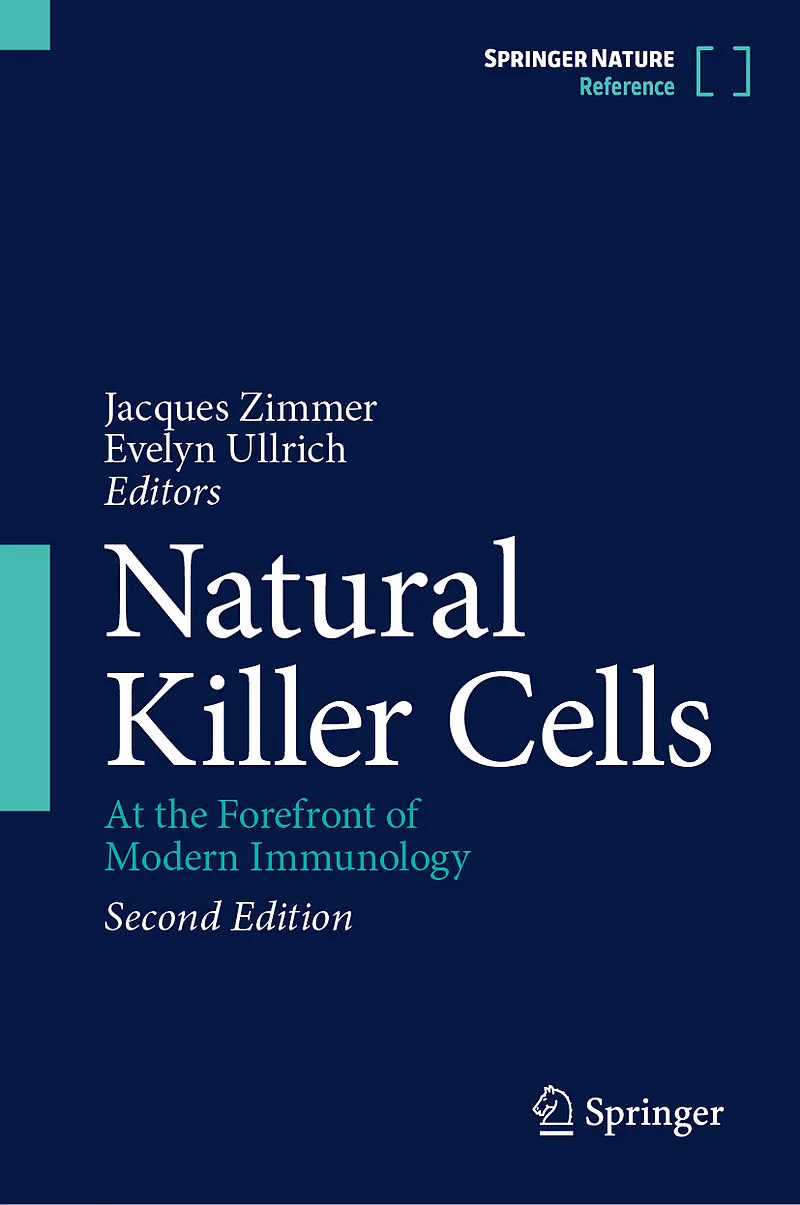
Natural Killer Cells
Beschreibung
This revised second edition highlights the growing importance of natural killer (NK) cells as key contributors to immune defense and immune regulation. Their unique position between innate and adaptive immunity has made them central to current research, from ...
Format auswählen
- Fester EinbandCHF 205.20
- Fester EinbandCHF 201.60
- E-Book (pdf)CHF 177.00
- Kartonierter EinbandCHF 201.60

Wird oft zusammen gekauft
Andere Kunden kauften auch
Beschreibung
This revised second edition highlights the growing importance of natural killer (NK) cells as key contributors to immune defense and immune regulation. Their unique position between innate and adaptive immunity has made them central to current research, from understanding infection and inflammation to designing nextgeneration immunotherapies.
Across six parts, the book integrates fundamental NKcell biology with insights from disease settings and advanced experimental approaches. It shows how developmental pathways, receptor systems and repertoire diversity shape NKcell function, and how these cells respond and adapt in the context of viral infection, chronic inflammation and cancer. This includes emerging evidence on their roles in SARSCoV2, fungal immunity and vascular and autoimmune disorders.
The volume also reveals how NKcell behavior differs across tissues such as the eye, lung, liver, uterus and skin, reflecting the influence of distinct microenvironments. Further chapters trace how cytokine signaling, immunometabolism and extracellular vesicles finetune NKcell activity.
A dedicated section on immunotherapy presents rapidly advancing strategiesfrom engineered NKcell lines to CARNK and iPSCderived approacheswhile the final part introduces cuttingedge investigative methods, including organoid models, epigenetic analysis and AIenabled concepts for therapy design.
With its coherent structure and forwardlooking scope, this reference work supports researchers and clinicians seeking to understand how NK cells are shaping modern immunology.
Integrates NK cell biology with disease and therapy insights to support advanced immunology research Highlights how NK cell functions vary across organs, infections and cancer to deepen mechanistic understanding Advances NK cell therapeutic development through engineered cells, manufacturing and AI driven approaches
Autorentext
Jacques Zimmer studied Medicine at the University of Strasbourg, France, where he also completed his PhD on natural killer (NK) cells in human TAP deficiency under the mentorship of Dr. Daniel Hanau and Dr. Henri de la Salle. He subsequently joined the Ludwig Institute for Cancer Research in Lausanne, Switzerland, as a postdoctoral fellow in the laboratory of Prof. Werner Held, contributing to the development of the cis-interaction model of NK cell education.
From 2003 to 2024, Dr. Zimmer served as Senior Research Scientist in Translational Immunology at the Luxembourg Institute of Health (LIH) under the direction of Prof. Markus Ollert. He obtained his Habilitation in 2006 (jury president: Nobel Laureate Prof. Jules A. Hoffmann). In parallel, he taught immunology at the University of Luxembourg and contributed to the organization of medical training in hematology and immunology.
Dr. Zimmer has published extensively on NK cell biology. According to Scopus (accessed February 2026), he has authored 117 publications, with 5203 citations and an h-index of 38. He has supervised multiple PhD candidates to completion and regularly serves as reviewer for international journals and funding agencies. He was editor of the first edition of this NK cell book in 2010.
Evelyn Ullrich, MD, is Professor of Cellular Immunology and head of the research unit “Experimental Immunology and Cell Therapy” at Goethe University Frankfurt, Germany. She received her clinical and scientific training in Freiburg, Regensburg, Erlangen and Paris, and is board-certified in internal medicine and immunology. Her research focuses on gene-engineered immune cell therapies with a strong emphasis on NK cell biology.
She has established a recognized research program on personalized immunotherapy and contributes extensively to national research structures. She serves as speaker of the study group “NK cells & ILCs” of the German Society for Immunology and leads NK cell related consortia funded by the German Cancer Research Center (DKTK) and the German Cancer Aid. She is also speaker of a DFG-funded Clinician Scientist Program and the Mildred Scheel Career Center in Frankfurt, promoting young researchers in oncology.
According to Scopus (accessed February 2026), Prof. Ullrich has authored 137 publications, with 11363 citations and an h-index of 39. She supervises PhD and MD theses and is an active reviewer and editor in the fields of immunology and immunotherapy. In 2025, Prof. Ullrich was awarded the prestigious Novartis Prize for Therapy-Relevant Immunological Research.
Inhalt
Natural Killer cells within the ILC Family.- Natural Killer Cell Development.- Inhibitory and activating NK receptors in humans: an historical overview.- Natural Killer cell differentiation.- Natural killer cell repertoires and functional diversity: calibration through education.- Natural Killer Cells and Memory.- Effect of cytokines on Natural Killer cells.- Natural Killer cells and chemokines.- Natural Killer cell metabolism.- Regulatory Natural Killer Cells.- NK exhaustion (transcriptional changes in exhausted NK cells).- Natural Killer Cells and Extracellular Vesicles.- Control of Natural Killer Cell Functions by the Nervous System.- NK cells in Inborn Errors of Immunity.- Natural Killer cells in Lymphoid Tissues (lymph nodes).- Natural Killer cells in the human lung.- Natural Killer cells in the liver.- Natural Killer cells in the Skin.- Natural Killer Cells in the Uterus and the Female Genital Tract.- Natural Killer Cells in the Eye.- Natural Killer Cells in the Nervous System in Health and Disease.- Antifungal Activity of Natural Killer Cells.