Beschreibung
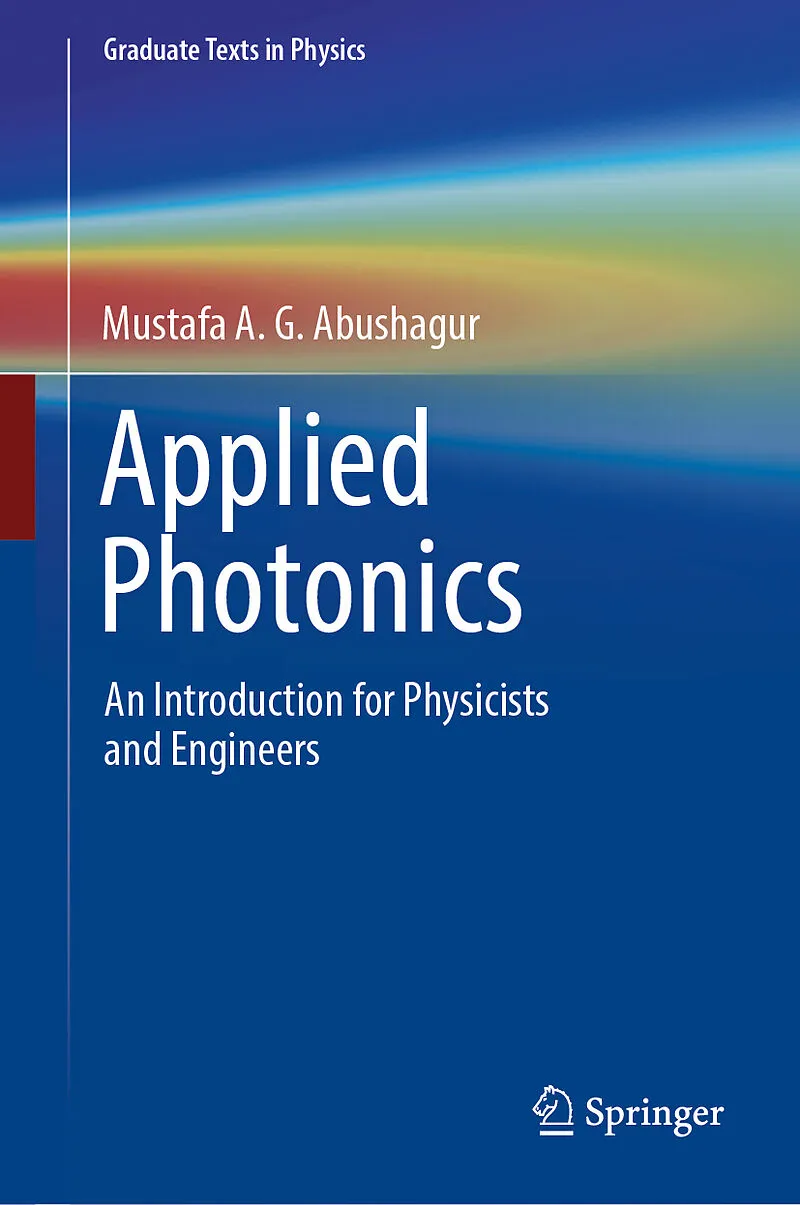
This textbook provides upper-undergraduate and graduate students in engineering and physics with a well-rounded foundation in optics and photonics, equipping them to tackle a wide range of research challenges. The first part of the book introduces readers to ...This textbook provides upper-undergraduate and graduate students in engineering and physics with a well-rounded foundation in optics and photonics, equipping them to tackle a wide range of research challenges.
The first part of the book introduces readers to the classical wave theory of light, exploring the fundamental question: What is the nature of light? Meanwhile, the second part approaches light as a stream of photons.
In the first part, readers learn the principles of geometrical optics, essential for analyzing and designing imaging optical systems and laser resonators. Physical optics is covered in detail, addressing key phenomena such as interference, diffraction, and interferometry, along with a comprehensive chapter on Fourier optics. The discussion extends to the application of wave theory to optical waveguides, which are fundamental for both discrete and integrated laser resonators, forming the foundation of photonic integrated circuits.
The second part of the book begins with an introduction to quantum mechanical principles necessary for designing semiconductor light sources, including laser diodes, light-emitting diodes, photodetectors, and light modulators. It concludes with a discussion on modern photonics applications, particularly optical communication systems, which have played a pivotal role in enabling the internet age.
With a wealth of worked problems and solutions, this textbook allows students to explore and engage deeply with various optical phenomena. By addressing both the wave and particle nature of light, presenting quantum mechanics in an accessible manner, and covering a broad spectrum of crucial topics, this book serves as an essential resource for courses in optics, photonics, and optoelectronics.
Covers important applications of photonics such as optical communications systems and quantum computing Guides readers from the classical to quantum description of light Includes numerous problems and solutions, as well as MATLAB code
Autorentext
Dr. Mustafa Abushagur is a professor in the Department of Electrical and Microelectronic Engineering at the Rochester Institute of Technology. In 1984, he received his PhD in electrical engineering from the California Institute of Technology. He has over 35 years of experience teaching courses such as a Modern Optics for Engineers, Optoelectronics, Fourier Optics, Optical Fiber Communications, and Optical Information Processing. Dr. Abushagur's key research areas are nanophotonics, plasmonics, photonic microsystems, adaptive signal processing, optical MEMS, optical computing, optical communications, optical interconnects and fiber sensors. In 2002, Abushagur was the founding director of the PhD program in microsystems engineering at the Rochester Institute of Technology. He holds three patents, has published ninety-eight research papers, published a book on Fourier optics, and has been invited to write five book chapters. As a result of his significant contributions to the field ofoptics, the field of photonics, and for pioneering educational programs, Dr. Abushagur was named a fellow of the Optical Society of America and the International Society of Optics and Photonics (SPIE).
Zusammenfassung
This textbook offers both engineering and physics upper undergraduate/graduate students a well-rounded foundation in the fields of optics and photonics to enable them to solve a wide range of research problems. The book begins by guiding readers through the classical wave theory of light and exploring the fundamental questionwhat is light? The second part of the book assumes light as a stream of photons. Here, readers are taught the rules of geometrical optics to analyze and design imaging optical systems and laser resonators. Physical optics are covered to address phenomena such as interference, diffraction, and interferometry. A comprehensive chapter on Fourier optics is also included. Both discrete and integrated laser resonators which make the foundation of photonic integrated circuits are discussed in detail. The author introduces readers to the quantum mechanical principles needed for analyzing and designing semiconductor light sources such as laser diodes, light-emitting diodes, photoreactors, and light modulators. The third and final section of the book focuses on the modern applications of photonics, such as the optical communication systems that enabled the internet age and artificial intelligence as well as optical and quantum information processing for quantum computing.
This textbook includes a wealth of worked problems and solutions, as well as MATLAB code for students to study and explore the various optical phenomena that are discussed. By focusing on both sides of the dual nature of light and their corresponding phenomena, including a presentation of quantum mechanics that is accessible to those with no background, and covering a vast range of important topics, this textbook sets itself apart as an essential textbook for optics, photonics, and optoelectronics courses.
Inhalt
Chapter 1: What is Light?.- Chapter 2: Geometrical Optics.- Chapter 3: Physical Optics.- Chapter 4: Fourier Optics.- Chapter 5: Light Polarization.- Chapter 6: Optical Beams and Resonators.- Chapter 7: Optical Waveguides.- Chapter 8: Optical Fibers.- Chapter 9: Introduction to Quantum Mechanics.- Chapter 10: Semiconductor Energy Bands.- Chapter 11: Optoelectronic Semiconductors.- Chapter 12: Semiconductor Light Sources.- Chapter 13: Optical Detectors.- Chapter 14: Optical Modulators.- Chapter 15: Optical Fiber Communication Systems.
10%