
IHR WARENKORB IST AKTUELL LEER.
Haben Sie noch nichts passendes gefunden? Stöbern Sie durch unser komplettes Sortiment.
Oder melden Sie sich an bzw. registrieren Sie sich.
- Kostenlose Lieferung
- Kauf auf Rechnung
- Ex Libris Tiefpreis
- Filiallieferung und 650+ Abholorte
- Rabatt-Bons als Club-Mitglied
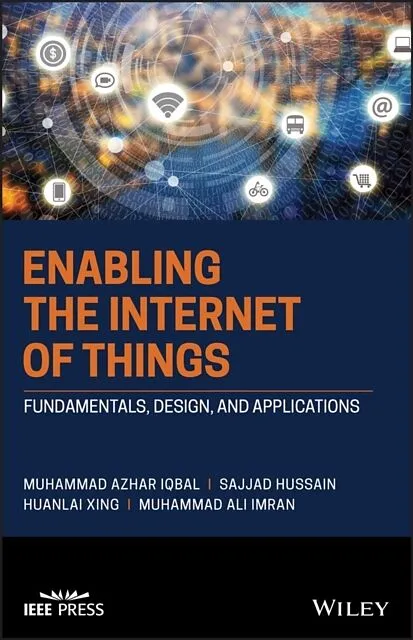
Enabling the Internet of Things
Beschreibung
LEARN MORE ABOUT FOUNDATIONAL AND ADVANCED TOPICS IN INTERNET OF THINGS TECHNOLOGY WITH THIS ALL-IN-ONE GUIDE Enabling the Internet of Things: Fundamentals, Design, and Applications delivers a comprehensive starting point for anyone hoping to understand the f...
Format auswählen
- Fester EinbandCHF 150.00

Wird oft zusammen gekauft
Andere Kunden kauften auch
Beschreibung
LEARN MORE ABOUT FOUNDATIONAL AND ADVANCED TOPICS IN INTERNET OF THINGS TECHNOLOGY WITH THIS ALL-IN-ONE GUIDE
Enabling the Internet of Things: Fundamentals, Design, and Applications delivers a comprehensive starting point for anyone hoping to understand the fundamentals and design of Internet of Things (IoT) systems. The book's distinguished academics and authors offer readers an opportunity to understand IoT concepts via programming in an abstract way. Readers will learn about IoT fundamentals, hardware and software components, IoT protocol stacks, security, IoT applications and implementations, as well as the challenges, and potential solutions, that lie ahead.
Readers will learn about the social aspects of IoT systems, as well as receive an introduction to the Blockly Programming Language, IoT Microcontrollers, IoT Microprocessors, systems on a chip and IoT Gateway Architecture. The book also provides implementation of simple code examples in Packet Tracer, increasing the usefulness and practicality of the book. Enabling the Internet of Things examines a wide variety of other essential topics, including:
- The fundamentals of IoT, including its evolution, distinctions, definitions, vision, enabling technologies, and building blocks
- An elaboration of the sensing principles of IoT and the essentials of wireless sensor networks
- A detailed examination of the IoT protocol stack for communications
- An analysis of the security challenges and threats faced by users of IoT devices, as well as the countermeasures that can be used to fight them, from the perception layer to the application layer
Perfect as a supplementary text for undergraduate students taking computer science or electrical engineering courses, Enabling the Internet of Things also belongs on the bookshelves of industry professionals and researchers who regularly work with and on the Internet of Things and who seek a better understanding of its foundational and advanced topics.
Autorentext
MUHAMMAD AZHAR IQBAL, PHD, is Lecturer (Assistant Professor) at the Southwest Jiaotong University in China. He obtained his PhD in Communication and Information Systems from Huazhong University of Science and Technology, China, in 2012. SAJJAD HUSSAIN, PHD, is Senior Lecturer (Associate Professor) at the University of Glasgow in the United Kingdom. He received his doctorate in Signal Processing and Communications from the University of Rennes 1 in France in 2009. HUANLAI XING, PHD, is Associate Professor at the Southwest Jiaotong University in China. He received his PhD in Computer Science at the University of Nottingham in the United Kingdom in 2013. MUHAMMAD ALI IMRAN, PHD, is Professor of Communication Systems in James Watt School of Engineering at the University of Glasgow in the United Kingdom and Dean University of Glasgow, UESTC.
Inhalt
About the Authors xiii
Preface xv
Acknowledgments xix
1 Internet of Things (IoT) Fundamentals 1
1.1 Introduction 1
1.2 Evolution of IoT Concept 2
1.3 IoT Vision 3
1.4 IoT Definition 5
1.5 IoT Basic Characteristics 6
1.6 IoT Distinction 7
1.6.1 IoT Versus Embedded Systems 7
1.6.2 IoT Versus M2M 7
1.6.3 IoT Versus CPS 7
1.6.4 IoT Versus WSN 8
1.6.5 IoT Versus WoT 8
1.7 IoT General Enablers 9
1.7.1 Identification and Sensing Technologies 10
1.7.2 Wireless Communication and Networking 11
1.7.3 Aggregation Standardization 14
1.7.4 Augmented Intelligence 14
1.7.5 Augmented Behavior 15
1.8 IoT Architectures 16
1.8.1 Three-layer IoT Architecture 17
1.8.1.1 Perception Layer 17
1.8.1.2 Network Layer 18
1.8.1.3 Application Layer 18
1.8.2 Five-Layer IoT Architecture 19
1.8.2.1 Object (Perception) Layer 19
1.8.2.2 Object Abstraction (Network) Layer 19
1.8.2.3 Service Management (Middleware) Layer 19
1.8.2.4 Application Layer 19
1.8.2.5 Business Layer 19
1.8.3 Six-layer Architecture 20
1.8.3.1 Focus Layer 21
1.8.3.2 Cognizance Layer 21
1.8.3.3 Transmission Layer 21
1.8.3.4 Application Layer 21
1.8.3.5 Infrastructure Layer 21
1.8.3.6 Competence Business Layer 21
1.8.4 Seven-layer Architecture 21
1.8.4.1 Layer 1: Things Layer 21
1.8.4.2 Layer 2: Connectivity 21
1.8.4.3 Layer 3: Edge/Fog Computing 22
1.8.4.4 Layer 4: Data Accumulation 23
1.8.4.5 Layer 5: Data Abstraction Layer 23
1.8.4.6 Level 6: Application Layer 23
1.8.4.7 Layer 7: Collaboration and Processes 23
1.9 Advantages and Disadvantages of IoT 23
Review Questions 23
References 25
2 IoT Building Blocks - Hardware and Software 29
2.1 IoT Building Blocks 29
2.2 The Smart Things 29
2.2.1 Smart Thing Sensor 30
2.2.2 Smart Thing Communicator 31
2.2.3 Smart Thing Actuator 31
2.2.4 Smart Thing Controller 32
2.2.4.1 Microcontroller (MCU) 32
2.2.4.2 Development Boards 32
2.2.4.3 Packet Tracer and MCUs 33
2.2.5 Smart Thing Capabilities 36
2.3 The IoT Gateway 38
2.4 Network Infrastructure 39
2.5 IoT Cloud 39
2.5.1 Virtual Resource Pool 39
2.5.2 Application Server 39
2.5.3 Database Servers 40
2.5.4 Load-balancing Servers 41
2.6 IoT Analytics 41
2.6.1 IoT Analytics - Tools and Techniques 42
2.6.2 IoT Analytics Life Cycle 43
2.7 IoT Applications 43
Review Questions 43
References 45
3 Sensing Principles and Wireless Sensor Network 49
3.1 Sensor Fundamentals 49
3.2 Sensor Classification 51
3.2.1 Simple (Direct) Sensor Versus Complex Sensor 51
3.2.2 Active Sensors Versus Passive Sensors 51
3.2.3 Contact Sensors Versus Noncontact Sensors 52
3.2.4 Absolute Sensors and Relative Sensors 52
3.2.5 Digital Sensors Versus Analog Sensors (Based on Output) 52
3.2.6 Scalar Sensor Versus Vector Sensors (Based on Data Types) 52
3.3 Anatomy of Sensors 52
3.4 Physical Principles of Sensing 53
3.4.1 Capacitance 53
3.4.1.1 Examples of Capacitive Sensors 55
3.4.2 Magnetism and Induction 57
3.4.2.1 Magnetic Sensing Examples 59
3.4.3 Electric Resistance and Resistivity 60
3.4.3.1 Resistive Sensor Applications 61
3.4.4 Piezoelectric Effect 61
3.5 Use of Basic Sensing Principles in RFID Technology 61
3.6 Actuators 62
3.7 Wireless Sensor Networks (WSNs) 63
3.7.1 WSN Architecture 63
3.7.2 Types of WSNs 64
3.7.3 General Characteristics of WSNs 64
3.7.4 Protocol Stack of WSNs 65
3.7.4.1 Physical Layer 65
3.7.4.2 Data Link Layer (DLL) 66
3.7.4.3 Network Layer 68
3.7.4.4 Transport Layer 68
3.7.4.5 Application Layer 69
3.7.4.6 Cross-layer WSN Protocols 69
3.7.5 WSN Operating Systems 69
3.7.5.1 WSN OS Design Issues 71
Review Questions 72
References 72
4 IoT Gateway 75
4.1 The IoT Gateway 75
4.2 Sensing Domain and IoT Gateways 77
4.3 The Architecture of IoT Gateway 79
4.3.1 Hardware Layer of IoT Gateway 79
4.3.2 OS Layer of IoT Gateway 80
4.3.3 Hardware Abstraction Layer 80
4.3.4 Data Forwarding Layer 80
4.3.5 Service Abstraction Layer 81
4.3.6 Manageability Layer 81
4.3.7 Security Layer 81
4.3.8 Application Layer 81
4.4 Selection of IoT Gateway 81
4.4.1 Nature of IoT System Architecture 81
4.4.2 Multiple Network Connectivity Support 82
4.4.3 Data Storage Capacity 82
4.4.4 Development Environment 82
4.4.5 Robust Security Mechanism 82
4.4.6 External Hardware Watchdog Timer 83
4.4.7 Time Synchronization 83
4.4.8 Firmware Update 83
4.4.9 LED Indication and Remote Reboot 83
4.4.10 Support for Legacy Equipment 83
4.4.11 Standard Protocol Support 83
4.4.12 Gateway Certification 83
4.4.13 Control of Low Power Footprint 84
4.4.14 Support for Edge Computing 84
4.5 IoT Gateways and Edge Computing 84
4.5.1 Benefits of Edge Computing 84
4.5.2 Use Cases of Edge Computing 85
4.5.2.1 Smart Home 85
4.5.2.2 Cooperative Safety Smart Vehicles 86
4.5.2.3 Provisioning of Infotainment Services for Smart Vehicles 86
4.5.2.4 Online Shopping Service 86
4.5.2.5 Healthcare and Collaborative Edge 86
4…