
IHR WARENKORB IST AKTUELL LEER.
Haben Sie noch nichts passendes gefunden? Stöbern Sie durch unser komplettes Sortiment.
Oder melden Sie sich an bzw. registrieren Sie sich.
- Kostenlose Lieferung
- Kauf auf Rechnung
- Ex Libris Tiefpreis
- Filiallieferung und 650+ Abholorte
- Rabatt-Bons als Club-Mitglied
CONT MAILLARD PATH GEN FLAV 1042 ACSSS C
Beschreibung
Informationen zum Autor Donald Mottram;Andrew Taylor Klappentext The role of the Maillard reaction in forming flavors from amino acid and sugar precursors has been studied for many years. To establish the basic chemistry of the reaction, researchers have used ...Format auswählen
- Fester EinbandCHF 186.80
Wird oft zusammen gekauft
Andere Kunden kauften auch
Beschreibung
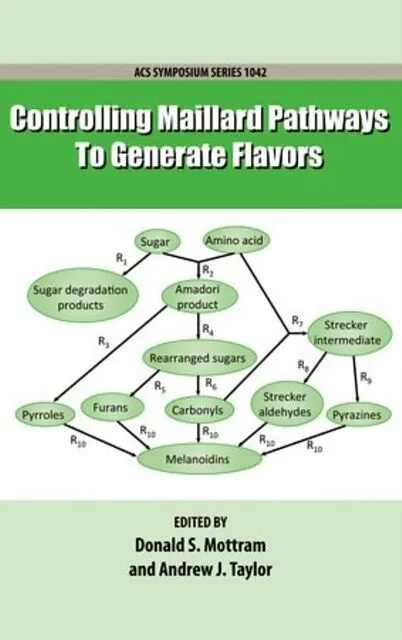
Informationen zum Autor Donald Mottram;Andrew Taylor Klappentext The role of the Maillard reaction in forming flavors from amino acid and sugar precursors has been studied for many years. To establish the basic chemistry of the reaction, researchers have used model systems, often solutions of a single amino acid with a single sugar. Despite the apparent simplicity of the system, heating such a solution can generate tens if not hundreds of compounds, which requires careful and time-consuming analysis to identify and quantify eachcomponent. Data from the model systems has allowed researchers to study the pathways that lead to flavor formation, and various schemes have been proposed to identify the main "routes" that lead to flavor compounds. Such schemes have led to one of the main control principles, namely an understanding of the role of amino acids in forming some characteristic aromas, e.g., bread flavor from proline, as well as an appreciation of the role of C5 and C6 sugars in controlling the rate of reaction. Recently, the formation of taste compounds through the Maillard reaction has been investigated and new potent compounds have been discovered that can contribute to the overall flavor formed during the Maillard reaction. These findings also offer the potential for control and manipulation of the Maillard reaction to form specific types of flavor. Although the nature of the end-products of the Maillard reaction in both food and model systems are well documented, applying these principles tocontrol flavor formation in real foods has proved difficult. This book describes recent research and developments related to the control of the Maillard reaction to give optimum flavor quality. These include kinetic modeling of the reaction, the effect of physical parameters (temperature, time, moisture content, pH), and the effect of chemical parameters (amino acid and sugar composition, the presence of other components). The topics covered relate to real food systems and reaction product flavorings, as well as model systems. Contributors from academiaand industry have come together to provide an up to date overview of progress in this important area of flavor research. Zusammenfassung The role of the Maillard reaction in forming flavors from amino acid and sugar precursors has been studied for many years. To establish the basic chemistry of the reaction, researchers have used model systems, often solutions of a single amino acid with a single sugar. Despite the apparent simplicity of the system, heating such a solution can generate tens if not hundreds of compounds, which requires careful and time-consuming analysis to identify and quantify eachcomponent. Data from the model systems has allowed researchers to study the pathways that lead to flavor formation, and various schemes have been proposed to identify the main "routes" that lead to flavor compounds. Such schemes have led to one of the main control principles, namely an understanding of the role of amino acids in forming some characteristic aromas, e.g., bread flavor from proline, as well as an appreciation of the role of C5 and C6 sugars in controlling the rate of reaction. Recently, the formation of taste compounds through the Maillard reaction has been investigated and new potent compounds have been discovered that can contribute to the overall flavor formed during the Maillard reaction. These findings also offer the potential for control and manipulation of the Maillard reaction to form specific types of flavor. Although the nature of the end-products of the Maillard reaction in both food and model systems are well documented, applying these principles tocontrol flavor formation in real foods has proved difficult. This book describes recent research and developments related to the control of the Maillard reaction to give optimum flavor quality. These include kinetic modeling of the reaction, the effect of physical p...
Autorentext
Donald Mottram;Andrew Taylor
Klappentext
The role of the Maillard reaction in forming flavors from amino acid and sugar precursors has been studied for many years. To establish the basic chemistry of the reaction, researchers have used model systems, often solutions of a single amino acid with a single sugar. Despite the apparent simplicity of the system, heating such a solution can generate tens if not hundreds of compounds, which requires careful and time-consuming analysis to identify and quantify each component. Data from the model systems has allowed researchers to study the pathways that lead to flavor formation, and various schemes have been proposed to identify the main "routes" that lead to flavor compounds. Such schemes have led to one of the main control principles, namely an understanding of the role of amino acids in forming some characteristic aromas, e.g., bread flavor from proline, as well as an appreciation of the role of C5 and C6 sugars in controlling the rate of reaction. Recently, the formation of taste compounds through the Maillard reaction has been investigated and new potent compounds have been discovered that can contribute to the overall flavor formed during the Maillard reaction. These findings also offer the potential for control and manipulation of the Maillard reaction to form specific types of flavor. Although the nature of the end-products of the Maillard reaction in both food and model systems are well documented, applying these principles to control flavor formation in real foods has proved difficult. This book describes recent research and developments related to the control of the Maillard reaction to give optimum flavor quality. These include kinetic modeling of the reaction, the effect of physical parameters (temperature, time, moisture content, pH), and the effect of chemical parameters (amino acid and sugar composition, the presence of other components). The topics covered relate to real food systems and reaction product flavorings, as well as model systems. Contributors from academia and industry have come together to provide an up to date overview of progress in this important area of flavor research.
Inhalt
Preface; 1. Predictive Modeling of Flavor Compound Formation in the Maillard Reaction: A SWOT Analysis; M. A. J. S. van Boekel; 2. Kinetic Modeling of the Formation of Volatile Compounds in Heated Beef Muscle Extracts Containing Added Ribose; Dimitrios P. Balagiannis, Jack Howard, Jane K. Parker, Neil Desforges, and Donald S. Mottram; 3. Dicarbonyl Intermediates: A Control Factor in the Maillard Reaction; Yu Wang and Chi-Tang Ho; 4. Dicarbonyls from Maillard Degradation of Glucose and Maltose; M. A. Glomb, J. Gobert, and M. Voigt; 5. Generation of 4-Hydroxy-2,5-dimethyl-3(2H)-furanone during Extrusion Cooking: A Multidisciplinary Approach; Tomas Davidek, Silke Illmann, Andreas Rytz, Helene Chanvrier, Greet Vandeputte, Heike P. Schuchmann, Imre Blank, and Josef Kerler; 6. Hydroxycinnamic Acid - Maillard Reactions in Simple Aqueous Model Systems; Marlene R. Moskowitz and Devin G. Peterson; 7. Science and Serendipity: The Maillard Reaction and the Creative Flavo