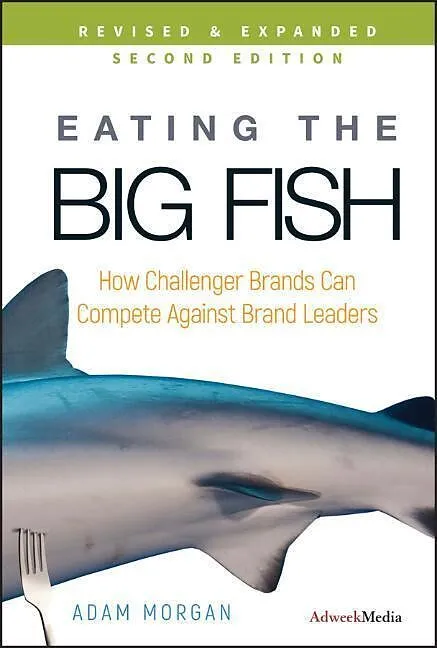
Eating the Big Fish
Beschreibung
A revised and updated version of the classic book on what it takes for small brands to eat the big tuna Since Wiley first published Eating the Big Fish in 1999, the concept of the challenger brand has become a mainstream idea among marketers and advertisers. I...Format auswählen
- Fester EinbandCHF 42.30

Wird oft zusammen gekauft
Andere Kunden kauften auch
Beschreibung
A revised and updated version of the classic book on what it takes for small brands to eat the big tuna Since Wiley first published Eating the Big Fish in 1999, the concept of the challenger brand has become a mainstream idea among marketers and advertisers.
Introduces a different typology of 12 different kinds of Challengers.
"Eating the Big Fish is a lucid, well organized and well executed analysis of successful Challenger strategies...Highly recommended." (TheBookBag.co.uk, April 23rd 2009)
Autorentext
ADAM MORGAN is a partner in eatbigfish (www.eatbigfish.com), an international brand and marketing consultancy specializing in Challenger brand strategy, behavior, and culture. Previously an executive with TBWA\Chiat\Day, one of the world's largest advertising agencies, he has worked with clients like IKEA, Unilever, Virgin, and Apple. He and his partners together run The Challenger Project, the evolving research into how Challenger brands think and behave, on which their thinking, writing, and speaking is based.
Klappentext
Once upon a time, spirited David challenged the towering Goliath. Forty years ago, rental car company Avis challenged Hertz-the big fish in its industry-and won a larger, more profitable share of the market by "trying harder." Today, Challengers such as method, JetBlue, Nintendo Wii, and Linux successfully compete with much bigger brands in their markets by redefining in their favor the criteria consumers use to make choices. The leaders in any market are never in reality invulnerable; they just seem that way before a smart, focused, Challenger brand takes them on. Updated and revised with additional chapters and thirty new examples of Challenger brands in action, the Second Edition of Eating the Big Fish reflects recent developments in the marketplace and media since the publication of the bestselling and influential first edition. Author Adam Morgan-who, with his company, has researched and worked with Challengers over the last decade-presents and analyzes the effective marketing tactics Challenger brands use to raise their profiles and take market share. Morgan provides practical advice and plentiful, easy-to-follow examples to show how a Challenger brand can get noticed and steal customers from competitors with much bigger advertising and marketing budgets. He presents eight Challenger credos that stress bringing a fresh perspective to market, building a prominent and emotionally appealing identity, implementing a pervasive communication strategy, and focusing intently on ideas rather than consumers. This new edition explores what needs to change and what needs to stay the same for Challenger brands in the shifting communications landscape of media, technology, and the Web. Most important, it affirms that Challenger brands are alive, well, and hungry. If you want to increase the profile and the profitability of your brand against bigger competitors, this book puts the big fish on your menu.
Inhalt
Preface xiii
Foreword by Antonio Lucio xxi
Part 1 The Size and Nature of the Big Fish 1
1 The Law of Increasing Returns 3
The task facing a Challenger in competing strongly against a Market Leader is more intimidating than we might have imagined. This chapter explores the scale of the advantages their superior size-and the fact of leadership-brings, and points to why we need as Challengers to consider a different kind of strategic approach in order to succeed.
2 The Consumer Isn't 13
Marketeers step into this new business world equipped with a set of basic assumptions about their business that have by now become dangerously flawed. The fundamental premises underlying everyday marketing vocabulary such as consumer, audience, and category require careful reexamination, and the implications of their weaknesses need to be understood-in particular, the consequent need for ideas, rather than communications, as the new currency of growth.
3 What Is a Challenger Brand? 24
This chapter offers an entirely new kind of brand model for second-rank brands finding themselves threatened by the Brand Leader-the model of the Challenger brand. A Challenger brand is defined through three attributes: a state of market, a state of mind, and a rate of success. This chapter concludes by explaining how the core brands considered in Part 2 came to be chosen, and gives
an example of how the book attempts to turn each significant Challenger case history into a relevant exercise that can be valuably applied to the marketeer's own brand.
Part 2 The Eight Credos of Successful Challenger Brands 33
What marketing characteristics do the great Challenger brands and companies of the past 15 years share? If we could identify those characteristics, how could we apply them to our own situation
to generate a source of personal business advantage?
This section identifies and discusses the common marketing strands these brands have shared and devotes eight chapters to discussing each in turn.
4 The First Credo: Intelligent Naivety 35
The great wave makers in any category are those who are new to it-like Jeff Bezos, who came out of finance to change the way books were sold, or Eric Ryan of method, who left advertising to reinvent the household cleaning business. This chapter looks at the need for marketeers to break free from the clutter of little pieces of knowledge that are the basis of their strategic thinking in order to see the real opportunities for radical growth. It also offers ways for those already deeply experienced in a category to achieve this vital innocence.
5 Monsters and Other Challenges: Gaining Clarity on the Center 61
Once you have explored the potential opportunities available to you as a Challenger, it is time to be clear about what your challenge to the category or another category player is going to be. This chapter explores a structure for thinking about that central challenge and discusses the key options open to us; this clarity is also a key part of laying the foundations for the strategic thinking that follows.
6 The Second Credo: Build a Lighthouse Identity 80
Success as a Challenger comes through developing a very clear sense of who or what you are as a brand/business and why-and then projecting that identity intensely, consistently, and saliently
to the point where, like a lighthouse, consumers notice you (and know where you stand) even if they are not looking for you. This chapter looks at the roots, source, and nature of such identities and how successful Challengers have built them.
7 The Third Credo: Take Thought Leadership of the Category 109
Marketeers tend to talk as if there is one Brand Leader in every category. In fact, there are two: the Market Leader (the brand with the biggest share and the biggest distribution) and the Thought
Leader-the brand that, while it may not be the largest, is the one that everyone is talking about, that has the highest ''sensed momentum'' in the consumer's mind. In this chapter the nature of Thought Leadership is analyzed, and the methods of achieving it are explored.
8 The Fourth Credo: Create Symbols of Re-evaluation 134
Successful Challengers are brands in a hurry: they desire (and need) to puncture the consumer's autopilot and create reappraisal of themselves and their category swiftly and powerfully. To do so,
they create big, impactful acts or marketing ideas that capture the indifferent consumer's imagination and bring about a rapid re-evaluation of their image in the consumer's mind, and role in the consumer's
life. This chapter discusses some of the most striking of these symbols, what specifically it was about them that achieved the results they did, and what set them apart them from being just another publicity stunt.
9 The Fifth Credo: Sacrifice 156
Challengers have fewer resources in almost every aspect of the business and marketin…