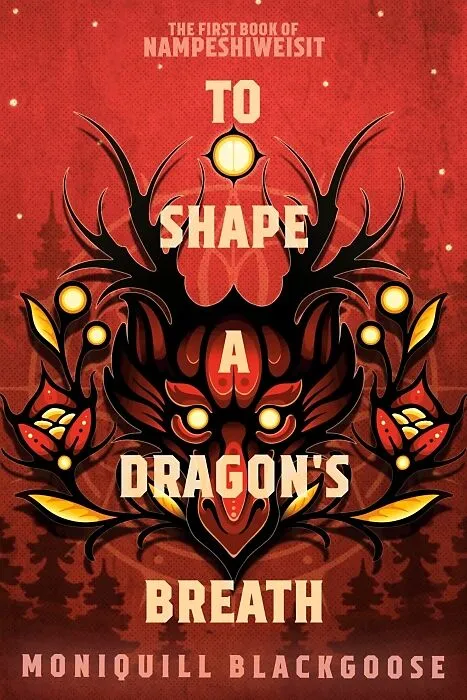
To Shape a Dragon's Breath
Beschreibung
A young Indigenous woman enters a colonizer-run dragon academy--and quickly finds herself at odds with the “approved” way of doing things--in the first book of this brilliant new fantasy series. The remote island of Masquapaug has not seen a dragon...Format auswählen
- Kartonierter EinbandCHF 21.90

Wird oft zusammen gekauft
Andere Kunden kauften auch
Beschreibung
A young Indigenous woman enters a colonizer-run dragon academy--and quickly finds herself at odds with the “approved” way of doing things--in the first book of this brilliant new fantasy series. The remote island of Masquapaug has not seen a dragon in many generations--until fifteen-year-old Anequs finds a dragon’s egg and bonds with its hatchling. Her people are delighted, for all remember the tales of the days when dragons lived among them and danced away the storms of autumn, enabling the people to thrive. To them, Anequs is revered as Nampeshiweisit--a person in a unique relationship with a dragon. Unfortunately for Anequs, the Anglish conquerors of her land have different opinions. They have a very specific idea of how a dragon should be raised, and who should be doing the raising--and Anequs does not meet any of their requirements. Only with great reluctance do they allow Anequs to enroll in a proper Anglish dragon school on the mainland. If she cannot succeed there, her dragon will be killed. For a girl with no formal schooling, a non-Anglish upbringing, and a very different understanding of the history of her land, challenges abound--both socially and academically. But Anequs is smart, determined, and resolved to learn what she needs to help her dragon, even if it means teaching herself. The one thing she refuses to do, however, is become the meek Anglish miss that everyone expects. Anequs and her dragon may be coming of age, but they’re also coming to power, and that brings an important realization: the world needs changing--and they might just be the ones to do it.
Autorentext
Moniquill Blackgoose is the bestselling author of To Shape a Dragon’s Breath, which has won both the Nebula and Lodestar Awards. She began writing science fiction and fantasy when she was twelve and hasn’t stopped writing since. She is an enrolled member of the Seaconke Wampanoag Tribe and a lineal descendant of Ousamequin Massasoit. She is an avid costumer and an active member of the steampunk community. She has blogged, essayed, and discussed extensively across many platforms the depictions of Indigenous and Indigenous-coded characters in sci-fi and fantasy.
Klappentext
**NATIONAL BESTSELLER • WINNER OF THE ASTOUNDING, NEBULA, AND LODESTAR AWARDS • FINALIST FOR THE LOCUS AND BRITISH FANTASY NEWCOMER AWARDS • “My favorite book of the year . . . a coming-of-age story that is cozy and hair-raising in equal measure.”—Charlie Jane Anders, The Washington Post
“I tore through it, caught up in an enthusiasm for dragons that I hadn’t experienced since I was a teenager obsessed with Ursula Le Guin’s Earthsea and Anne McCaffrey’s Pern.”—NPR
A BEST BOOK OF THE YEAR: The Washington Post, NPR, PopSugar, Chicago Public Library, Polygon, She Reads, Autostraddle
The remote island of Masquapaug has not seen a dragon in many generations—until fifteen-year-old Anequs finds a dragon’s egg and bonds with its hatchling. Her people are delighted, for all remember the tales of the days when dragons lived among them and danced away the storms of autumn, enabling the people to thrive. To them, Anequs is revered as Nampeshiweisit—a person in a unique relationship with a dragon.
Unfortunately for Anequs, the Anglish conquerors of her land have different opinions. They have a very specific idea of how a dragon should be raised, and who should be doing the raising—and Anequs does not meet any of their requirements. Only with great reluctance do they allow Anequs to enroll in a proper Anglish dragon school on the mainland. If she cannot succeed there, her dragon will be killed.
For a girl with no formal schooling, a non-Anglish upbringing, and a very different understanding of the history of her land, challenges abound—both socially and academically. But Anequs is smart, determined, and resolved to learn what she needs to help her dragon, even if it means teaching herself. The one thing she refuses to do, however, is become the meek Anglish miss that everyone expects.
Anequs and her dragon may be coming of age, but they’re also coming to power, and that brings an important realization: the world needs changing—and they might just be the ones to do it.
Leseprobe
I was gathering mussels on Slipstone Island when I saw the dragon.
I’d never seen a proper dragon before, but there was no mistaking it for anything else. It had come walking out of the scraggy stand of pine trees at the base of the temple mound and was standing on the rocky hillside, looking out to sea.
It was red and gold and glorious with the evening sun behind it, like a hillside in autumn. From nose to tail it was twice as long as my canoe, and from wing tip to wing tip three times as long. It had a crown of antlers that must have come to thirty points or more. It stretched its wings, and the sun came through them, showing the scarlet net of its bloodworks. It had a long, sinuous body, like an otter or a fisher. Its neck double-curved like a heron’s. Its mane was bloodred, each spiky feather tipped with black, and it had black markings on its eyes and muzzle and along the rims of its deerlike ears.
For a very long time, it did nothing. It sat poised in the sun with its wings outstretched while I stared, hardly able to breathe. We hadn’t had dragons on Masquapaug since the great dying. Anglish and Vaskosish dragons in Catchnet didn’t count; they’d come later. This was a . . . Nampeshiwe. That was the word for it. The kind of dragon that belonged here.
A seagull screamed, and a pair of them wheeled down to land on my abandoned basket of mussels. I turned to shoo them away, and when I turned back, the dragon was looking at me.
Its eyes were sorrow. Golden, and keenly intelligent, and holding a sadness so howlingly deep that I felt my throat tightening. The dragon looked over its shoulder, back into the trees. Back to where the ruined temple was. It seemed to sigh heavily as it looked at me again.
The dragon turned and leaped off the hillside, falling effortlessly into flight with a few flaps of its enormous wings, gliding away over the surface of the ocean. Eastward, into the darkness of twilight.
In the distance behind me, I heard Sigoskwe call my name.
“Anequs! Anequs, what are you doing?”
A minute later I heard his footsteps thumping on the wet sand.
“What happened?” he asked, panting, as I finally turned to look at him. “What’d you see?”
“A dragon,” I said faintly. “Up on the hill there.” I gestured with a nod to where the dragon had been. “It flew away.”
“What kind of a dragon? Anglish or Vaskosish? Who was riding it?” Sigoskwe asked.
“No. Not an Anglish dragon. A . . . real one. A Nampeshiwe. Nobody was riding it.”
Sigoskwe looked up at me and crossed his arms.
“Nampeshiwe aren’t a thing anymore.”
I shook my head and looked back across the water, where the dragon had gone. Slipstone Island was the easternmost island; there was nothing past it but bits of wet rock fit for seals and then miles and miles of ocean. Where could it possibly be going?
“You’re not kidding, are you?” Sigoskwe asked after a long silence.
“No,” I said, shaking my head. “I saw it.”
“Did you see it or did you see it see it? Like a vision or something?” He seemed very excited at the idea that it might have been a vision. Having a big sister who had visions would be something worth talking about.
“I think it was real?” I said, no longer certain. “I’ve never had visions befor…