Beschreibung
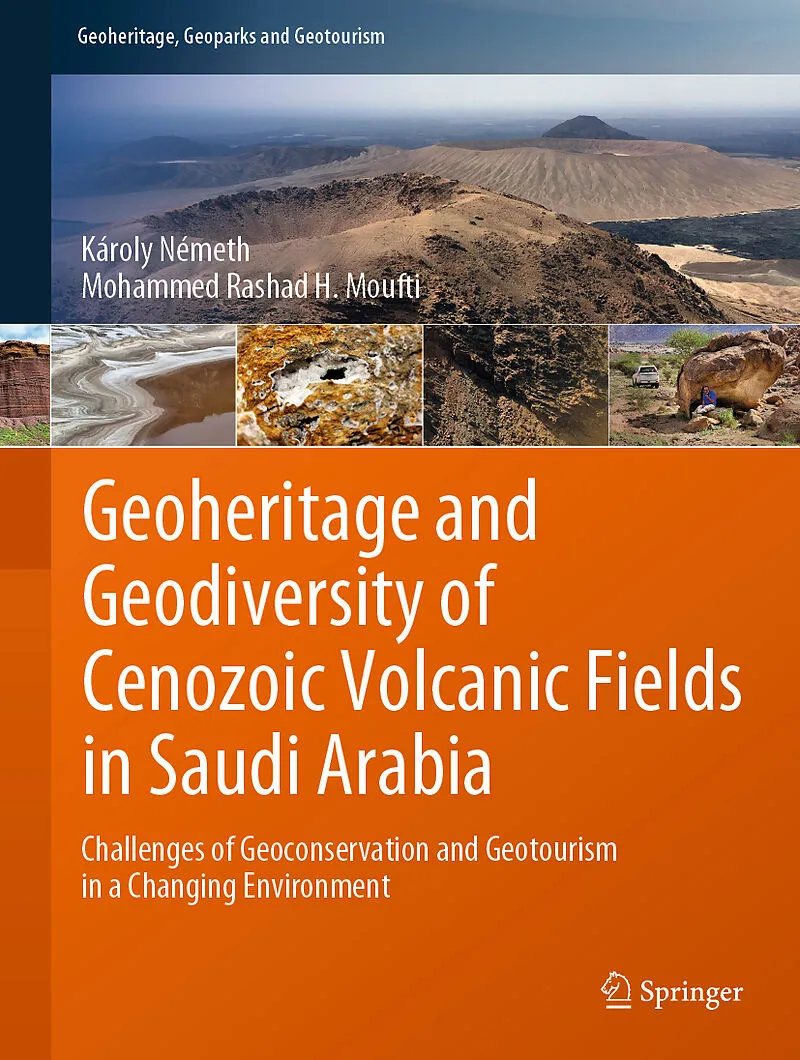
Saudi Arabia hosts at least six major volcanic fields located on the western margin of the Arabian Peninsula. The volcanic surface covered is comparable to about a fifth of the land surface of the country and the distinct appearance of the volcanic landscape ...Saudi Arabia hosts at least six major volcanic fields located on the western margin of the Arabian Peninsula. The volcanic surface covered is comparable to about a fifth of the land surface of the country and the distinct appearance of the volcanic landscape of the region is deeply engraved in the geo-cultural perspective of the territory. Volcanic fields, especially their extensive lava fields form one of the largest if not the largest volcanic region on Earth, which are occupied by the most common volcanic landforms not only on Earth but the known Solar System. Volcanic fields are a vital part of the geoheritage and geodiversity elements of the Arabian Peninsula and beyond in the Middle East.
Here we provide the most up-to-date overview of the geoheritage and geoheritage elements of these huge volcanic provinces both qualitative and quantitative outlines of their geodiversity and link to biodiversity. The volcanic province will be treated from the ecosystem, and geosystem services perspective and explore the challenges of such a concept in a region that is primarily industry and resource-based economy driven. This book will look beyond the traditional approach of describing geoheritage of volcanic regions as it will provide a conceptual framework for dispersed volcanic fields where scale and scope to define and estimate the value of geoheritage requires different approaches than those applied for long-lived polygenetic volcanoes.
This book aims to provide a succinct overview of geoheritage and geodiversity aspects of monogenetic volcanic fields tested in an area globally outstanding and volcanically active. The book intends to be a good specialist handbook for a broad range of audiences from geologists, volcanologists, natural hazard experts, geoconservation experts, social geology experts, geotourism operators, and heritage researchers. The book will be a valuable resource for anyone directly or indirectly involved or wish to be involved in local development projects or experts looking for external information to apply to volcanic fields elsewhere.
A fundamental research output for future developments for nature conservation and geopark development The first comprehensive summary of volcanic geoheritage and geodiversity of large monogenetic volcanic fields Rich in illustrations, carthography and additional electronic material
Autorentext
Károly Németh is an expert at the Saudi Geological Survey working on Volcanology, Geohazard, and Geoheritage of volcanic fields of the Arabian Peninsula. He is also a senior researcher at the Institute of Earth Physics and Space Science, Hungary; a Doctor of Sciences of the Hungarian Academy of Sciences; Adjunct Professor of the Volcanic Risk Solutions, Massey University, New Zealand; and a research affiliate at the National Institute of Geophysics and Volcanology, Italy. He is the Chairperson of the Geoconservation Trust Aotearoa Pacific, based in New Zealand. He was a member of the Executive Committee of the International Association of Volcanology and Chemistry of Earth Interior, leading its Volcaniclastic Sediments, Monogenetic Volcanism and Volcanic Geoheritage commissions. In 2024, he has been elected to be one of the co-leaders of the IAVCEI Commission on Volcano Geology. Currently, he is a Vice President of the International Association of Sedimentologists and Chair of the International Union of Geological Sciences' Sub-commission on Geological Heritage Sites. He has worked in the SW Pacific in the last 20 years focusing on volcanic hazard and geoheritage research mostly in Vanuatu and Samoa. He has spent great deal of time in the region and accumulated substantial amount of knowledge and experiences on Pacific cultures and continuously explored the way how these unique geocultural aspect of the region could be more visible and valued. He has conducted numerous research, supervised and mentored young scientists in Samoa and presented large number of research outputs within the volcanic geoheritage of the Samoan Islands. His family base is in Samoa where his wife, Diana and son, Karcsi comes from. Vladyslav Zakharovskyi is a Junior Research Officer at the Volcanic Risk Solutions, Massey University, Palmerston North, New Zealand. His research focuses on geodiversity calculations, geoheritage categorization, and remote sensing. As a PhD research student at Massey University, he authored several influential publications about geodiversity, specifically focusing on the development of qualitative-quantitative assessments of geodiversity. This method offers practical estimates of geodiversity by identifying geosite hot spots. It is robust enough to use publicly available spatial data and local geoscience knowledge while allowing parameter adjustments for specific purposes such as geotourism or geoconservation projects, from local to global scales. He has worked on geodiversity projects associated with volcanic sites in New Zealand, Samoa, Hungary, and Saudi Arabia. Currently, he is exploring deeper levels of remote sensing in hyperspectral imaging and data processing with the introduction of new techniques into geodiversity studies.
Inhalt
Conceptual Framework of Geoheritage and Geodiversity Estimates of Monogenetic Volcanic Fields: Advances and Challenges.- Systematic Overview of the Geoheritage and Geodiversity of Monogenetic Volcanic Fields of Saudi Arabia.- Geotourism Development and Opportunity of Monogenetic Volcanic Fields of Saudi Arabia.- Ecosystem and Geosystem Perspective of Geoheritage of Volcanic Fields in a Primary Industry Driven Economic Environment: Challenges of Geoconservation.- Geoheritage as an Engine for Development on Resilient Volcanic Hazard Programs: The Geoeducation Opportunity.- Synthesis.