Beschreibung
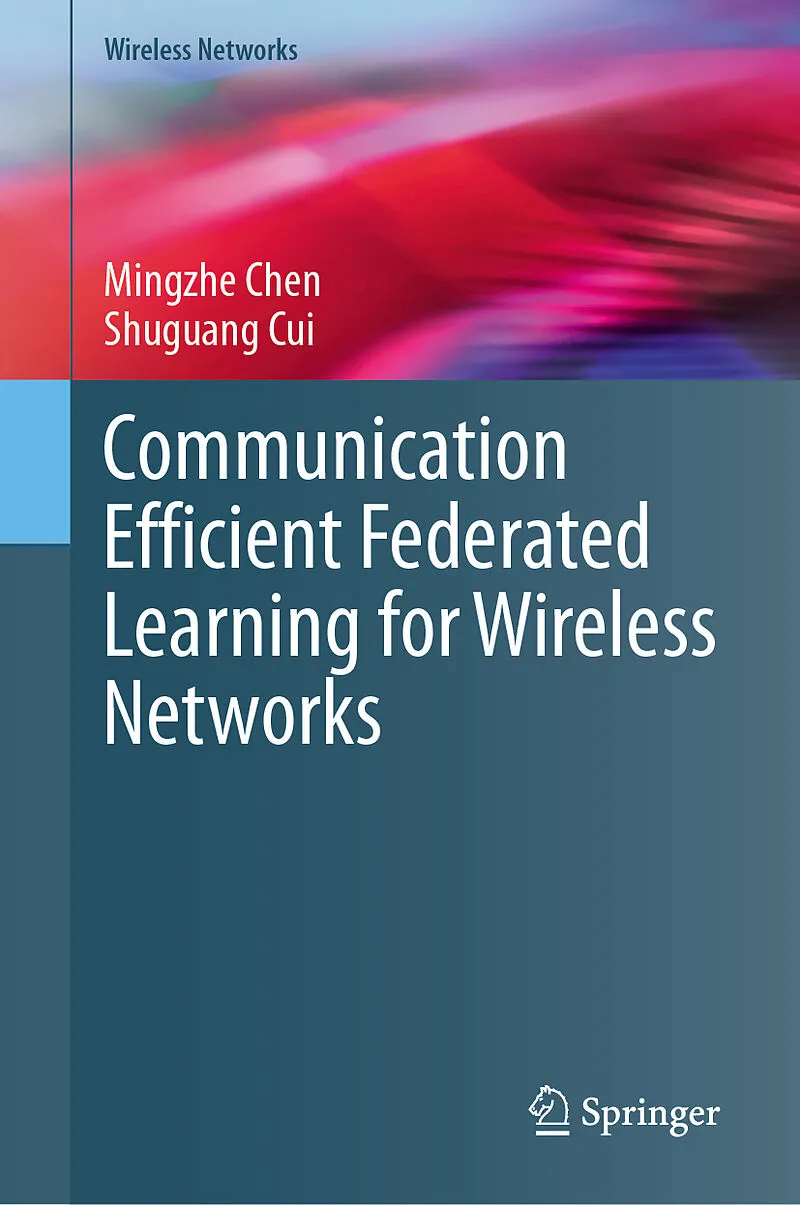
This book provides a comprehensive study of Federated Learning (FL) over wireless networks. It consists of three main parts: (a) Fundamentals and preliminaries of FL, (b) analysis and optimization of FL over wireless networks, and (c) applications of wireless...This book provides a comprehensive study of Federated Learning (FL) over wireless networks. It consists of three main parts: (a) Fundamentals and preliminaries of FL, (b) analysis and optimization of FL over wireless networks, and (c) applications of wireless FL for Internet-of-Things systems. In particular, in the first part, the authors provide a detailed overview on widely-studied FL framework. In the second part of this book, the authors comprehensively discuss three key wireless techniques including wireless resource management, quantization, and over-the-air computation to support the deployment of FL over realistic wireless networks. It also presents several solutions based on optimization theory, graph theory and machine learning to optimize the performance of FL over wireless networks. In the third part of this book, the authors introduce the use of wireless FL algorithms for autonomous vehicle control and mobile edge computing optimization.
Machine learning and data-driven approaches have recently received considerable attention as key enablers for next-generation intelligent networks. Currently, most existing learning solutions for wireless networks rely on centralizing the training and inference processes by uploading data generated at edge devices to data centers. However, such a centralized paradigm may lead to privacy leakage, violate the latency constraints of mobile applications, or may be infeasible due to limited bandwidth or power constraints of edge devices. To address these issues, distributing machine learning at the network edge provides a promising solution, where edge devices collaboratively train a shared model using real-time generated mobile data. The avoidance of data uploading to a central server not only helps preserve privacy but also reduces network traffic congestion as well as communication cost. Federated learning (FL) is one of most important distributed learning algorithms. In particular, FL enables devices to train a shared machine learning model while keeping data locally. However, in FL, training machine learning models requires communication between wireless devices and edge servers over wireless links. Therefore, wireless impairments such as noise, interference, and uncertainties among wireless channel states will significantly affect the training process and performance of FL. For example, transmission delay can significantly impact the convergence time of FL algorithms. In consequence, it is necessary to optimize wireless network performance for the implementation of FL algorithms.
This book targets researchers and advanced level students in computer science and electrical engineering. Professionals working in signal processing and machine learning will also buy this book.
Offers a comprehensive and systematic book on design of federated learning Provides key approaches for optimizing performance of federated learning Demonstrates effective applications of federated learning in wireless networks
Autorentext
Yang Yang received the B.S degree in information engineering from the School of Communication, Xidian University, Xi' an, China, in June 2013, and the Ph.D. degree in information and communication engineering from the School of Information and Communication Engineering, Beijing University of Posts and Telecommunications (BUPT), Beijing, China, in June 2018. He is currently an Associate Professor with the School of Information and Communication Engineering BUPT. His research interests include intelligent wireless communications and positioning. He was a recipient of the IEEE WCNC 2021 Best Paper Award. He published more than 70 papers in high quality journals and conferences such as IEEE JSAC/TWC/GLOBECOM/ICC. He organized several symposium/workshops for IEEE GLOBECOM, IEEE ICC, IEEE WCNC and IEEE WCSP. Mingzhe Chen is currently an Assistant Professor with the Department of Electrical and Computer Engineering and the Knight Foundation Chair in Data Science and AI in the Frost Institute of Data Science and Computing at University of Miami. His research interests include federated learning, reinforcement learning, virtual reality, unmanned aerial vehicles, and Internet of Things. He has received four IEEE Communication Society journal paper awards including the IEEE Marconi Prize Paper Award in Wireless Communications in 2023, the Young Author Best Paper Award in 2021 and 2023, and the Fred W. Ellersick Prize Award in 2022, and four conference best paper awards at ICCCN in 2023, IEEE WCNC in 2021, IEEE ICC in 2020, and IEEE GLOBECOM in 2020. Prof. Liu's research interests lie in the general area of signal processing and wireless communications, and in particular in the area of Integrated Sensing and Communications (ISAC). He is the founding Academic Chair of the IEEE ComSoc ISAC Emerging Technology Initiative (ISAC-ETI), Vice Chair and founding member of the IEEE SPS ISAC Technical Working Group (ISAC-TWG), an elected member of the IEEE SPS Sensor Array and Multichannel Technical Committee (SAM-TC), an Associate Editor of the IEEE Transactions on Communications, IEEE Transactions on Mobile Computing, and IEEE Open Journal of Signal Processing, and a Guest Editor of the IEEE Journal on Selected Areas in Communications, IEEE Wireless Communications, and IEEE Vehicular Technology Magazine. He was a TPC Co-Chair of the 2nd-4th IEEE Joint Communication and Sensing (JC&S) Symposium, a Symposium Co-Chair for IEEE ICC 2026 and IEEE GLOBECOM 2023, and a Track Co-Chair for the IEEE WCNC 2024. He is a member of the IMT-2030 (6G) ISAC Task Group. He was listed among the World's Top 2% Scientists by Stanford University for citation impact from 2021 to 2024, and among the 2023 Elsevier Highly-Cited Chinese Researchers. He was a recipient of numerous Best Paper Awards, including the 2024 IEEE SPS Best Paper Award, 2024 IEEE SPS Donald G. Fink Overview Paper Award, 2024 IEEE ComSoc Asia-Pacific Outstanding Paper Award, 2023 IEEE Communications Society Stephan O. Rice Prize, and 2021 IEEE SPS Young Author Best Paper Award. He is a Senior Member of the IEEE. Shiwen Mao is a Professor and Earle C. Williams Eminent Scholar, and Director of the Wireless Engineering Research and Education Center at Auburn University. Dr. Mao's research interest includes wireless networks, multimedia communications, and smart grid. He is a Distinguished Lecturer of IEEE Communications Society and IEEE Council of RFID, and the editor-in-chief of IEEE Transactions on Cognitive Communications and Networking. He received the IEEE ComSoc MMTC Outstanding Researcher Award in 2023, the SEC (Southeastern Conference) 2023 Faculty Achievement Award for Auburn, the IEEE ComSoc TC-CSR Distinguished Technical Achievement Award in 2019, the Auburn University Creative Research & Scholarship Award in 2018, the NSF CAREER Award in 2010, and several service awards from the IEEE. He is a co-recipient of several journal and conference best paper/demo awards from the IEEE.
Klappentext
This book provides a comprehensive study of Federated Learning (FL) over wireless networks. It consists of three main parts: (a) Fundamentals and preliminaries of FL, (b) analysis and optimization of FL over wireless networks, and (c) applications of wireless FL for Internet-of-Things systems. In particular, in the first part, the authors provide a detailed overview on widely-studied FL framework. In the second part of this book, the authors comprehensively discuss three key wireless techniques including wireless resource management, quantization, and over-the-air computation to support the deployment of FL over realistic wireless networks. It also presents several solutions based on optimization theory, graph theory and machine learning to optimize the performance of FL over wireless networks. In the third part of this book, the authors introduce the use of wireless FL algorithms for autonomous vehicle control and mobile edge com…