Beschreibung
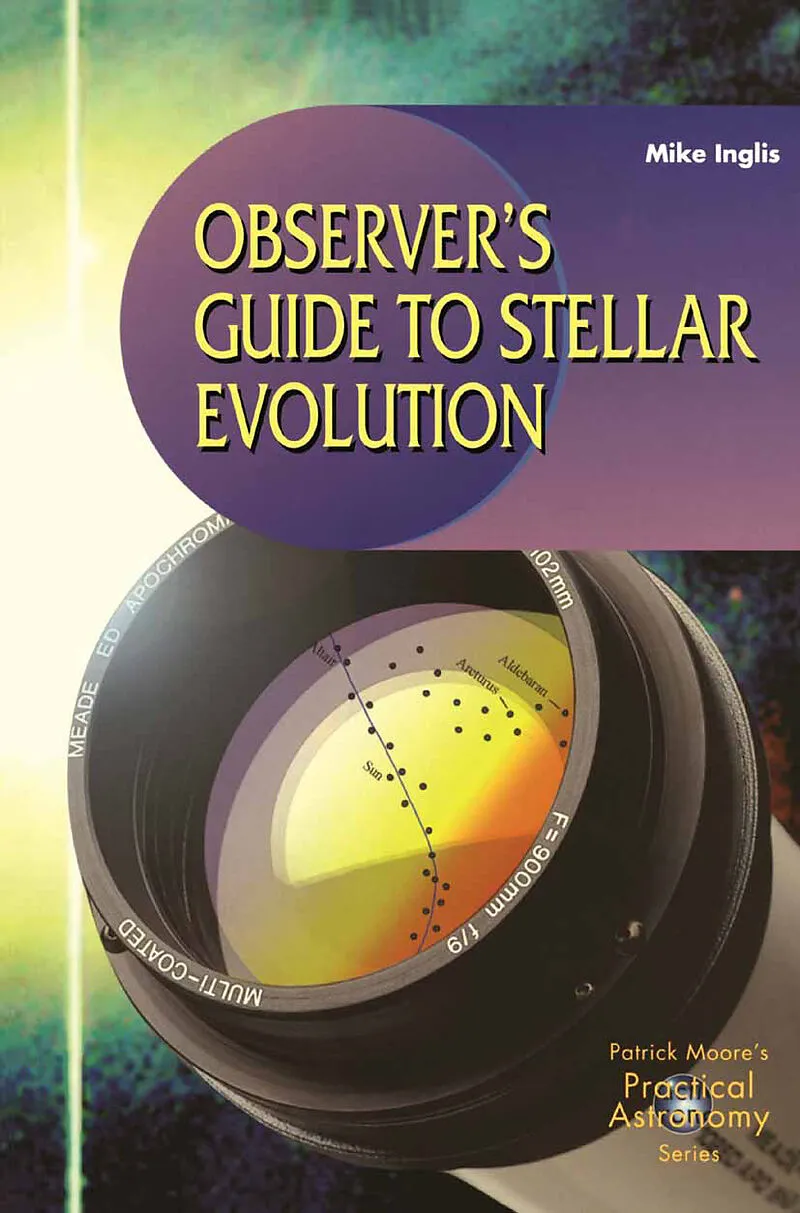
Stellar evolution - the birth, development and death of stars - is central to our current understanding of astronomy. This area of astrophysics is often portrayed as being difficult and mathematical, but Mike Inglis brings it to life in a unique way, combining...Stellar evolution - the birth, development and death of stars - is central to our current understanding of astronomy. This area of astrophysics is often portrayed as being difficult and mathematical, but Mike Inglis brings it to life in a unique way, combining a step-by-step introduction with suggestions for making practical observations of stars at different stages in their evolution. Every amateur astronomer - regardless of their current level of knowledge - will find this book fascinating and informative.
Introduces the theory of stellar evolution through practical observation of stars Accessible to every amateur astronomer, regardless of background knowledge Mathematics is not ignored, but is presented in 'boxes' that readers can skip over if they prefer Includes supplementary material: sn.pub/extras
Inhalt
A Brief Introduction.- 1 Stellar Evolution The Basics.- 1.1 Distance to the Stars.- 1.2 The Nearest Stars.- 1.3 The Brightness and Luminosity of Stars.- 1.4 The Magnitudes of Stars.- 1.5 The Brightest Stars.- 1.6 The Colour of Stars.- 1.7 The Size and Mass of Stars.- 1.8 The Biggest Stars.- 1.9 The Constituents of Stars.- 1.10 The Spectra of Stars.- 1.11 Stellar Classification.- 1.12 The HertzsprungRussell Diagram.- 1.13 The HR Diagram and a Star's Radius.- 1.14 The HR Diagram and a Star's Luminosity.- 1.15 The HR Diagram and a Star's Mass.- 2 Beginnings Star Birth.- 2.1 Introduction.- 2.2 The Interstellar Medium.- 2.3 Nebulae.- 2.4 Molecular Clouds.- 2.5 Protostars.- 2.6 Pre-Main Sequence Evolution.- 2.7 Mass Loss and Mass Gain.- 2.8 Star Clusters.- 2.9 Stellar Associations and Streams.- 2.10 Star Formation Triggers.- 3 The Main Sequence and Beyond.- 3.1 Introduction.- 3.2 Our Nearest Star The Sun.- 3.3 From the Surface to the Core.- 3.4 The ProtonProton Chain.- 3.5 The Flow of Energy from the Core to the Surface.- 3.6 Main Sequence Lifetimes.- 3.7 Towards the Red Giant.- 3.8 Helium Burning and the Helium Flash.- 3.9 Red Giants, Star Clusters and the HR Diagram.- 3.10 Post-Main Sequence Star Clusters: The Globular Clusters.- 3.11 Stars That Pulsate.- 3.12 Cepheid Variables and the PeriodLuminosity Relationship.- 3.13 Cepheid Variables: Temperature and Mass.- 3.14 RR Lyrae and Long-Period Variable Stars.- 4 The End Point Star Death.- 4.1 Introduction.- 4.2 The Asymptotic Giant Branch.- 4.3 Dredge-Ups.- 4.4 Mass Loss and Stellar Winds.- 4.5 Infrared Stars.- 4.6 The End of an AGB Star's Life.- 4.7 Planetary Nebulae.- 4.8 White Dwarf Stars.- 4.9 Electron Degeneracy and White Dwarfs.- 4.10 The Chandrasekhar Limit.- 4.11 WhiteDwarf Evolution.- 4.12 White Dwarf Origins.- 4.13 High-Mass Stars: Nuclear Burning and an Onion.- 4.14 Iron, Supernovae and the Formation of the Elements.- 4.15 The Supernova Remnant.- 4.16 A Final Note on Supernovae.- 4.17 Neutron Stars, Pulsars and Black Holes.- 4.18 From Beginning to End.- Appendix 1 Degeneracy.- Appendix 2 Books, Magazines and Organizations.- Appendix 3 The Greek Alphabet.- Appendix 4 Colour Photographs.- Object Index.