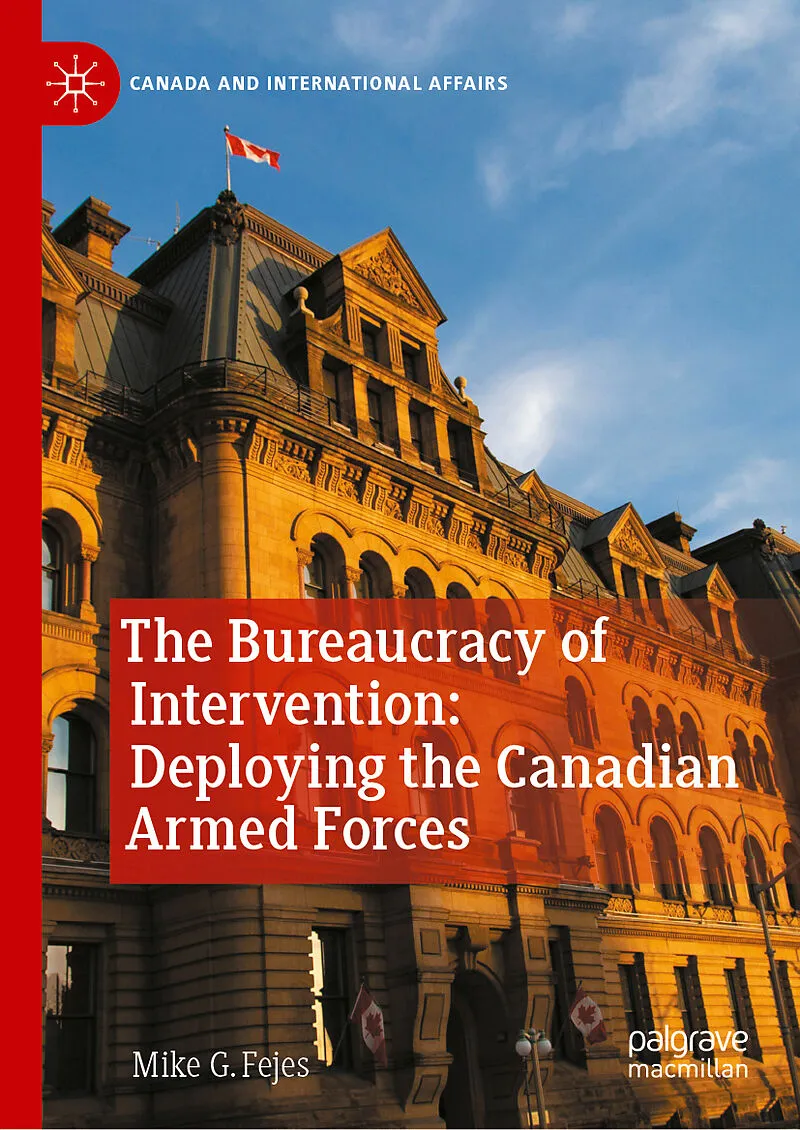
Beschreibung
This book advances the contemporary intervention literature by focusing on Canadian Armed Forces deployments and the role of the public service. The author focuses on three recent post-Afghanistan deployments, including Iraq, Ukraine, Mali, and one non-deploy...This book advances the contemporary intervention literature by focusing on Canadian Armed Forces deployments and the role of the public service. The author focuses on three recent post-Afghanistan deployments, including Iraq, Ukraine, Mali, and one non-deployment to Colombia, seeking to explain why the Canadian government varies in deploying the armed forces abroad, specifically the time required to announce a deployment and the deployment's composition/size. The book seeks to examine the civil-military relationship in Canada and highlight aspects of the principal-agent relationship by focusing on how the federal bureaucracy defines and shapes military commitments. These four case studies look past the implementation stage of the decision-making process to explain how federal bureaucracies impact policy through agenda setting and policy formulation, specifically in regards to the use of armed force abroad.
Studies how the Canadian Armed Forces has been re-deployed after Afghanistan and how contemporary missions are designed Examines civil-military relations to explain bureaucratic agency in the decision-making process behind interventions Advances Canadian defence past 9/11 and Afghanistan, and contributes to wider research beyond budgets and procurement
Autorentext
Mike G. Fejes is Assistant Professor at The Royal Military College of Canada in Kingston, Ontario where he has taught since 2019. An infantry officer with 30 years of military service in both the regular and reserve force (including five international deployments and one domestic response operation), his research includes civil-military relations, comparative defence policy, and the contemporary use of armed force.
Klappentext
This book advances the contemporary Civil-Military literature, focusing on Canadian military deployments and the role of the public service. The author focuses on the implementation stage of three recent post-Afghanistan deployments and one non-deployment, asking why Cabinet varies in deploying the armed forces and explaining how the federal bureaucracy defines and shapes military commitments.
Mike G. Fejes is Assistant Professor at The Royal Military College of Canada in Kingston.
"This book sheds light on several key questions: Why do states vary in deploying their armed forces, and how does Canada deploy its military? Drawing on a wealth of experience, interviews, and theories, Fejes highlights how federal departments influenced recent military deployments, and shows the importance of looking beyond Cabinet to understand how the public service shapes Canada’s military missions. The Bureaucracy of Intervention should be required reading for students, scholars, and practitioners of Canadian defence policy.”
-Philippe Lagassé, Associate Professor and Barton Chair, Norman Paterson School of International Affairs, Ottawa
"Comparing recent military deployments, Fejes makes an important contribution to Canadian defence policy. Asking why deployments often small and late, he argues that players in the federal bureaucracy can stymie decision-making towards their own interests. Consequently, Fejes’s book is a must read to understand Canadian civil-military relations and Canada’s foreign policy decision-making process." -Stephen M. Saideman, Paterson Chair in International Affairs, Director Canadian Defence and Security Network, Norman Paterson School of International Affairs, Ottawa "This book makes an important contribution to our understanding of the whole-of-government decision-making process surrounding military deployments in Canada. Each chapter uncovers the complex interplay between key bureaucratic actors, leading to a decision to send our military into harm’s way, or not. Fejes points out that each actor brings its own interests and perspectives, explaining why decisions take so long, and how deployments take shape. Based on extensive interviews, this book is essential reading for Canadian students of foreign and defence policy."
Vincent Rigby, former National Security and Intelligence Advisor to the Prime Minister
Inhalt
Chapter 1 - Introduction: Assumptions, Importance, and Definitions.- Chapter 2 - Explaining Canadian Interventions.- Chapter 3 OPERATION IMPACT: IRAQ - Deploying a relatively large contingent quickly (850 personnel deployed in 4-5 weeks).- Chapter 4 OPERATION UNIFIER: UKRAINE - Deploying a relatively small contingent slowly (200 personnel deployed in 11 weeks).- Chapter 5 - OPERATION PRESENCE: MALI - Deploying a relatively small contingent even slower (250 personnel deployed in 19 weeks).- Chapter 6 - OPERATION CHALLENGE: COLOMBIA - A very slow non-deployment decision (0 Personnel in 39 weeks).- Chapter 7 - Conclusion: The Role of Bureaucracy in Intervention.