
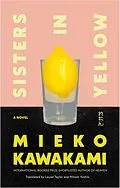
Sisters in Yellow
Beschreibung
Rising star Mieko Kawakami reaches new heights in this pacy, thrilling novel, a Japanese All of them are fleeing something. Growing up without a father, Hana’s tired of the pity in her classmates’ eyes, and;finds a flashier mother figure;in Kimiko....Format auswählen
- Kartonierter EinbandCHF 21.10
- Fester EinbandCHF 33.20

Wird oft zusammen gekauft
Andere Kunden kauften auch
Beschreibung
Rising star Mieko Kawakami reaches new heights in this pacy, thrilling novel, a Japanese All of them are fleeing something. Growing up without a father, Hana’s tired of the pity in her classmates’ eyes, and;finds a flashier mother figure;in Kimiko. Kimiko is older than Hana''s mother but seems much younger, chatting easily about school and boys and wanting a better life.;Fate throws them together with two more young women--bruised but not broken by life. Together the four set out to remake their;lives, fighting predatory lenders, organized criminals, and plain bad luck as they open a bar called Lemon.; Keeping the business going, and trying to take care of each other, forms the core of this enrapturing novel. It is a story of startling reversals and vivid portraits of the matriarchy of Tokyo nightlife and its adjacent criminal underclasses. From the bar owners to the aging hostesses to the young street touts coaxing people off the street to places like Lemon, everyone wants a chance at renewal, but can everyone get it?; Narrated by Hana in Kawakami’s trademark evocatively poetic style and paced like a noir, <Sisters in Yellow <will be the literary blockbuster of the season. This epic of friendship and betrayal is the kind of book one longs to return to when away from it: a world unto itself, and a book that makes you think while it produces immensities of feeling. It is a major novel that, like so many of the best recent phenomena--from Donna Tartt to Hanya Yanagihara--explores how we survive (or don''t) together.
Autorentext
MIEKO KAWAKAMI is the acclaimed author of the international bestsellers Breasts and Eggs, Heaven, and All The Lovers of the Night. Her books, translated into over twenty languages, are known for their insights into the female body, and preoccupation with ethics and modern society. Kawakami has won the Akutagawa Prize, the Tanizaki Prize, and the Murasaki Shikibu Prize. Heaven, translated by Sam Bett and David Boyd, was shortlisted for the 2022 International Booker Prize. Born in Osaka*,* Kawakami lives in Tokyo.
LAUREL TAYLOR is a translator, poet, and researcher. She has translated works by Kaori Fujino, Minae Mizumura, Shibasaki Tomoka, and Aoko Matsudo, among others.
HITOMI YOSHIO is the translator of Natsuko Imamura's This Is Amiko, Do You Copy? and the co-translator of Mieko Kawakami's Ashes of Spring.
Leseprobe
PREMONITION
I first met Ran Kato out on the street.
Whenever I went outside to see a customer off or to go home after closing up the bar for the night, there was always a group of girls by the main drag, handing out fliers and pulling in customers. Ran was one of those girls.
She was petite and always wore the same pair of rhinestone-studded hot pink platform sandals. Her hair was bleached, almost blonde, and she had a narrow forehead. Her eyebrows were plucked thin, and her makeup stood out, too, her eyes accentuated in a dusting of white shimmer.
“Hi there,” Ran said to me one night in early December. “Cold, isn’t it? I’ve seen you around.”
“Hi. Is it just you out here today?”
Kimiko had asked me to go to the drugstore to pick up a bottled energy shot. It was around nine.
“Yeah, all the other girls have customers. Except for me.” Ran was wearing an oversized white bomber jacket and a strappy black dress that hugged her body. “It’s kind of dead around here today, don’t you think?” she asked with an exaggerated shiver. “You work around here, too, right?”
I turned to point toward our building and told her I worked at the bar on the third floor. Just then, En came out of Little Heaven to see a customer off. I waved. She waved back, then ducked inside.
“A bar? What’s it called?”
“Lemon.”
“Lemon? I don’t think I’ve heard of it.”
“We’re still pretty new. We’ve only been open a couple of months.”
“I’m over there, down the street. You know that big building? The one with the huge atrium? I work on the second floor at the cabaret club.”
“There’s a club over there?”
“Yup. We probably don’t have the same customers though.” A gust of cold wind blew between us. I smiled to let her know I was heading back, and Ran, arms crossed and hunched against the cold, shook her whole body like she was waving me off.
“Hey, Kimiko, did you know there was a cabaret club around here?”
Back upstairs, I handed the energy shot to Kimiko, who was slumped down in one of the booths. She twisted off the cap with a heavy sigh, then drank it slowly. She’d been under the weather for about a week now, making it through the nights with over-the-counter medicine and energy shots, and spending her days lying in bed.
“Ugh, why does this have to be so syrupy . . . Uh, what were you saying? A cabaret club? Yeah, maybe . . .”
“I was chatting with one of the girls from there just now.”
“Huh. I guess it’s a quiet day for everybody.”
“How are you feeling?” I asked. “All achy.”
“Kimiko, if you don’t get better by next week, you should see a doctor.”
“Yeah, I know.”
At the end of December, it would be a full three months since we opened. I was getting used to the job, and Lemon was doing all right. We inherited more than a few customers from Mama Atsuko, and got some new ones, too. Maybe sixty percent of them were older men who were Sangenjaya locals. Thirty per-cent were younger men—first-timers who happened to come in one day and came back every once in a while. The other ten percent were people who worked at other clubs and bars in the neighborhood. In that sense, no one was really a stranger. We had a good number of regulars who showed up at the bar like they were stopping by their local café to read the newspaper.
Customers had a few options for how they spent their money. Some went with our all-you-can-sing, all-you-can-drink option, which cost ¥4,000, plus the drinks they bought for us. So if they stayed for two hours or so, they’d pay about ¥6,000. Some bought bottles to keep at the bar, so they only paid for the mixers each time they came, but they tended to come a lot—some maybe three times a week. Then there were the people who ordered what they wanted à la carte. For them, the cover charge was ¥3,000; then they’d pay for karaoke and drinks on top of that. They were the ones who ended up spending the most.
I’d developed a taste and tolerance for beer, so I got straight to work whenever a generous customer came in and encouraged us to let loose. A medium bottle cost ¥800, so if they ordered three, that came to ¥2,400. At the restaurant where I used to work, that would have been almost four hours of work. It seemed too good to be true—to be able to make the same amount of money by just sitting there and drinking beer all night. On a good day, it wasn’t unusual to make ¥10,000 or even ¥20,000 off a single customer.
Each day was different, like the weather or your mood, but on average, Lemon was pulling in around ¥30,000 a night. On top of that, Kotomi came by maybe twice a month, bringing her fancy customers from Ginza, and they were on a completely different level from our normal crowd, spending way more money than any of the regulars. And that meant that we made a lot more each month.
Plus, there was something special about the people who came to Lemon.
It was like they were all members of the same group, even the other bar and club workers from the neighborhood. Everyone got along and enjoyed each other’s company; no one seemed to mind when Kimiko and I sp…