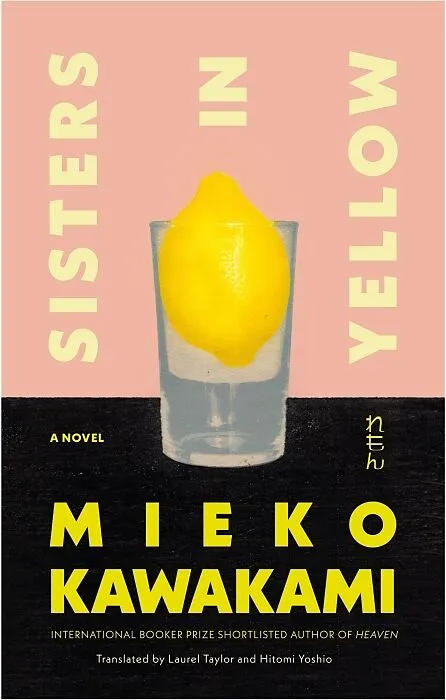
Sisters in Yellow
Beschreibung
From Mieko Kawakami, award-winning author of “I can never forget the sense of pure astonishment I felt when I first read Mieko Kawakami.” --Haruki Murakami Hana has nothing – she’s fifteen years old and living in a tiny apartment in a s...Format auswählen
- Fester EinbandCHF 33.20

Wird oft zusammen gekauft
Andere Kunden kauften auch
Beschreibung
From Mieko Kawakami, award-winning author of “I can never forget the sense of pure astonishment I felt when I first read Mieko Kawakami.” --Haruki Murakami Hana has nothing – she’s fifteen years old and living in a tiny apartment in a suburb of Tokyo with her young mother, a hostess at a local dive bar. They have no money, no security. Then Kimiko appears. Kimiko is older, a bright light in Hana’s dark world. Together they set up Lemon, a bar that, despite its shabby setting and seedy clientele, becomes a haven for Hana. Suddenly Hana has a job she loves, friends to share her days with, and the glittering promise of money. She feels like a normal girl. She feels invincible. But in the narrow alleys of Sangenjaya, nothing is as it seems. Soon all of Hana’s hope, her optimism, and her drive will be pushed to the limit . . . A story of enduring friendship and deep betrayal, <Sisters in Yellow< is a masterpiece of teenage dreams and adult cruelties that confirms Mieko Kawakami as one of the great writers of her generation.
Autorentext
Mieko Kawakami
Klappentext
**From Mieko Kawakami, award-winning author of Breasts and Eggs, comes a bold novel of sacrifice and the tumultuous bonds of sisterhood, set in the gritty Tokyo of the 1990s.
“I can never forget the sense of pure astonishment I felt when I first read Mieko Kawakami.” —Haruki Murakami
“To read her work is to feel that she is not afraid of anything at all.” —The New York Times Book Review**
Hana has nothing – she’s fifteen years old and living in a tiny apartment in a suburb of Tokyo with her young mother, a hostess at a local dive bar. They have no money, no security. Then Kimiko appears.
Kimiko is older, a bright light in Hana’s dark world. Together they set up Lemon, a bar that, despite its shabby setting and seedy clientele, becomes a haven for Hana. Suddenly Hana has a job she loves, friends to share her days with, and the glittering promise of money. She feels like a normal girl. She feels invincible.
But in the narrow alleys of Sangenjaya, nothing is as it seems. Soon all of Hana’s hope, her optimism, and her drive will be pushed to the limit . . .
A story of enduring friendship and deep betrayal, Sisters in Yellow is a masterpiece of teenage dreams and adult cruelties that confirms Mieko Kawakami as one of the great writers of her generation.
Zusammenfassung
**“I can never forget the sense of pure astonishment I felt when I first read Mieko Kawakami.” —Haruki Murakami
From Mieko Kawakami, award-winning author of Breasts and Eggs, comes a bold novel of sacrifice and the tumultuous bonds of sisterhood, set in the gritty Tokyo of the 1990s.**
Hana has nothing – she’s fifteen years old and living in a tiny apartment in a suburb of Tokyo with her young mother, a hostess at a local dive bar. They have no money, no security. Then Kimiko appears.
Kimiko is older, a bright light in Hana’s dark world. Together they set up Lemon, a bar that, despite its shabby setting and seedy clientele, becomes a haven for Hana. Suddenly Hana has a job she loves, friends to share her days with, and the glittering promise of money. She feels like a normal girl. She feels invincible.
But in the narrow alleys of Sangenjaya, nothing is as it seems. Soon all of Hana’s hope, her optimism, and her drive will be pushed to the limit . . .
A story of enduring friendship and deep betrayal, Sisters in Yellow is a masterpiece of teenage dreams and adult cruelties that confirms Mieko Kawakami as one of the great writers of her generation.
Leseprobe
PREMONITION
I first met Ran Kato out on the street.
Whenever I went outside to see a customer off or to go home after closing up the bar for the night, there was always a group of girls by the main drag, handing out fliers and pulling in customers. Ran was one of those girls.
She was petite and always wore the same pair of rhinestone-studded hot pink platform sandals. Her hair was bleached, almost blonde, and she had a narrow forehead. Her eyebrows were plucked thin, and her makeup stood out, too, her eyes accentuated in a dusting of white shimmer.
“Hi there,” Ran said to me one night in early December. “Cold, isn’t it? I’ve seen you around.”
“Hi. Is it just you out here today?”
Kimiko had asked me to go to the drugstore to pick up a bottled energy shot. It was around nine.
“Yeah, all the other girls have customers. Except for me.” Ran was wearing an oversized white bomber jacket and a strappy black dress that hugged her body. “It’s kind of dead around here today, don’t you think?” she asked with an exaggerated shiver. “You work around here, too, right?”
I turned to point toward our building and told her I worked at the bar on the third floor. Just then, En came out of Little Heaven to see a customer off. I waved. She waved back, then ducked inside.
“A bar? What’s it called?”
“Lemon.”
“Lemon? I don’t think I’ve heard of it.”
“We’re still pretty new. We’ve only been open a couple of months.”
“I’m over there, down the street. You know that big building? The one with the huge atrium? I work on the second floor at the cabaret club.”
“There’s a club over there?”
“Yup. We probably don’t have the same customers though.” A gust of cold wind blew between us. I smiled to let her know I was heading back, and Ran, arms crossed and hunched against the cold, shook her whole body like she was waving me off.
“Hey, Kimiko, did you know there was a cabaret club around here?”
Back upstairs, I handed the energy shot to Kimiko, who was slumped down in one of the booths. She twisted off the cap with a heavy sigh, then drank it slowly. She’d been under the weather for about a week now, making it through the nights with over-the-counter medicine and energy shots, and spending her days lying in bed.
“Ugh, why does this have to be so syrupy . . . Uh, what were you saying? A cabaret club? Yeah, maybe . . .”
“I was chatting with one of the girls from there just now.”
“Huh. I guess it’s a quiet day for everybody.”
“How are you feeling?” I asked. “All achy.”
“Kimiko, if you don’t get better by next week, you should see a doctor.”
“Yeah, I know.”
At the end of December, it would be a full three months since we opened. I was getting used to the job, and Lemon was doing all right. We inherited more than a few customers from Mama Atsuko, and got some new ones, too. Maybe sixty percent of them were older men who were Sangenjaya locals. Thirty per-cent were younger men—first-timers who happened to come in one day and came back every once in a while. The other ten percent were people who worked at other clubs and bars in the neighborhood. In that sense, no one was really a stranger. We had a good number of regulars who showed up at the bar like they were stopping by their local café to read the newspaper.
Customers had a few options for how they spent their money. Some went with our all-you-can-sing, all-you-can-drink option, which cost ¥4,000, plus the drinks they bought for us. So if they stayed for two hours or so, they’d pay about ¥6,000. Some bought bottles to keep at the bar, so they only paid for the mixers each time they came, but they tended to come a lot—some maybe three times a week. Then there were the people who ordered what they wanted à la carte. For them, the cover charge was ¥3,000; then they’d pay for karaoke …