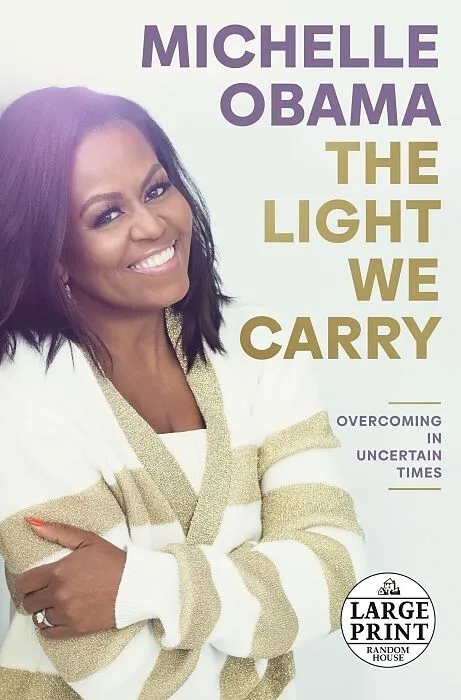
The Light We Carry
Beschreibung
Informationen zum Autor Michelle Obama Klappentext #1 NEW YORK TIMES AND USA TODAY BESTSELLER • In an inspiring follow-up to her acclaimed memoir Becoming, former First Lady Michelle Obama shares practical wisdom and powerful strategies for staying hopefu...Format auswählen
- BroschiertCHF 37.20
- Fester EinbandCHF 33.60
- Audio CD (CD/SACD)CHF 49.50

Wird oft zusammen gekauft
Andere Kunden kauften auch
Beschreibung
Informationen zum Autor Michelle Obama Klappentext #1 NEW YORK TIMES AND USA TODAY BESTSELLER • In an inspiring follow-up to her acclaimed memoir Becoming, former First Lady Michelle Obama shares practical wisdom and powerful strategies for staying hopeful and balanced in today's highly uncertain world. There may be no tidy solutions or pithy answers to life's big challenges, but Michelle Obama believes that we can all locate and lean on a set of tools to help us better navigate change and remain steady within flux. In The Light We Carry, she opens a frank and honest dialogue with readers, considering the questions many of us wrestle with: How do we build enduring and honest relationships? How can we discover strength and community inside our differences? What tools do we use to address feelings of self-doubt or helplessness? What do we do when it all starts to feel like too much? Michelle Obama offers readers a series of fresh stories and insightful reflections on change, challenge, and power, including her belief that when we light up for others, we can illuminate the richness and potential of the world around us, discovering deeper truths and new pathways for progress. Drawing from her experiences as a mother, daughter, spouse, friend, and First Lady, she shares the habits and principles she has developed to successfully adapt to change and overcome various obstaclesthe earned wisdom that helps her continue to become. She details her most valuable practices, like starting kind, going high, and assembling a kitchen table of trusted friends and mentors. With trademark humor, candor, and compassion, she also explores issues connected to race, gender, and visibility, encouraging readers to work through fear, find strength in community, and live with boldness. When we are able to recognize our own light, we become empowered to use it, writes Michelle Obama. A rewarding blend of powerful stories and profound advice that will ignite conversation, The Light We Carry inspires readers to examine their own lives, identify their sources of gladness, and connect meaningfully in a turbulent world. Leseprobe Introduction At some point when I was a child, my father started using a cane to keep himself balanced when he walked. I don't remember exactly when it showed up in our home on the South Side of ChicagoI was maybe four or five years old at the timebut suddenly it was there, slim and sturdy and made of a smooth dark wood. The cane was an early concession to multiple sclerosis, the disease that had given my father a severe left-legged limp. Slowly and silently and probably long before he received a formal diagnosis, MS was undermining his body, eating away at his central nervous system and weakening his legs as he went about his everyday business: working at the city's water filtration plant, running a household with my mom, trying to raise good kids. The cane helped my dad get himself up the stairs to our apartment or down a city block. In the evenings, he would set it against the arm of his recliner and seemingly forget about it as he watched sports on TV, or listened to jazz on the stereo, or pulled me onto his lap to ask about my day at school. I was fascinated by the cane's curved handle, the black rubber tip at its end, the hollow clatter it made when it fell to the floor. Sometimes I'd try to use it, imitating my father's motions as I hobbled around our living room, hoping to feel what it was like to walk in his shoes. But I was too small and the cane was too big, and so instead I would incorporate it as a stage prop in my games of pretending. As we say it in my family, that cane symbolized nothing. It was just a tool, the same way my mother's spatula was a tool in the kitchen, or my grandfather's hammer got used any time he came over to fix a broken shelf or curtain rod. It was ut...
Autorentext
Michelle Obama
Klappentext
**#1 NEW YORK TIMES AND USA TODAY BESTSELLER • In an inspiring follow-up to her acclaimed memoir Becoming, former First Lady Michelle Obama shares practical wisdom and powerful strategies for staying hopeful and balanced in today’s highly uncertain world.**
There may be no tidy solutions or pithy answers to life’s big challenges, but Michelle Obama believes that we can all locate and lean on a set of tools to help us better navigate change and remain steady within flux. In The Light We Carry, she opens a frank and honest dialogue with readers, considering the questions many of us wrestle with: How do we build enduring and honest relationships? How can we discover strength and community inside our differences? What tools do we use to address feelings of self-doubt or helplessness? What do we do when it all starts to feel like too much?
Michelle Obama offers readers a series of fresh stories and insightful reflections on change, challenge, and power, including her belief that when we light up for others, we can illuminate the richness and potential of the world around us, discovering deeper truths and new pathways for progress. Drawing from her experiences as a mother, daughter, spouse, friend, and First Lady, she shares the habits and principles she has developed to successfully adapt to change and overcome various obstacles—the earned wisdom that helps her continue to “become.” She details her most valuable practices, like “starting kind,” “going high,” and assembling a “kitchen table” of trusted friends and mentors. With trademark humor, candor, and compassion, she also explores issues connected to race, gender, and visibility, encouraging readers to work through fear, find strength in community, and live with boldness.
“When we are able to recognize our own light, we become empowered to use it,” writes Michelle Obama. A rewarding blend of powerful stories and profound advice that will ignite conversation, The Light We Carry inspires readers to examine their own lives, identify their sources of gladness, and connect meaningfully in a turbulent world.
Leseprobe
Introduction
At some point when I was a child, my father started using a cane to keep himself balanced when he walked. I don’t remember exactly when it showed up in our home on the South Side of Chicago—I was maybe four or five years old at the time—but suddenly it was there, slim and sturdy and made of a smooth dark wood. The cane was an early concession to multiple sclerosis, the disease that had given my father a severe left-legged limp. Slowly and silently and probably long before he received a formal diagnosis, MS was undermining his body, eating away at his central nervous system and weakening his legs as he went about his everyday business: working at the city’s water filtration plant, running a household with my mom, trying to raise good kids.
The cane helped my dad get himself up the stairs to our apartment or down a city block. In the evenings, he would set it against the arm of his recliner and seemingly forget about it as he watched sports on TV, or listened to jazz on the stereo, or pulled me onto his lap to ask about my day at school. I was fascinated by the cane’s curved handle, the black rubber tip at its end, the hollow clatter it made when it fell to the floor. Sometimes I’d try to use it, imitating my father’s motions as I hobbled around our living room, hoping to feel what it was like to walk in his shoes. But I was too small and the cane was too big, and so instead I would incorporate it as a stage prop in my games of pretending.
As we say it in my family, that cane symbolized nothing. It was just a tool, the same way my mother’s spatula was a tool in the kitchen, or my grandfather’s hammer got used any time he came over to fix a broken shelf or curtain rod. It was utilitarian, …