
IHR WARENKORB IST AKTUELL LEER.
Haben Sie noch nichts passendes gefunden? Stöbern Sie durch unser komplettes Sortiment.
Oder melden Sie sich an bzw. registrieren Sie sich.
- Kostenlose Lieferung
- Kauf auf Rechnung
- Ex Libris Tiefpreis
- Filiallieferung und 650+ Abholorte
- Rabatt-Bons als Club-Mitglied
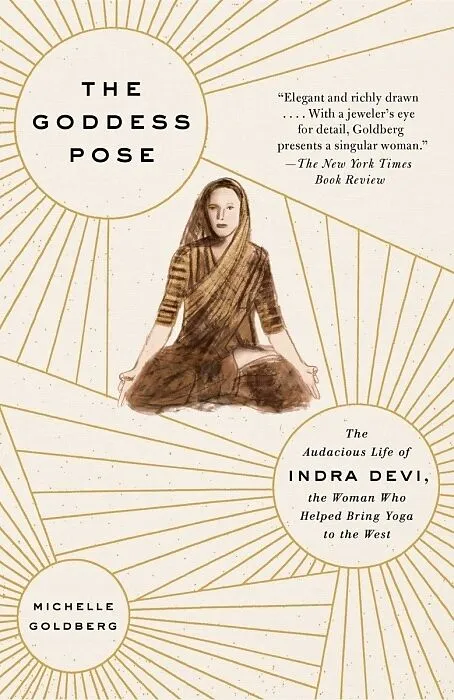
The Goddess Pose
Beschreibung
Zusatztext 44987249 Informationen zum Autor Michelle Goldberg Klappentext New York Times best-selling author Michelle Goldberg tells the globetrotting story of the incredible woman who brought yoga to the West. When Indra Devi was born in Russia in 1899, yoga ...Format auswählen
- Kartonierter EinbandCHF 22.70
- E-Book (epub)CHF 11.90

Wird oft zusammen gekauft
Andere Kunden kauften auch
Beschreibung
Zusatztext 44987249 Informationen zum Autor Michelle Goldberg Klappentext New York Times best-selling author Michelle Goldberg tells the globetrotting story of the incredible woman who brought yoga to the West. When Indra Devi was born in Russia in 1899, yoga was virtually unknown outside of India. By the time of her death, in 2002, it was being practiced around the world. Here Michelle Goldberg tells the globetrotting story of the incredible woman who helped usher in a craze that continues unabated to this day. A sweeping picture of the twentieth century that travels from the cabarets of Berlin to the Mysore Palace to Golden Age Hollywood and beyond, The Goddess Pose brings the Devi's little known but extraordinary adventures vividly to life.INTRODUCTION I NEVER WOULD have started doing yoga if there had been aerobics in the Himalayas, but I was desperate. The few times I'd taken yoga classes in college, my failed attempts to relax redoubled my anxiety. Each pose was a reminder of the lifelong inflexibility that had often mortified me. When I was a little girl, a sadistic ballet teacher barred me from a holiday party because of my terrible splits. In elementary school, I dreaded being forced to sit Indian style, because it left my hips and back screaming. Later, trying yoga, my awkward efforts to keep my legs and back straight while touching my toes and my inability to do even a half lotus only left me tense and humiliated, convinced that the practice was best for those who were already calm, willowy, and graceful. Besides, while I'd been captivated by India's kaleidoscopic religious richness during months of traveling, I was wary of anyone purporting to peddle enlightenment to credulous Westerners. On my first trip to the country, a short backpacking sojourn in the late 1990s, I'd read and loved Gita Mehta's Karma Cola , a wry Indian look at the Western spiritual tourists who flock to the subcontinent, and the enterprising Indian sages who've risen to meet the demand. As our home industry expands on every front, at last it is our turn to mass market, she writes. The hippie spiritual scene interested me as a journalistic subject, but I certainly didn't want to participate in it. I wasn't sure if I could even chant Om with a straight face. Yet, I needed exercise. Living in McLeod Ganj, a mountain village just outside the city of Dharamsala, where the Tibetan exile movement was headquartered, I was sick of hiking. My husband and Iwe'd eloped the previous year, when I was twenty-four and he was twenty-eightwere about six months into what would be a year-long trip through Asia. Prior to our departure, he'd worked at an Internet start-up. When he cashed out his stock options before they bottomed out in the crash of the late 1990s, we became Internet thousandaires, with a sum in the low five figures that seemed, at the time, to be a fortune. Both of us loved to travel. Putting all our stuff in storage, we flew to Ho Chi Minh City. After three months bumming around Southeast Asia, we went from Singapore to the tip of the Indian state of Tamil Nadu, then west to the relatively idyllic state of Kerala, where, while lying on a beach, we were approached by movie producers looking for extras for an Indian musical. They were shooting a scene in an ashram, and since no Indian ashram is complete without a handful of flaky Westerners, they asked for our help. Delighted, we agreed. On set, we met a thirty-two-year-old Argentine devotee of the real-life guru Sai Baba, about whom I'd long been curious. His followers believe he's God, and I'd seen his face, beaming beneath his surprising Afro, on stickers and trinkets for sale all over the country. A former medical student, the Argentine had given up her studies and her Buenos Aires apartment after dreaming that Sai Baba summoned her to India. Later, as we snaked our ...
ldquo;Elegant and richly drawn. . . . With a jeweler’s eye for detail, Goldberg presents a singular woman.” —*The New York Times Book Review
*
“Groundbreaking. . . . [Goldberg’s] clear prose illuminates the forces of war and social change and reveals the complex roots of our country’s yoga boom.” —San Francisco Chronicle
“Fascinating. . . . [Devi’s] story and influence live on in this can’t-miss memoir.” —Yoga Journal
“It’s hard to believe that the life of Indra Devi . . . hasn’t been made into a blockbuster film. . . . Without idolizing or condemning her, Goldberg evokes Devi’s complicated nature as deftly as she does the Russian Empire, Weimar Berlin, occupied Shanghai, and so many of the other places where Devi worked, loved, and proselytized.” —New York Magazine
"Goldberg’s book is lots of fun. . . . Even if you don’t care enough about yoga to hold a pigeon pose for the length of time it takes to say [the] title, Indra Devi . . . remains no less a fascinating character." —*Los Angeles Times
*
"Engaging. . . offers fresh insights into commonly held assumptions, including the relatively new origins of many physical asanas. . . . Goldberg’s own discovery of yoga and Indra Devi forms a riveting prologue to an expansive book that underlines how truly global yoga has become after it was taken from Indian shores more than a century ago." —The Times of India
"A celebration of female freedom and everything it can bring: an appetite for adventure, fearlessness in the face of challenge, and, most important, discovery and assertion of self."
—Anna Holmes, founding editor, Jezebel
"The story of how Devi came to embrace yoga and spread its gospel in America is as fascinating as it is unlikely. . . . [Goldberg’s] goal in writing The Goddess Pose seems to have been not just chronicling the life of one of the world’s great iconoclasts, but also providing a history for how hatha yoga went from an Indian spiritual tradition to an everyday part of western lives. She succeeds admirably on both counts." —The Guardian
"Michelle Goldberg’s masterful engagement with her astonishing subject—and with the diverse political, spiritual, and physical worlds she inhabited—is evident on every page." —Rebecca Traister, author of Big Girls Don’t Cry
"Goldberg’s account of Devi takes the reader through three chronicled, influential centuries of the yogi, actress, and fearless voyager’s life which will leave you with a better understanding of how westernized Yoga differs from its roots . . . and a major dose of inspiration to get you on the way to your next blissed-out savasana." —Nylon
"[The Goddess Pose] captures Devi’s Forrest Gump–like propensity to live parallel to some of the most important moments of the previous century." —New York Post
"[Goldberg] expertly assembles the puzzle pieces of Devi’s life, pausing to provide context for the growing influence of spiritualism on modern American life." —The Globe and Mail (Toronto)
"Whether you’re a student of yoga, a history buff, an armchair adventurer, or just a reader in search of an unputdownable story that happens to be true, you’ll love this fascinating biography of one of the twentieth century’s boldest, most influential women." —Katha Pollitt, author of Learning to Drive: And Other Life Stories
"Goldberg brings Indra Devi, a complicated and incredible woman, to life in Technicolor brilliance. . . . I’ll never think of yoga the same way again—and neither will you." —Susannah Cahalan, New York Times best-selling author of Brain on Fire
"Terrific. . . . An irresistible story of yoga’s unlikely and, yes, even a…