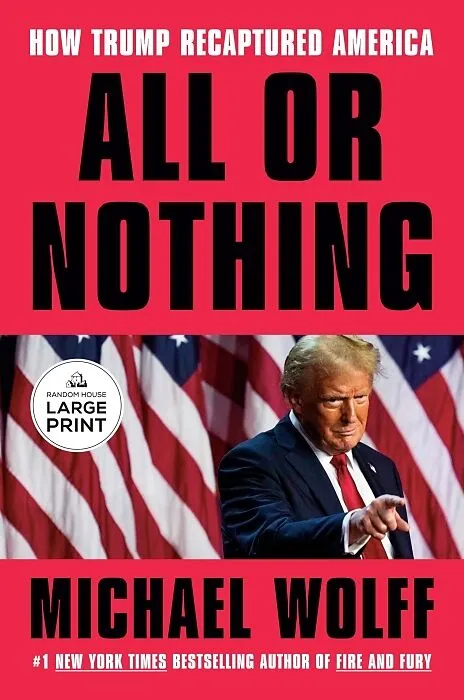
All or Nothing
Beschreibung
An upcoming book to be published by Penguin Random House. Autorentext Michael Wolff has written four New York Times bestsellers since 2018, including the #1 Fire and Fury. In addition to his three prior books about the Trump White House, his twelve books inclu...Format auswählen
- Kartonierter Einband (Kt)CHF 38.00
- E-Book (epub)CHF 13.50

Wird oft zusammen gekauft
Andere Kunden kauften auch
Beschreibung
An upcoming book to be published by Penguin Random House.
Autorentext
Michael Wolff has written four New York Times bestsellers since 2018, including the #1 Fire and Fury. In addition to his three prior books about the Trump White House, his twelve books include The Man Who Owns the News, a biography of Rupert Murdoch; The Fall: The End of Fox News; and Burn Rate, his memoir of the early internet years. For more than a decade, Wolff was a regular columnist for New York Magazine and Vanity Fair. He is the winner of two National Magazine Awards.
Klappentext
NEW YORK TIMES BESTSELLER • The author of Fire and Fury delivers a breathtaking insider account of the 2024 Trump campaign—undoubtedly the wildest, most unpredictable campaign in U.S. history, including multiple criminal trials, two assassination attempts, and a sudden switch of opponents.
All or Nothing takes readers on a journey accompanying Donald Trump on his return to power as only Michael Wolff, the foremost chronicler of the Trump era, can do it. As Trump cruelly and swiftly dispatches his opponents, heaps fire and fury on the prosecutors and judges who are pursuing him, and mocks and belittles anyone in his way, including the president of the United States, this becomes not just another election but perhaps, both sides say, the last election. The stakes could not be clearer: Either the establishment destroys Donald Trump, or he destroys the establishment.
What soon emerges is a split-screen reality: On one side, a picture that could not be worse for Trump: an inescapable, perhaps mortal legal quagmire; on the other side, an entirely positive political outlook: overwhelming support within his party, ever-rising polling numbers, and lackluster opposition. Through personal access to Trump’s inner circle, Wolff details a behind-the-scenes, revealing landscape of Trumpworld and its unlikely cast of primary players as well as the candidate himself, the most successful figure in American politics since, arguably, Roosevelt, but who might easily seem to be raving mad.
Threading a needle between tragedy and farce, the fate of the nation, the liberal ideal, and democracy itself, All or Nothing paints a gobsmacking portrait of a man whose behavior is so unimaginable, so uncontrolled, so unmindful of cause and effect, that it defeats all the structures and logic of civic life. And yet here in one of the most remarkable comebacks in American political history, Trump is victorious. This is not just a story about politics: It is a vivid exposé of the demons, discord, and anarchy—the fire, fury, and future—of American life under Trump.
Leseprobe
Prologue
**
Mar-a-Lago**
When Donald Trump returned to Mar-a-Lago on Inauguration Day, January 20, 2021, a dwindling band seeing him off from Andrews Air Force Base, it was at best a loser’s fantasy that he could run for president again. In the orbits around him (family, White House aides, Republican leaders, donors), there certainly weren’t many cogent voices encouraging him in this fantasy. If you were close to him, you tended to be at best circumspect, if not mortified, on his behalf—defeat; crazy, Keystone Cops efforts to deny his loss; January 6; exile.
Most immediately, he faced another impeachment trial in the Senate and could hardly even marshal a competent legal team to put up his defense—a ragtag band of small-time practitioners was assembled only after a wide casting call. He was saved—and his ability to hold office again preserved—only by Republican Senate leader Mitch McConnell’s pity and desire to wash his hands of him. Through conventional eyes, this trial was just one more coffin nail. (Still, an advantage perhaps evident only to him, it did keep him in the news.)
His finances were in disarray. His sons, with their own livelihoods at issue, were counting on a level of calm and distance, with him necessarily out of the news, to help re-establish the brand, with hope that in a year or two or three, “Trump,” would be old news. There were several open outbursts at Mar-a-Lago between them and him, with the sons emphasizing the seriousness of the situation and the discipline that would be required. Their suggestion that he could be most valuable as an ambassador to the family’s foreign properties—Donald Trump on a permanent golfing tour—hardly sat well with him.
There were rumblings about legal threats he might face. All the more reason to keep his head down and not provoke the new sheriff in town.
The state of his mental health was a whispered concern. He really did not seem to appreciate, or grasp, the reality of what had occurred.
His chief adviser in the White House, the aide with real authority and influence, the conduit of normalcy to the extent that any existed, was his son-in-law, Jared Kushner. Trump expected Kushner to continue in Mar-a-Lago as his right hand. But Kushner’s own clear and immediate post–White House plan was to put distance between himself and his father-in-law. Asked about his father-in-law’s future by a friend, Kushner replied, “What was Nixon’s future?” Kushner and his wife, Ivanka, for social and tax reasons, were themselves moving to Florida—but to Miami instead of Palm Beach, using new schools for their children as an explanation. Replacing himself, Kushner staffed up his father-in-law’s new exile office. But it wasn’t much of a staff: Susie Wiles, a local Florida political operative at retirement age (in a young person’s profession), took on the job more out of duty than ambition; Nick Luna, a young man married to one of Kushner’s assistants, would commute several days a week to Palm Beach from Miami; Jason Miller, a comms person in the campaign, would be on call for a few months in Washington; and Molly Michael, another of his look-alike assistants, would step in as the designated young woman attending to him (notably, Hope Hicks, his favorite young woman retainer, had fled during his effort to overthrow the election).
His wife, Melania, was straightforward about how she saw her husband’s future—or the future she did not see. She had not enjoyed a single day in the White House. To the extent that they had had a marriage (even on a negotiated footing), it was further disrupted by her husband’s mood swings and constant sense of offense and injury while in the White House. It had all been bad, in her view, for their son, Barron, and had only increased tensions between her and the rest of the Trump family. So, good riddance. She was young, her husband was old, and she had her own life to make—she felt nothing but relief that he was finished with politics (or it was finished with him).
Trump, however, simply did not acknowledge his defeat and exile. There was not the slightest indication, not the smallest opening of self- awareness, that he even sensed the enormity and finality of what had occurred since Election Day, November 3. He showed no inclination to look for meaning in the events, or to sift the experience. Nor was anyone aware of a friend or confidant with whom he might be considering the recent past and unknown future. He was not, as many defeated politicians have described themselves, consumed by a period of self-doubt and reflection. Rather, he was still, for all intents and purposes, and never breaking character, the president.
You might believe such an ongoing fantasy of, say, a despot of some minor country exiled to the South of France, surrounded by a retinue of sycophantic loyalists, seeing himself in a displaced but unchanged world. Perhaps this was similar. Most of the people around the former president in Mar-a-Lago—family, his political and Mar-a-Lago staff, …