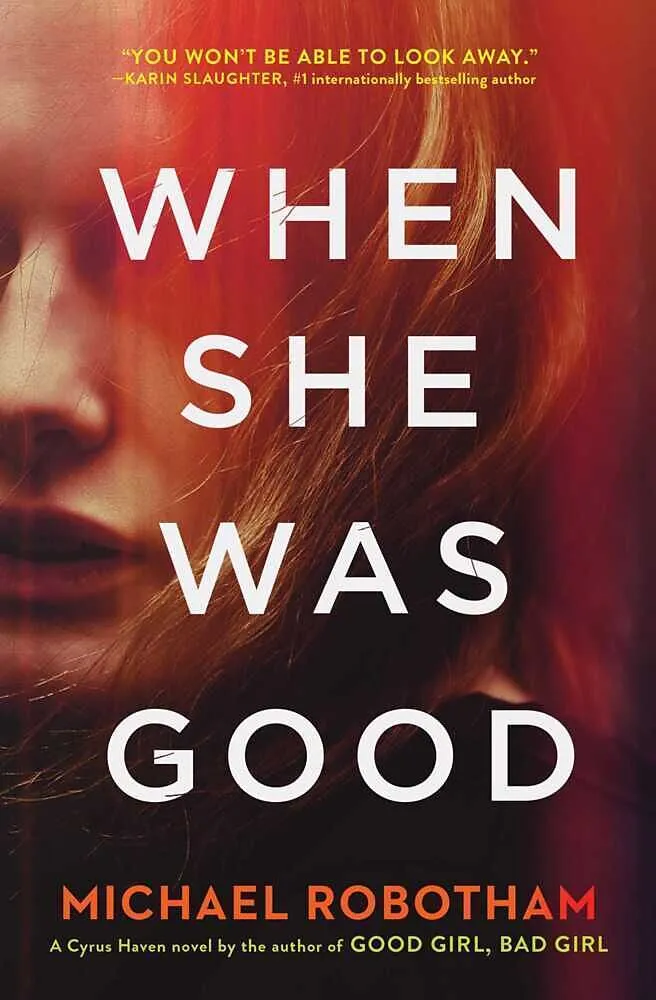
When She Was Good
Beschreibung
From the bestselling author of Good Girl, Bad Girl and When You Are Mine comes a gripping thriller featuring the brilliant forensic psychologist Cyrus Haven as he becomes embroiled in an explosive murder case with disturbing origins. Criminal psychologist Cyru...Format auswählen
- Kartonierter EinbandCHF 24.00
Wird oft zusammen gekauft
Andere Kunden kauften auch
Beschreibung
From the bestselling author of Good Girl, Bad Girl and When You Are Mine comes a gripping thriller featuring the brilliant forensic psychologist Cyrus Haven as he becomes embroiled in an explosive murder case with disturbing origins.
Criminal psychologist Cyrus Haven and Evie Cormac return in this "powerhouse of a novel" (Booklist, starred review) from internationally bestselling author Michael Robotham, a writer Stephen King calls "an absolute master...with heart and soul."
Who is Evie, the girl with no past, running from? She was discovered hiding in a secret room in the aftermath of a terrible crime. Her ability to tell when someone is lying helped Cyrus crack an impenetrable case in Good Girl, Bad Girl. Now, the closer Cyrus gets to uncovering answers about Evie's dark history, the more he exposes Evie to danger, giving her no choice but to run. Ultimately, both will have to decide if some secrets are better left buried and some monsters should never be named...
Autorentext
Michael Robotham is a former investigative journalist whose bestselling psychological thrillers have been translated into twenty-five languages. He has twice won a Ned Kelly Award for Australia's best crime novel, for Lost in 2005 and Shatter in 2008. His recent novels include When She Was Good, winner of the UK's Ian Fleming Steel Dagger Award for best thriller; The Secrets She Keeps; Good Girl, Bad Girl; When You Are Mine; Lying Beside You; Storm Child; and The White Crow. After living and writing all over the world, Robotham settled his family in Sydney, Australia.
Klappentext
"Originally published in Great Britain in 2020 by Sphere." -- Title page verso.
Zusammenfassung
"[A] gripping follow-up to Good Girl, Bad Girl. . . . Robotham delves into some very (very) dark territory, and the horror steadily mounts... Readers will be putty in this supremely talented author's capable hands. An urgent, poignant, and terrifying thriller. More please." -Kirkus Reviews**,STARRED review**
"[A] powerhouse of a novel. . . . The whole enterprise is enriched by wonderfully cadenced prose that almost invites one to feel its texture. It's rare to be overawed by the writing in scenes of violence and danger, but...this one's a jewel, and readers who don't know Robotham should immediately catch up." -Booklist, STARRED review
"Twisty. . . . fans of grim psychological suspense will be rewarded." -Publishers Weekly
"[A] page-turner from the start. . . . When She Was Good makes a desperate plea for the forces of love and justice to prevail." -New York Journal of Books
Leseprobe
Chapter 1: May 2020: Cyrus 1 May 2020 CYRUS
Late spring. Morning cold. A small wooden boat emerges from the mist, sliding forward with each pull on the oars. The inner harbor is so mirror smooth it shows every ripple as it radiates outwards before stretching and breaking against the bow.
The rowing boat follows the grey rock wall, past the fishing trawlers and yachts, until it reaches a narrow shingle beach. The lone occupant jumps out and drags the boat higher up the stones where it cants drunkenly sideways, looking clumsy on land. Elegance lost.
The hood of an anorak is pushed back and hair explodes from inside. True red hair. Red as flame. Red as the daybreak. She takes a hairband from her wrist, looping the tresses into a single bundle that falls down the center of her back.
My breath has fogged up the window of my room. Tugging my sleeve over my fist, I wipe the small square pane of glass to get a better view. She's finally here. I have been waiting six days. I have walked the footpaths, visited the lighthouse, and exhausted the menu at O'Neill's Bar & Restaurant. I have read the morning newspapers and three discounted novels and listened to the local drunks tell me their life stories. Fishermen mostly, with hands as gnarled as knobs of ginger and eyes that squint into brightness when there is no sun.
Leaning into the rowing boat, she pulls back a tarpaulin revealing plastic crates and cardboard boxes. This is her fortnightly shopping trip for supplies. With her hands full of boxes, she climbs the steps from the beach and crosses the cobblestones. My eyes follow her progress, as she walks along the promenade, past shuttered kiosks and tourist shops, towards a small supermarket with a light burning inside. Stepping over a bundle of newspapers, she knocks on the door. A middle-aged man, red-nosed and rosy-cheeked, raises a blind and nods in recognition. He turns the deadlock and ushers her inside, pausing to scan the street, looking for me perhaps. He knows I've been waiting.
Dressing quickly in jeans and a sweatshirt, I pull on my boots and descend the pub stairs to a side entrance. The air outside smells of drying seaweed and wood smoke, and the distant hills are edged in orange where God has opened the furnace door and stoked the coals for a new day.
The bell jangles on a metal arm. The shopkeeper and the woman turn towards me. They're each holding matching mugs of steam. She braces herself, as if ready to fight or flee, but holds her ground. She looks different from her photographs. Smaller. Her face is windburned and her hands are callused and her left thumbnail is blackened where she has jammed it between two hard objects.
"Sacha Hopewell?" I ask.
She reaches into the pocket of her anorak. For a moment I imagine a weapon. A fishing knife or a can of mace.
"My name is Cyrus Haven. I'm a psychologist. I wrote to you."
"That's him," says the shopkeeper. "The one who's been asking after you. Should I sic Roddy onto him?"
I don't know if Roddy is a dog or a person.
Sacha pushes past me and begins collecting groceries from the shelves, loading a trolley, choosing sacks of rice and flour, tins of vegetables and stewed fruit. I follow her down the aisle. Strawberry jam. Long-life milk. Peanut butter.
"Seven years ago, you found a child in a house in north London. She was hiding in a secret room."
"You have me mistaken for someone else," she says brusquely.
I pull a photograph from my jacket pocket. "This is you."
She gives the image a cursory glance and continues collecting dry goods.
The picture shows a young special constable dressed in black leggings and a dark top. She's