
IHR WARENKORB IST AKTUELL LEER.
Haben Sie noch nichts passendes gefunden? Stöbern Sie durch unser komplettes Sortiment.
Oder melden Sie sich an bzw. registrieren Sie sich.
- Kostenlose Lieferung
- Kauf auf Rechnung
- Ex Libris Tiefpreis
- Filiallieferung und 650+ Abholorte
- Rabatt-Bons als Club-Mitglied
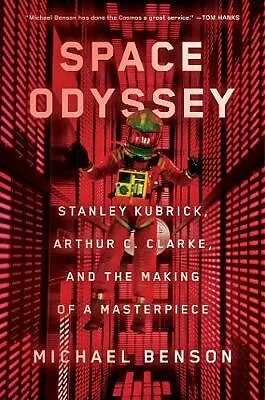
Space Odyssey
Beschreibung
The definitive story of the making of 2001: A Space Odyssey, acclaimed today as one of the greatest films ever made, and of director Stanley Kubrick and writer Arthur C. Clarke-"a tremendous explication of a tremendous film....Breathtaking" (The Washington Pos...Format auswählen
- BroschiertCHF 24.30

Wird oft zusammen gekauft
Andere Kunden kauften auch
Beschreibung
The definitive story of the making of 2001: A Space Odyssey, acclaimed today as one of the greatest films ever made, and of director Stanley Kubrick and writer Arthur C. Clarke-"a tremendous explication of a tremendous film....Breathtaking" (The Washington Post).Fifty years ago a strikingly original film had its premiere. Still acclaimed as one of the most remarkable and important motion pictures ever made, 2001: A Space Odyssey depicted the first contacts between humanity and extraterrestrial intelligence. The movie was the product of a singular collaboration between Stanley Kubrick and science fiction visionary Arthur C. Clarke. Fresh off the success of his cold war satire Dr. Strangelove, Kubrick wanted to make the first truly first-rate science fiction film. Drawing from Clarke's ideas and with one of the author's short stories as the initial inspiration, their bold vision benefited from pioneering special effects that still look extraordinary today, even in an age of computer-generated images.In Space Odyssey, author, artist, and award-winning filmmaker Michael Benson "delivers expert inside stuff" (San Francisco Chronicle) from his extensive research of Kubrick's and Clarke's archives. He has had the cooperation of Kubrick's widow, Christiane, and interviewed most of the key people still alive who worked on the film. Drawing also from other previously unpublished interviews, Space Odyssey provides a 360-degree view of the film from its genesis to its legacy, including many previously untold stories. And it features dozens of photos from the making of the film, most never previously published."At last! The dense, intense, detailed, and authoritative saga of the making of the greatest motion picture I've ever seen...Michael Benson has done the Cosmos a great service" (Academy Award-winning actor Tom Hanks).
"[An] engrossing, immersive examination of the long path to Stanley Kubrick and Arthur C. Clarke's masterpiece. . . . The pair's fraught but hugely successful relationship forms the backdrop of this astonishing tale of obsessive genius at work."
Autorentext
Michael Benson works at the intersection of art and science. An artist, writer, and filmmaker, he’s a Fellow of the NY Institute of the Humanities and a past Visiting Scholar at the MIT Media Lab’s Center for Bits and Atoms. In addition to Space Odyssey he has written such books as Cosmigraphics: Picturing Space Through Time, a finalist for the Science and Technology award at the 2015 Los Angeles Times “Festival of Books.” Benson’s planetary landscape photography exhibitions have been shown internationally. He has contributed to many publications including The New Yorker, The New York Times, The Washington Post, The Atlantic, Smithsonian, and Rolling Stone. Visit Michael-Benson.com.
Klappentext
The definitive story of the making of 2001: A Space Odyssey, acclaimed today as one of the greatest films ever made, and of director Stanley Kubrick and writer Arthur C. Clarke—****“a tremendous explication of a tremendous film….Breathtaking” (The Washington Post).
Fifty years ago a strikingly original film had its premiere. Still acclaimed as one of the most remarkable and important motion pictures ever made, 2001: A Space Odyssey depicted the first contacts between humanity and extraterrestrial intelligence. The movie was the product of a singular collaboration between Stanley Kubrick and science fiction visionary Arthur C. Clarke. Fresh off the success of his cold war satire Dr. Strangelove, Kubrick wanted to make the first truly first-rate science fiction film. Drawing from Clarke’s ideas and with one of the author’s short stories as the initial inspiration, their bold vision benefited from pioneering special effects that still look extraordinary today, even in an age of computer-generated images.
In Space Odyssey, author, artist, and award-winning filmmaker Michael Benson “delivers expert inside stuff” (San Francisco Chronicle) from his extensive research of Kubrick’s and Clarke’s archives. He has had the cooperation of Kubrick’s widow, Christiane, and interviewed most of the key people still alive who worked on the film. Drawing also from other previously unpublished interviews, Space Odyssey provides a 360-degree view of the film from its genesis to its legacy, including many previously untold stories. And it features dozens of photos from the making of the film, most never previously published.
“At last! The dense, intense, detailed, and authoritative saga of the making of the greatest motion picture I’ve ever seen*…*Michael Benson has done the Cosmos a great service” (Academy Award-winning actor Tom Hanks).
Leseprobe
Space Odyssey
CHAPTER ONE
PROLOGUE: THE ODYSSEY
The very meaninglessness of life forces man to create his own meanings.
—STANLEY KUBRICK
The twentieth century produced two great latter-day iterations of Homer’s Odyssey. The first was James Joyce’s Ulysses, which collapsed Odysseus’s decade of wandering down to a single city, Dublin, and a seemingly arbitrary day, June 16, 1904. In Ulysses, the role of Ithaca’s wily king was played by a commoner, Leopold Bloom—a peaceable Jewish cuckold with an uncommonly fascinating inner life, one the author effectively allowed us to hear. Serialized from 1918 to 1920, it was published in full in 1922.
The other was Stanley Kubrick and Arthur C. Clarke’s 2001: A Space Odyssey, in which the islands of the southeastern Mediterranean became the solar system’s planets and moons, and the wine-dark sea the airless void of interplanetary, interstellar, and even intergalactic space.
Shot in large-format panoramic 65-millimeter negative and initially projected on giant, curving Cinerama screens in specially modified theaters, 2001 premiered in Washington, DC, on April 2, 1968, and in New York City the following day. Produced and directed by Kubrick and conceived in collaboration with Clarke, one of the leading authors of science fiction’s “golden age,” the film was initially 161 minutes long. Following a disastrous series of preview and premiere screenings, the director cut it down to a leaner 142 minutes.
Where Joyce’s strategy had been to transform Odysseus into a benevolently meditative cosmopolitan flaneur, and to reduce ten years of close calls and escape artistry to twenty-four hours in proximity of the River Liffey, Kubrick and Clarke took the opposite approach. Deploying science as a kind of prism, which during the nineteenth and twentieth centuries entirely transformed our sense of the size and duration of the universe, they vastly expanded Homer’s spatiotemporal parameters. 2001: A Space Odyssey encompassed four million years of human evolution, from prehuman Australopithecine man-apes struggling to survive in southern Africa, through to twenty-first-century space-faring Homo sapiens, then on to the death and rebirth of their Odysseus astronaut, Dave Bowman, as an eerily posthuman “Star Child.” In the final scene, the weightless fetus returns to Earth as Richard Strauss’s 1896 composition Thus Spoke Zarathustra pounds cathartically on the soundtrack.
In 2001: A Space Odyssey, the meddlesome gods of the ancients have become an inscrutable, prying alien super-race. Never seen directly, they swoop down periodically from their galactic Olympus to intervene in human affairs. The instrument of their power, a rectangular black monolith, appears at key turning points in human destiny. First seen among starving man-apes in a parched African landscape at the “Dawn of Man,” 2001’s totemic extraterrestrial artifact engenders the idea among our distant ancestors…