
IHR WARENKORB IST AKTUELL LEER.
Haben Sie noch nichts passendes gefunden? Stöbern Sie durch unser komplettes Sortiment.
Oder melden Sie sich an bzw. registrieren Sie sich.
- Kostenlose Lieferung
- Kauf auf Rechnung
- Ex Libris Tiefpreis
- Filiallieferung und 650+ Abholorte
- Rabatt-Bons als Club-Mitglied
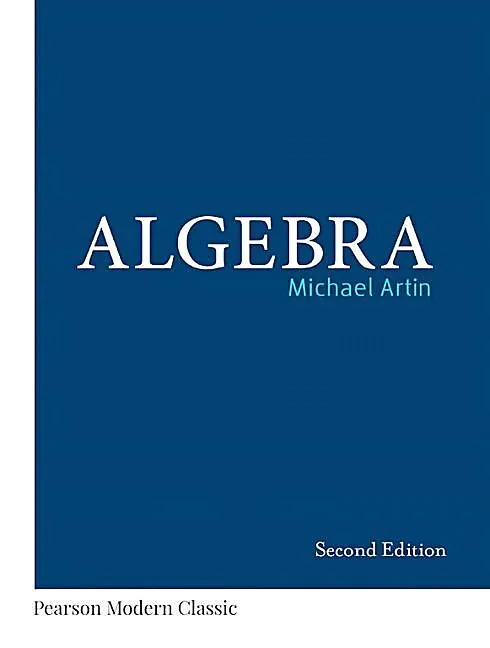
Algebra (Classic Version)
Beschreibung
Appropriate for one- or two-semester algebra courses This title is part of the Pearson Modern Classics series. Pearson Modern Classics are acclaimed titles at a value price. Algebra, 2nd Edition, by Michael Artin, is ideal for the honors undergraduate or intr...
Format auswählen
- Kartonierter EinbandCHF 99.70
Wird oft zusammen gekauft
Andere Kunden kauften auch
Beschreibung
Appropriate for one- or two-semester algebra courses
This title is part of the Pearson Modern Classics series. Pearson Modern Classics are acclaimed titles at a value price.
Algebra, 2nd Edition, by Michael Artin, is ideal for the honors undergraduate or introductory graduate course. The second edition of this classic text incorporates twenty years of feedback and the author's own teaching experience. The text discusses concrete topics of algebra in greater detail than most texts, preparing students for the more abstract concepts; linear algebra is tightly integrated throughout.
Appropriate for one- or two-semester algebra courses
This title is part of the Pearson Modern Classics series. Pearson Modern Classics are acclaimed titles at a value price. Please visit www.pearsonhighered.com/math-classics-series for a complete list of titles.
**
**
Algebra, 2nd Edition, by Michael Artin, provides comprehensive coverage at the level of an honors-undergraduate or introductory-graduate course. The second edition of this classic text incorporates twenty years of feedback plus the author's own teaching experience. This book discusses concrete topics of algebra in greater detail than others, preparing readers for the more abstract concepts; linear algebra is tightly integrated throughout.
Autorentext
About our authorMichael Artin received his A.B. from Princeton University in 1955 and his M.A. and Ph.D. from Harvard University in 1956 and 1960, respectively. He continued at Harvard as Benjamin Peirce Lecturer, 1960 - 63. He joined the MIT mathematics faculty in 1963, and was appointed Norbert Wiener Professor from 1988 - 93. Outside MIT, Artin served as President of the American Mathematical Society from 1990-92. He has received honorary doctorate degrees from the University of Antwerp and University of Hamburg.Professor Artin is an algebraic geometer, concentrating on non-commutative algebra. He has received many awards throughout his distinguished career, including the Undergraduate Teaching Prize and the Educational and Graduate Advising Award. He received the Leroy P. Steele Prize for Lifetime Achievement from the AMS. In 2005 he was honored with the Harvard Graduate School of Arts & Sciences Centennial Medal, for being "an architect of the modern approach to algebraic geometry." Professor Artin is a Member of the National Academy of Sciences, Fellow of the American Academy of Arts & Sciences, Fellow of the American Association for the Advancement of Science, and Fellow of the Society of Industrial and Applied Mathematics. He is a Foreign Member of the Royal Holland Society of Sciences, and Honorary Member of the Moscow Mathematical Society.
Klappentext
Appropriate for one- or two-semester algebra courses
This title is part of the Pearson Modern Classics series. Pearson Modern Classics are acclaimed titles at a value price. Please visit www.pearsonhighered.com/math-classics-series for a complete list of titles.
Algebra, 2nd Edition, by Michael Artin, is ideal for the honors undergraduate or introductory graduate course. The second edition of this classic text incorporates twenty years of feedback and the authorGÇÖs own teaching experience. The text discusses concrete topics of algebra in greater detail than most texts, preparing students for the more abstract concepts; linear algebra is tightly integrated throughout.
Zusammenfassung
** Appropriate for one- or two-semester algebra courses
This title is part of the Pearson Modern Classics series. Pearson Modern Classics are acclaimed titles at a value price. Please visit www.pearsonhighered.com/math-classics-series for a complete list of titles.
**
**
Algebra, 2nd Edition, by Michael Artin, provides comprehensive coverage at the level of an honors-undergraduate or introductory-graduate course. The second edition of this classic text incorporates twenty years of feedback plus the author’s own teaching experience. This book discusses concrete topics of algebra in greater detail than others, preparing readers for the more abstract concepts; linear algebra is tightly integrated throughout.
Inhalt
- Matrices
1.1 The Basic Operations
1.2 Row Reduction
1.3 The Matrix Transpose
1.4 Determinants
1.5 Permutations
1.6 Other Formulas for the Determinant
1.7 Exercises 2. Groups
2.1 Laws of Composition
2.2 Groups and Subgroups
2.3 Subgroups of the Additive Group of Integers
2.4 Cyclic Groups
2.5 Homomorphisms
2.6 Isomorphisms
2.7 Equivalence Relations and Partitions
2.8 Cosets
2.9 Modular Arithmetic
2.10 The Correspondence Theorem
2.11 Product Groups
2.12 Quotient Groups
2.13 Exercises 3. Vector Spaces
3.1 Subspaces of Rn
3.2 Fields
3.3 Vector Spaces
3.4 Bases and Dimension
3.5 Computing with Bases
3.6 Direct Sums
3.7 Infinite-Dimensional Spaces
3.8 Exercises 4. Linear Operators
4.1 The Dimension Formula
4.2 The Matrix of a Linear Transformation
4.3 Linear Operators
4.4 Eigenvectors
4.5 The Characteristic Polynomial
4.6 Triangular and Diagonal Forms
4.7 Jordan Form
4.8 Exercises 5. Applications of Linear Operators
5.1 Orthogonal Matrices and Rotations
5.2 Using Continuity
5.3 Systems of Differential Equations
5.4 The Matrix Exponential
5.5 Exercises 6. Symmetry
6.1 Symmetry of Plane Figures
6.2 Isometries
6.3 Isometries of the Plane
6.4 Finite Groups of Orthogonal Operators on the Plane
6.5 Discrete Groups of Isometries
6.6 Plane Crystallographic Groups
6.7 Abstract Symmetry: Group Operations
6.8 The Operation on Cosets
6.9 The Counting Formula
6.10 Operations on Subsets
6.11 Permutation Representation
6.12 Finite Subgroups of the Rotation Group
6.13 Exercises 7. More Group Theory
7.1 Cayley's Theorem
7.2 The Class Equation
7.3 r-groups
7.4 The Class Equation of the Icosahedral Group
7.5 Conjugation in the Symmetric Group
7.6 Normalizers
7.7 The Sylow Theorems
7.8 Groups of Order 12
7.9 The Free Group
7.10 Generators and Relations
7.11 The Todd-Coxeter Algorithm
7.12 Exercises 8. Bilinear Forms
8.1 Bilinear Forms
8.2 Symmetric Forms
8.3 Hermitian Forms
8.4 Orthogonality
8.5 Euclidean spaces and Hermitian spaces
8.6 The Spectral Theorem
8.7 Conics and Quadrics
8.8 Skew-Symmetric Forms
8.9 Summary
8.10 Exercises 9. Linear Groups
9.1 The Classical Groups
9.2 Interlude: Spheres
9.3 The Special Unitary Group SU2
9.4 The Rotation Group SO3
9.5 One-Parameter Groups
9.6 The Lie Algebra
9.7 Translation in a Group
9.8 Normal Subgroups of SL2
9.9 Exercises 10. Group Representations
10.1 Definitions
10.2 Irreducible Representations
10.3 Unitary Representations
10.4 Characters
10.5 One-Dimensional Characters
10.6 The Regular Representations
10.7 Schur's Lemma
10.8 Proof of the Orthogonality Relations
10.9 Representationsof SU2
10.10 Exercises 11. Rings
11.1 Definition of a Ring
11.2 Polynomial Rings
11.3 Homomorphisms and Ideals
11.4 Quotient Rings
11.5 Adjoining Elements
11.6 Product Rings
11.7 Fraction Fields
11.8 Maximal Ideals
11.9 Algebraic Geometry
11.10 Exercises 12. Factoring
12.1 Factoring Integers
12.2 Unique Factorization Domains
12.3 Gauss's Lemma
12.4 Factoring Integer Polynomial
12.5 Gauss Primes
12.6 Exercises 13. Quadratic Number Fields
13.1 Algebraic Integers
13.2 Factoring Algebraic Integers
13.3 Ideals in Z (-5)
13.4…