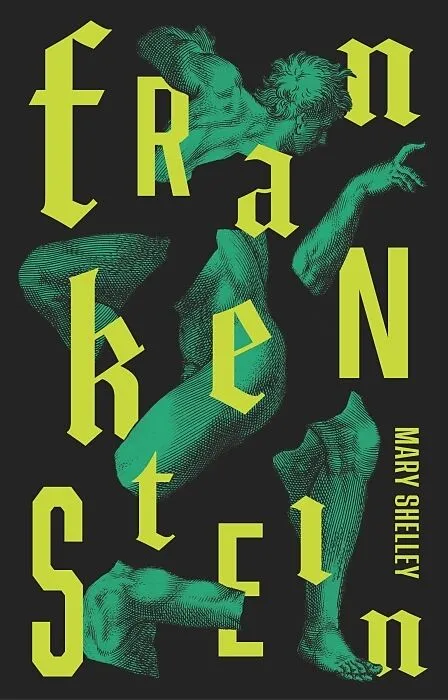
Frankenstein
Beschreibung
No-one in the grip of Mary Shelley''s FRANKENSTEIN, with its mythic-minded hero and its highly sympathetic monster who reads Goethe and longs to be at peace with himself, can fail to notice how much more excellent the original is than all the adaptations, imit...Format auswählen
- Kartonierter EinbandCHF 13.00
- Fester EinbandCHF 30.00

Wird oft zusammen gekauft
Andere Kunden kauften auch
Beschreibung
No-one in the grip of Mary Shelley''s FRANKENSTEIN, with its mythic-minded hero and its highly sympathetic monster who reads Goethe and longs to be at peace with himself, can fail to notice how much more excellent the original is than all the adaptations, imitations, and homages which have followed in its ample wake. In her first novel, written at the instigation of Lord Byron and published in 1818 (and revised in 1831), Mary Shelley produced English Romanticism''s finest prose fiction.
Autorentext
Mary Shelley Introduction by Jeanette Winterson
Klappentext
NOW A NETFLIX FILM • The most famous horror story in world literature—the original tale of a mad scientist and his monster—is also a profoundly moving masterpiece.
Features a New Introduction by Jeanette Winterson
When the scientist Victor Frankenstein attempts to create life in his laboratory, he sets in motion tragic forces beyond his control and faces losing everything he loves. No reader in the grip of Mary Shelley's novel, with its mythic-minded hero and its highly sympathetic monster who reads Goethe and longs to be at peace with himself, can fail to notice how much more excellent the original is than all the countless adaptations, imitations, and homages which have followed in its ample wake. In her first novel, written at the instigation of Lord Byron and published in 1818 (and revised in 1831), the teenaged Shelley managed to produce English Romanticism's finest prose fiction. This edition reproduces her original 1818 text.
Leseprobe
from the Introduction to the Vintage Classics Edition (2025)
by Jeanette Winterson
A new generation is reading Frankenstein in a new way.
We are who Mary Shelley imagined we would be, more than two hundred years ago, when this nineteen-year-old woman vaulted across time. She landed here, with us, the first people on the planet to create a new kind of intelligence. An artificial life-form that we hope, or fear, will be faster, stronger, smarter. Not subject to the constraints of time as we are. A different kind of being. A different way of being.
AI.
American mathematician John McCarthy named computing power “artificial intelligence” in 1955. He did so to distinguish between the human mind—what we call natural intelligence—and what he, and his colleagues in the USA and Britain, were working to develop.
The Bible tells us in the Book of Ecclesiastes that there is “nothing new under the sun.” This is no longer true. It hasn’t been true since America dropped the atomic bomb on Hiroshima and Nagasaki in 1945. From then on, humans have had the power to wipe out all of life on Earth.
Since then, we have expanded the range of our self-destruct options. New under the sun is man-made climate breakdown. But we can trace it back to Mary Shelley’s time, the time of the industrial revolution, which started in the north of England in the late 1700s.
My hometown of Manchester was the world’s first industrial city—exporting its name across the world. There are thirty Manchesters in the USA alone. The industrial revolution was the time when fossil fuels first came out of the ground in planet-changing quantities. Coal powered the movement from an agricultural society to an industrial society. Coal could also produce gas, and later, electricity.
Number three new under the sun is AI. At present, AI is a tool, and humans are tool-using animals. The race in Silicon Valley is to develop AI into much more. A coworker with us. A non-biological life-form.
Victor Frankenstein says, “If I could bestow animation on lifeless matter . . .”
“Smart AI” can be embodied—from a self-driving car to a robot—or nonembodied, as are most cognitive and generative systems. As smart AI develops, it is likely that it could be both—and simultaneously—because AI is not a bounded condition in the way that biological entities are. It doesn’t have to be one thing in one place at one time. Put simply, AI is not made of meat.
Victor Frankenstein must visit the charnel houses and graveyards for his collection of body parts. That’s how he gets going on his new life-form. We are learning how to do it using the zeros and ones of code. Both these new and hybrid forms of life—Victor’s monster, and maybe ours—are powered by electricity.
Mary Shelley was reflecting her own time when she has Victor going about the ghoulish business of collecting body parts. If bodies could not be found aboveground—accidents, sudden death, victims of the death penalty—then grave-robbing would supply cadavers, or bits of them, to the medical schools. Mary Shelley wrote, “The dissecting room and the charnel house furnished many of my materials and often did my human nature turn with loathing from my occupation.”
Once Victor has sewn his hideous assemblage together, it is what it is—lying lifeless on the slab. An ugly, oversize chunk of dead meat. What’s missing?
The answer is a massive jolt of electricity.
When Mary Shelley conceived of her man-made monster and had him galvanized into life by electricity, she was foreseeing a future that was nowhere near at hand. Electricity was poorly understood and not in practical use. It is astonishing that Mary Shelley made this connection. Life in the future would depend on electricity. A new life-form could not be brought into being without it.
To understand the genius of Mary Shelley’s intuition about electricity, we have to go back to her childhood years living with her father, the political philosopher William Godwin (1756–1836).
The tall, thin, house on Skinner Street was close to Newgate Prison. From her upper window, Mary could see those convicted of murder being bundled into carts for their last journey to the gallows. Their bodies were automatically earmarked for medical dissection. It was just a fact of life.
In 1803, when Mary was six years old, a remarkable experiment took place in the prison. Giovanni Aldini, a professor of physics at the University of Bologna, was visiting London. Aldini’s uncle was Luigi Galvani, the man who had made dead frogs leap into the air by applying electrodes, connected to a rudimentary battery, to their skin. His surname gives us both the industrial process of coating metal with zinc using an electric current and the verb: to galvanize, meaning to shock into action.
Galvani’s nephew wanted to do better than frogs, so he arranged for permission to try to re-animate the freshly dead corpse of a hanged man.
Onlookers watched in horror as fingers clenched, then an eye opened. Scientists in the room asked themselves: Was the new discovery of electricity the discovery of the divine spark?
Or, as Victor Frankenstein asks himself, as he prepares to sew together his creature: “Whence . . . did the principle of life proceed?”
It is important for the modern reader to understand that in the early nineteenth century, science and philosophy were not separated in the way that they are now, any more than a rigorous approach to science was separated from a fascination with the supernatural—religious or not. Thinkers were polymaths. Men of science (and they were men) venerated the arts as God-given expressions of beauty.
To be a scientist and a painter or musician was not odd. To be a scientist and to believe in God was normal. Speculative inquiry was wide-ranging and all-encompassing. Specialism was for tradesman.
The British chemist and philosopher-poet Sir Humphry Davy was a frequent visitor to Skinner Street. Davy had learned how to use what was then called a “voltaic pile”—a basic battery—invented by yet another Italian, Al…