
IHR WARENKORB IST AKTUELL LEER.
Haben Sie noch nichts passendes gefunden? Stöbern Sie durch unser komplettes Sortiment.
Oder melden Sie sich an bzw. registrieren Sie sich.
- Kostenlose Lieferung
- Kauf auf Rechnung
- Ex Libris Tiefpreis
- Filiallieferung und 650+ Abholorte
- Rabatt-Bons als Club-Mitglied
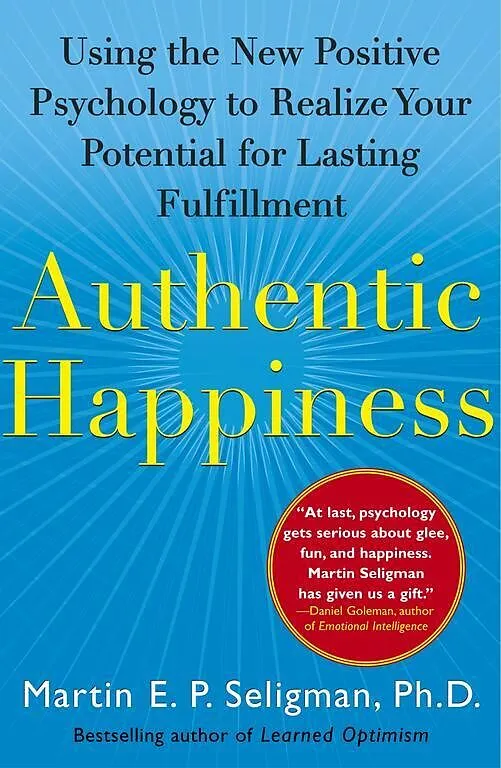
Authentic Happiness
Beschreibung
Zusatztext Elle A bold new plan for taking control of your life and finding lasting happiness. Informationen zum Autor Martin Seligman, PhD, is a professor at the University of Pennsylvania, director of the Positive Psychology Center, and former president of t...Format auswählen
- Kartonierter EinbandCHF 26.70

Wird oft zusammen gekauft
Andere Kunden kauften auch
Beschreibung
Zusatztext Elle A bold new plan for taking control of your life and finding lasting happiness. Informationen zum Autor Martin Seligman, PhD, is a professor at the University of Pennsylvania, director of the Positive Psychology Center, and former president of the American Psychological Association. He received his BA in philosophy from Princeton University, and his PhD in psychology from the University of Pennsylvania and holds ten honorary doctorates. He was named the most influential psychologist in the world by Academic Influence. Along with writing for numerous scholarly publications and appearing in The New York Times , Time , Newsweek , and many others, he is also the author and coauthor of over thirty books, including Flourish , Authentic Happiness , and Tomorrowmind . Klappentext A groundbreaking look at how readers can improve the world around them and achieve new and lasting levels of authentic contentment and joy. Chapter One: Positive Feeling And Positive Character In 1932, Cecilia O´Payne took her final vows in Milwaukee. As a novice in the School Sisters of Notre Dame, she committed the rest of her life to the teaching of young children. Asked to write a short sketch of her life on this momentous occasion, she wrote: God started my life off well by bestowing upon me grace of inestimable value....The past year which I spent as a candidate studying at Notre Dame has been a very happy one. Now I look forward with eager joy to receiving the Holy Habit of Our Lady and to a life of union with Love Divine. In the same year, in the same city, and taking the same vows, Marguerite Donnelly wrote her autobiographical sketch: I was born on September 26, 1909, the eldest of seven children, five girls and two boys....My candidate year was spent in the motherhouse, teaching chemistry and second year Latin at Notre Dame Institute. With God´s grace, I intend to do my best for our Order, for the spread of religion and for my personal sanctification. These two nuns, along with 178 of their sisters, thereby became subjects in the most remarkable study of happiness and longevity ever done. Investigating how long people will live and understanding what conditions shorten and lengthen life is an enormously important but enormously knotty scientific problem. It is well documented, for example, that people from Utah live longer than people from the neighboring state of Nevada. But why? Is it the clean mountain air of Utah as opposed to the exhaust fumes of Las Vegas? Is it the staid Mormon life as opposed to the more frenetic lifestyle of the average Nevadan? Is it the stereotypical diet in Nevada -- junk food, late-night snacks, alcohol, coffee, and tobacco -- as opposed to wholesome, farm-fresh food, and the scarcity of alcohol, coffee, and tobacco in Utah? Too many insidious (as well as healthful) factors are confounded between Nevada and Utah for scientists to isolate the cause. Unlike Nevadans or even Utahans, however, nuns lead routine and sheltered lives. They all eat roughly the same bland diet. They don´t smoke or drink. They have the same reproductive and marital histories. They don´t get sexually transmitted diseases. They are in the same economic and social class, and they have the same access to good medical care. So almost all the usual confounds are eliminated, yet there is still wide variation in how long nuns live and how healthy they are. Cecilia is still alive at age ninety-eight and has never been sick a day in her life. In contrast, Marguerite had a stroke at age fifty-nine, and died soon thereafter. We can be sure their lifestyle, diet, and medical care were not the culprits. When the novitiate essays of all 180 nuns were carefully read, however, a very strong and surprising difference emerged. Looking back at what Cecilia and Marguerite wrote, can you spot it? Sister...
Elle A bold new plan for taking control of your life and finding lasting happiness.
Autorentext
Martin Seligman, PhD, is a professor at the University of Pennsylvania, director of the Positive Psychology Center, and former president of the American Psychological Association. He received his BA in philosophy from Princeton University, and his PhD in psychology from the University of Pennsylvania and holds ten honorary doctorates. He was named the most influential psychologist in the world by Academic Influence. Along with writing for numerous scholarly publications and appearing in The New York Times, Time, Newsweek, and many others, he is also the author and coauthor of over thirty books, including Flourish, Authentic Happiness, and Tomorrowmind.
Klappentext
A groundbreaking look at how readers can improve the world around them and achieve new and lasting levels of authentic contentment and joy.
Zusammenfassung
Argues that happiness can be a learned and cultivated behavior, explaining how every person possesses at least five of twenty-four profiled strengths that can be built on in order to improve life.
Leseprobe
Chapter One: Positive Feeling And Positive Character
In 1932, Cecilia O´Payne took her final vows in Milwaukee. As a novice in the School Sisters of Notre Dame, she committed the rest of her life to the teaching of young children. Asked to write a short sketch of her life on this momentous occasion, she wrote:
God started my life off well by bestowing upon me grace of inestimable value....The past year which I spent as a candidate studying at Notre Dame has been a very happy one. Now I look forward with eager joy to receiving the Holy Habit of Our Lady and to a life of union with Love Divine.
In the same year, in the same city, and taking the same vows, Marguerite Donnelly wrote her autobiographical sketch:
I was born on September 26, 1909, the eldest of seven children, five girls and two boys....My candidate year was spent in the motherhouse, teaching chemistry and second year Latin at Notre Dame Institute. With God´s grace, I intend to do my best for our Order, for the spread of religion and for my personal sanctification.
These two nuns, along with 178 of their sisters, thereby became subjects in the most remarkable study of happiness and longevity ever done.
Investigating how long people will live and understanding what conditions shorten and lengthen life is an enormously important but enormously knotty scientific problem. It is well documented, for example, that people from Utah live longer than people from the neighboring state of Nevada. But why? Is it the clean mountain air of Utah as opposed to the exhaust fumes of Las Vegas? Is it the staid Mormon life as opposed to the more frenetic lifestyle of the average Nevadan? Is it the stereotypical diet in Nevada -- junk food, late-night snacks, alcohol, coffee, and tobacco -- as opposed to wholesome, farm-fresh food, and the scarcity of alcohol, coffee, and tobacco in Utah? Too many insidious (as well as healthful) factors are confounded between Nevada and Utah for scientists to isolate the cause.
Unlike Nevadans or even Utahans, however, nuns lead routine and sheltered lives. They all eat roughly the same bland diet. They don´t smoke or drink. They have the same reproductive and marital histories. They don´t get sexually transmitted diseases. They are in the same economic and social class, and they have the same access to good medical care. So almost all the usual confounds are eliminated, yet there is still wide variation in how long nuns live and how healthy they are. Cecilia is still alive at age ninety-eight and has never been sick a day in her life. In contrast, Marguerite had a stroke at age fifty-nine, and died soon thereafter. We can be sure their lifestyle, diet, and medical care were not the culprits. When the novitiate essays of all 180 nuns were carefully read, however, a very strong and surprising difference emerged. Looking back at what Cecilia and Marguerite wrote, can you spot it?
…