Beschreibung
"Of all the men who attacked the flying problem in the 19th century, Otto Lilienthal was easily the most important. His greatness appeared in every phase of the problem. No one equaled him in power to draw new recruits to the cause; no one equaled him in full...
"Of all the men who attacked the flying problem in the 19th century, Otto Lilienthal was easily the most important. His greatness appeared in every phase of the problem. No one equaled him in power to draw new recruits to the cause; no one equaled him in fullness and dearness of understanding of the principles of flight; no one did so much to convince the world of the advantages of curved wing surfaces; and no one did so much to transfer the problem of human flight to the open air where it belonged."
These words were spoken by Wilbur Wright, who successfully accomplished the first powered flight together with his brother Orville in 1903 on the sand dunes of the Outer Banks off the coast of North Carolina. Wilbur was talking about the most important of their predecessors, Otto Lilienthal.
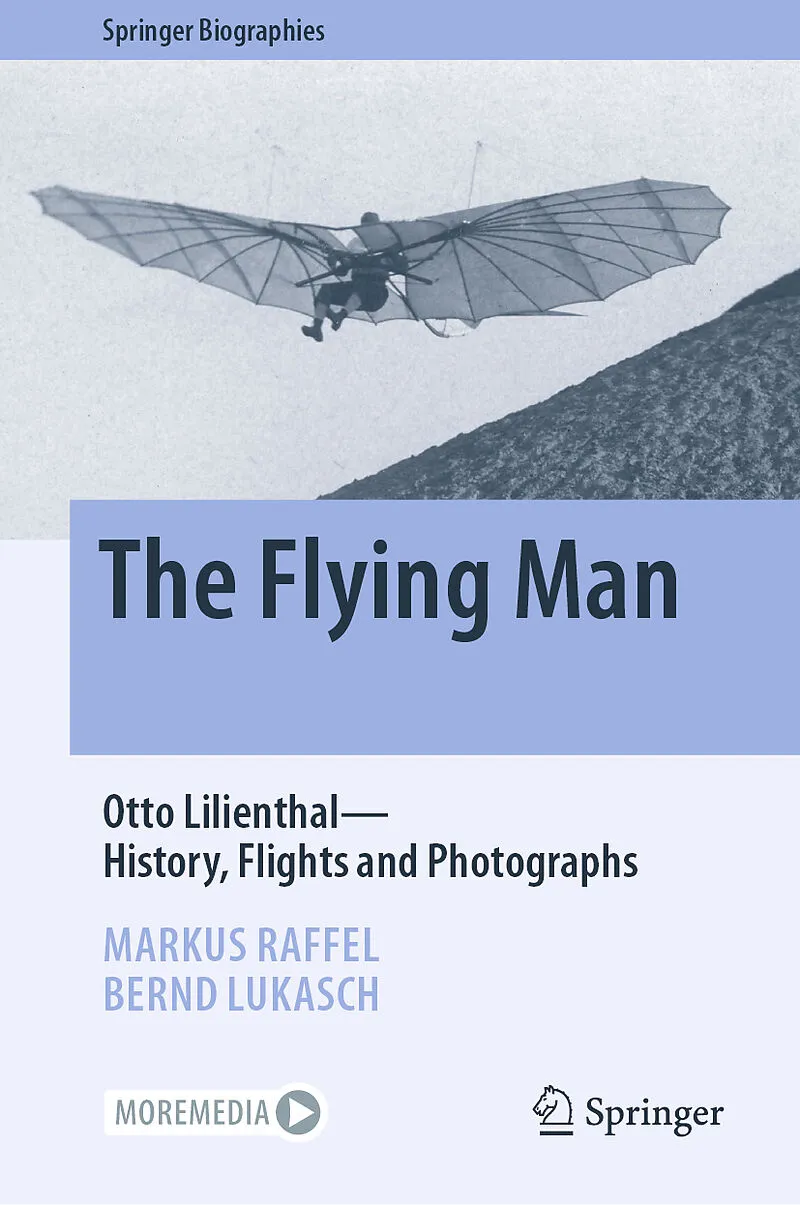
Lilienthal attracted worldwide attention due to the spectacular photographs showing him in flight, made possible by technology that had only just been developed by him. This fortuitousunion between a pioneer of aviation and the pioneers of so-called instantaneous photography is responsible for the immense contemporary popularity of Lilienthal's flights around the globe, the first ever free flights performed by man. This book traces the life of the German aviation pioneer, focusing on the designs of his many aircraft and the photographic documentation that has survived. The presentation ends with a remarkable research project conducted by one of the authors, right up to and including his own training exercises with Lilienthal's normal soaring apparatus and large biplane. This project offered new insight into Lilienthal's work, and also led to a spectacular aerial meeting of Lilienthal's 1895 biplane and the Wright brothers' 1902 biplane at a historic location on the Outer Banks. The book provides access to video material, largely stemming from this project.
The remarkable story of the man Wilbur Wright called "the greatest of precursors Presents spectacular photographic documentation Includes flight reports from replicas built and flown by one of the authors
Autorentext
Markus Raffel (*1962) ist Professor für Aerodynamik an der Leibniz Universität Hannover und Leiter der Abteilung Hubschrauber am Institut für Aerodynamik und Strömungstechnik des Deutschen Zentrums für Luft- und Raumfahrt (DLR). Seit 1991 arbeitet er beim DLR auf dem Gebiet der experimentellen Aerodynamik. Er hat über 150 Zeitschriften- und Konferenzbeiträge veröffentlicht und ist der Hauptautor des weit verbreiteten Lehrbuchs "Particle Image Velocimetry" über die heute gängigste optische Strömungsdiagnosetechnik. Nach einem kurzen Flugkurs mit Segelflugzeugen erwarb er seinen Privatpilotenschein und fliegt einmotorige und leichte Sportflugzeuge in Europa und den USA. Nachdem er sich in Frankreich und Kalifornien im Drachenfliegen geübt hatte, baute er einen originalgetreuen Nachbau des patentierten Eindeckers von Otto Lilienthal und war der erste Pilot, der ihn seit dem tödlichen Absturz von Otto Lilienthal im Jahr 1896 flog. Bernd Lukasch (*1954) studierte Physik in Berlin und arbeitete in der experimentellen Abteilung "Atomare Kollisionen in der Festkörperphysik", wo er 1984 promoviert wurde. Im Jahr 1988 übernahm er die Aufgabe, ein Otto Lilienthal gewidmetes Museum zu gründen. Es wurde 1991 eröffnet. Lukasch übernahm 1992 die Leitung des Museums und blieb bis 2019 dessen Direktor. Unter seiner Leitung wurde das Museum vom Staatsminister für Kultur und Medien der Bundesrepublik Deutschland mit dem Titel "Nationale Gedenkstätte" und vom Europäischen Museumsforum mit dem Titel "European Museum of the Year Award - Special Commendation" ausgezeichnet. Bernd Lukasch veröffentlichte 2005 eine Biografie über die beiden Lilienthal-Brüder ("Erfinderleben") und ist außerdem Autor oder Herausgeber zahlreicher Publikationen in populären und historischen Zeitschriften
Inhalt
The beginning of an era.- The skies over Pomerania.- From a poor student to good scholar.- Bed lodger engineer manufacturer.- Life goal: inventor.- From the dream of flight to aerodynamics.- From theory to flying apparatus.- 1891 the leap into a new century.- Captured in mid-air.- Modelled after a bat the path to serially produced aircraft.- Practical flying training and records.- An engine again inspired by birds.- The Fliegeberg a real airfield.- Flying machine customers and flight students.- More difficult than anticipated: steering.- A rich idea: the biplane.- Unfinished ideas and August 9, 1896.- To fly is everything Lilienthal 125 years later.
Tief- preis