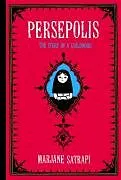
Persepolis 1
Beschreibung
Beeindruckender Comic, in dem die Autorin mit Ernst und Humor von ihrer Kindheit und dem Alltag im Iran während der Islamischen Revolution erzählt. Zusatztext 91737163 Informationen zum Autor MARJANE SATRAPI was born in Rasht, Iran. She now lives in Paris, whe...Format auswählen
- Kartonierter EinbandCHF 19.10

Wird oft zusammen gekauft
Andere Kunden kauften auch
Beschreibung
Beeindruckender Comic, in dem die Autorin mit Ernst und Humor von ihrer Kindheit und dem Alltag im Iran während der Islamischen Revolution erzählt.
Zusatztext 91737163 Informationen zum Autor MARJANE SATRAPI was born in Rasht, Iran. She now lives in Paris, where she is a regular contributor to magazines and newspapers throughout the world, including The New Yorker and The New York Times. She is the author of Persepolis, Persepolis 2, Embroideries, Chicken with Plums, and several children's books. She cowrote and codirected the animated feature film version of Persepolis, which was nominated for an Academy Award for Best Animated Feature. Her most recent film was a live-action version of Chicken with Plums. Klappentext A New York Times Notable Book A Time Magazine "Best Comix of the Year" A San Francisco Chronicle and Los Angeles Times Best-seller Wise, funny, and heartbreaking, Persepolis is Marjane Satrapi's graphic memoir of growing up in Iran during the Islamic Revolution. In powerful black-and-white comic strip images, Satrapi tells the story of her life in Tehran from ages six to fourteen, years that saw the overthrow of the Shah's regime, the triumph of the Islamic Revolution, and the devastating effects of war with Iraq. The intelligent and outspoken only child of committed Marxists and the great-granddaughter of one of Iran's last emperors, Marjane bears witness to a childhood uniquely entwined with the history of her country. Persepolis paints an unforgettable portrait of daily life in Iran and of the bewildering contradictions between home life and public life. Marjane's child's-eye view of dethroned emperors, state-sanctioned whippings, and heroes of the revolution allows us to learn as she does the history of this fascinating country and of her own extraordinary family. Intensely personal, profoundly political, and wholly original, Persepolis is at once a story of growing up and a reminder of the human cost of war and political repression. It shows how we carry on, with laughter and tears, in the face of absurdity. And, finally, it introduces us to an irresistible little girl with whom we cannot help but fall in love. Zusammenfassung NEW YORK TIMES BESTSELLER • Wise, funny, and heartbreaking, Persepolis is Marjane Satrapi's acclaimed graphic memoir of growing up in Iran during the Islamic Revolution. A wholly original achievement.... Satrapi evokes herself and her schoolmates coming of age in a world of protests and disappearances.... A stark, shocking impact. The New York Times: " The 50 Best Memoirs of the Past 50 Years" One of the New York Times 's 100 Best Books of the 21st Century In powerful black-and-white comic strip images, Satrapi tells the coming-of-age story of her life in Tehran from ages six to fourteen, years that saw the overthrow of the Shah's regime, the triumph of the Islamic Revolution, and the devastating effects of war with Iraq. The intelligent and outspoken only child of committed Marxists and the great-granddaughter of one of Iran's last emperors, Marjane bears witness to a childhood uniquely entwined with the history of her country. Persepolis paints an unforgettable portrait of daily life in Iran and of the bewildering contradictions between home life and public life. Marjane's child's-eye view of dethroned emperors, state-sanctioned whippings, and heroes of the revolution allows us to learn as she does the history of this fascinating country and of her own extraordinary family. Intensely personal, profoundly political, and wholly original, Persepolis is at once a story of growing up and a reminder of the human cost of war and political repression. It shows how we carry on, with laughter and tears, in the face of absurdity. And, finally, it introduces us to an irresistible little girl with whom we cannot help but fall in love....
“Delectable. . . Dances with drama and insouciant wit.” –*The New York Times Book Review
“A stunning graphic memoir hailed as a wholly original achievement in the form. There’s still a startling freshness to the book. It won’t age. In inky shadows and simple, expressive lines— reminiscent of Ludwig Bemelmans’s “Madeline”—Satrapi evokes herself and her schoolmates coming of age in a world of protests and disappearances . . . A stark, shocking impact.” — Parul Sehgal, “The 50 Best Memoirs of the Past 50 Years” The New York Times
- “A dazzlingly singular achievement. . . . Striking a perfect balance between the fantasies and neighborhood conspiracies of childhood and the mounting lunacy of Khomeini's reign, she's like the Persian love child of Spiegelman and Lynda Barry.” –*Salon
-
“A brilliant and unusual graphic memoir. . . . [Told] in a guileless voice . . . accompanied by a series of black-and-white drawings that dramatically illustrate how a repressive regime deforms ordinary lives.”–*Vogue
- "Odds are, you’ll be too busy being entertained to realize how much you’ve learned until you turn the last page.”–*Elle.com
- “[A] self-portrait of the artist as a young girl, rendered in graceful black-and-white comics that apply a childlike sensibility to the bleak lowlights of recent Iranian history. . . . [Her] style is powerful; it persuasively communicates confusion and horror through the eyes of a precocious preteen.” –*Village Voice
-
" This is an excellent comic book, that deserves a place with Joe Sacco and even Art Spiegelman. In her bold black and white panels, Satrapi eloquently reasserts the moral bankruptcy of all political dogma and religious conformity; how it bullies, how it murders, and how it may always be ridiculed by individual rebellions of the spirit and the intellect." --Zadie Smith, author of The Autograph Man and White Teeth 
-
"You've never seen anything like *Persepolis—**the intimacy of a memoir, the irresistability of a comic book, and the political depth of a the conflict between fundamentalism and democracy. Marjane Satrapi may have given us a new genre."
--Gloria Steinem
I grew up reading the Mexican comics of Gabriel Vargas, graduated to the political teachings of Rius, fell under the spell of Linda Barry, Art Spiegelman, and now I am a fan of Marjane Satrapi. Her stories thrummed in my heart for days. Persepolis is part history book, part Scheherazade, astonishing as only true stories can be. I learned much about the history of Iran, but more importantly, it gave me hope for humanity in these unkind times.
—Sandra Cisneros, author of The House on Mango Street **and CarameloI thought [Persepolis] was a superb piece of work, not only for the child's eye view—the developing child's eye view—of a society unknown to many of us in the west, and feared and suspected in proportion to being unknown.... Satrap has found a way of depicting human beings that is both simple and immediately comprehensible, AND is almost infinitely flexible. Anyone who's tried to draw a simplified version of a human face knows how immensely difficult it is not only to give the faces a range of expression, but also to maintain identities from one frame to the next. It's an enormous technical accomplishment."
--Philip Pullman, author ofThe Golden Compass, The Subtle Knife, and The Amber Spyglass**.-
"I cannot praise enough Marjane Satrapi's moving account of growing up as a spirited young girl in revolutionary and war-time Iran. *Persepolis is disarming and often humorous but ultimately it is shattering."
-- Joe Sacco, author of Palestine and Safe Area Gorazde***
-
"You've never seen anything like *Persepolis—**the intimacy of a memoir, the irresistability of a comic book, and the political depth of a the conflict between fundamentalism and democracy. Marjane Satrapi may have given us a new genre."
This witty, moving and illuminating book demonstrates graphically why the future of Iran lies with neither the clerics nor the…