
IHR WARENKORB IST AKTUELL LEER.
Haben Sie noch nichts passendes gefunden? Stöbern Sie durch unser komplettes Sortiment.
Oder melden Sie sich an bzw. registrieren Sie sich.
- Kostenlose Lieferung
- Kauf auf Rechnung
- Ex Libris Tiefpreis
- Filiallieferung und 650+ Abholorte
- Rabatt-Bons als Club-Mitglied
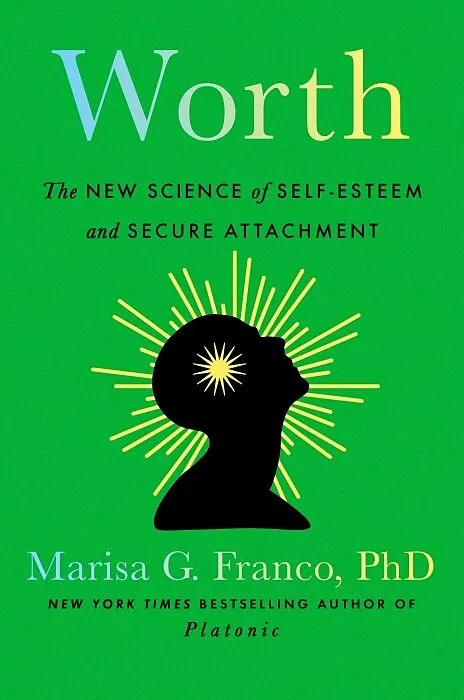
Worth
Beschreibung
From the What if what you thought you knew about secure attachment was wrong? Or even making you more insecure? Dr. Marisa G. Franco is the As secure attachment has become a status symbol, many of us are labeling ourselves secure, while ignoring the parts of o...Format auswählen
- Fester EinbandCHF 39.10

Wird oft zusammen gekauft
Andere Kunden kauften auch
Beschreibung
From the What if what you thought you knew about secure attachment was wrong? Or even making you more insecure? Dr. Marisa G. Franco is the As secure attachment has become a status symbol, many of us are labeling ourselves secure, while ignoring the parts of ourselves that aren’t. Ironically, this self-neglect makes us more insecure. Studies find that when we feel insecure, other things we think should raise our self-esteem in fact backfire: Positive events, when they threaten the story of who we are, ironically, make us feel worse. The good news: we change the story we have our worth--self-esteem is a skill that can be learned--and you can get better at it, which in turn strengthens all your other relationships. In If you feel like you’ve read every book on healing, but you are still struggling, <Worth< will help you finally find the transformation you’ve been looking for....
Autorentext
Dr. Marisa G. Franco is the New York Times bestselling author of Platonic: How the Science of Attachment Can Help You Make—and Keep—Friends. She holds a PhD in counseling psychology from the University of Maryland and works as a professor there currently. She writes for Psychology Today and has been a featured psychologist in The New York Times and on NPR and Good Morning America. Dr. Franco delivers talks about connection, belonging, and worth all over the country to private companies, universities, and nonprofit organizations. Her newest talk is entitled “Worth and Belonging: How to Build Self-Worth to Foster Belonging at Work.”
Klappentext
From the New York Times bestselling author of Platonic, a groundbreaking guide exploring the promise (and limits) of secure attachment to help us feel better and boost our self-esteem
What if what you thought you knew about secure attachment was wrong? Or worse, making you more insecure?
Dr. Marisa G. Franco is the New York Times bestselling friendship expert whose advice Glennon Doyle calls “wise, concrete, and effective”—Dr. Franco literally wrote the book on how to become a securely attached friend. But since then, she’s realized that when we feel unworthy, the things we think should make us feel secure and raise our self-esteem often backfire:
- Optimistic self-talk makes us feel worse, not better.
- Positive feedback raises our blood pressure.
- Compliments make us uncomfortable.
- Positive events make us sicker.
The good news: Self-esteem is a skill that can be learned—and you can get better at it, which in turn strengthens all your other relationships. In Worth, Dr. Franco mines promising new research at the intersection of psychology and neuroscience to show us why so many of us still struggle with self-esteem (even in this self-obsessed age), and how we can build a foundation of lasting self-worth that doesn’t rely on likes or followers.
Through exercises, stories, and the cutting-edge science of memory reconsolidation, updating damaging memories to change the stories we tell ourselves, Dr. Franco shows how we can bring meaning, self-worth, and secure attachment back into our lives, from the inside out. If you feel like you’ve read every book on healing, but you are still struggling, Worth will help you finally find the transformation you’ve been looking for.
Leseprobe
CAUTION: This email originated from outside of Penguin Random House. Please be extra cautious when opening file attachments or clicking on links.
1
Defining Worth
The best and worst people both have high self-esteem.
By high self-esteem, I mean that they score high on a classic assessment of the concept. Yes, they say, I am satisfied with myself. Yes, I have a number of good qualities. Yes, I'm a person of value. No, I don't think I'm a failure. No, I don't feel useless. No, I don't think I'm no good at all.
And yet, as you look closer at these high-self-esteem havers, you'll start to make out two very distinct groups of them. People with high self-esteem are either the kindest, calmest, most generous people you know or the meanest, most hostile, and most selfish. Self-esteem, it seems, is not a purely "good" or "bad" trait. And yet most of us would agree that self-esteem is a defining-perhaps the defining-characteristic of worth.
So how do we know if we have enough (and the right kind) of self-esteem?
Why Does Self-Esteem Look
So Different in Some People?
When I came across these clashing profiles of high self-esteem, I thought of a party I hosted where I served two specialty drinks with identical ingredients, except one contained alcohol and the other didn't. We called the nonalcoholic drink the "good friend" and the alcoholic one the "toxic friend."
My guest Heather asked, "Did you do it on purpose, make the toxic and nontoxic friend look the same?" Another guest requested a good friend but was accidentally served a toxic one. She began to feel loose and woozy. "Are you sure that was a good friend?" she asked.
Although both kinds of people with high self-esteem can appear identical at face value, there are tells. Some high-esteem individuals use their sense of worth for good . . . others, not so much.
Ask someone with high self-esteem about a time they did something bad, like broke the rules, acted unethically, or disappointed their parents. One will tell you why their behavior was someone else's fault, one study found. The other will admit they were wrong and share how they honestly felt. They'll reflect on their remorse, regret, and growth.
Imagine this person with high self-esteem was your romantic partner, and one day, you were too engrossed in your work to acknowledge that they entered the room. One would interpret this as a sign of disrespect and ignore you back. The other would assume you're invested in something important and go on with their day, as revealed by a study where people were exposed to those scenarios.
High self-esteem affects how people interact with the wider world. It can either make them angrier and more hostile than the average person, or it can make them less so, another study found. Because of this, according to another study, one type of high-self-esteem haver has the smoothest and most intimate relationships of all, while the other has the least.
In other words, while you might find no difference in how these high-self-esteem people speak of themselves-as worthy, confident, special-you will find a stark difference in how they treat others. One group treats others the best, and the other, the worst.
I call these two groups the "good" and "bad" twins of self-esteem because this same trait expresses itself so differently. Michael H. Kernis, the late psychology professor who studied self-esteem, referenced these twins of self-esteem when others critiqued his ideas and he jokingly replied: "I could respond to these commentaries by thoughtfully assimilating their meaning and modifying my position . . . or I could begin my response with a resounding #%+$@&*! OFF."
I explored this research on self-esteem to help me define worth. Yet I found that the concept of self-esteem was not necessarily aligned with how I see worth, or, to be more specific, the bad twin's kind wasn't, while the good twin's was. This is why it's important to have precision in my understanding of self-esteem. If I wasn't able to understand the differences between these twins, I might inadvertently lead us to become the bad twin, springing off the backs of others to lift ourselves higher. To truly understand worth, I had to distinguish the good twin's kind of self-esteem, so I could lead us to develop the type of self-esteem that doesn't come at everyone else's expense.
The stakes here are everyone we will ever love.
Good Twins Acknowledge-and Accept-Negative Feelings
…